
Enterprise event teams take technology evaluation seriously. They gather requirements from across the organization, document technical needs, and run structured RFP processes designed to reduce risk and identify the best platform.
On the surface, this approach makes sense. In practice, however, it often produces an unexpected result.
The platform that wins the RFP is frequently the platform that answers RFPs best, not the platform that will actually deliver the best event experiences.
This happens because most enterprise event technology RFPs evaluate the wrong things. They reward feature accumulation instead of experience quality, technical completeness instead of operational effectiveness, and compliance instead of coherence.
When events were primarily logistical exercises centered on registration and ticketing, this evaluation model worked reasonably well. Today, events play a much larger role inside modern organizations. They generate pipeline, accelerate deals, strengthen customer relationships, and build communities around brands.
Selecting event technology based primarily on feature checklists is no longer sufficient. Event leaders need a more effective way to evaluate platforms.
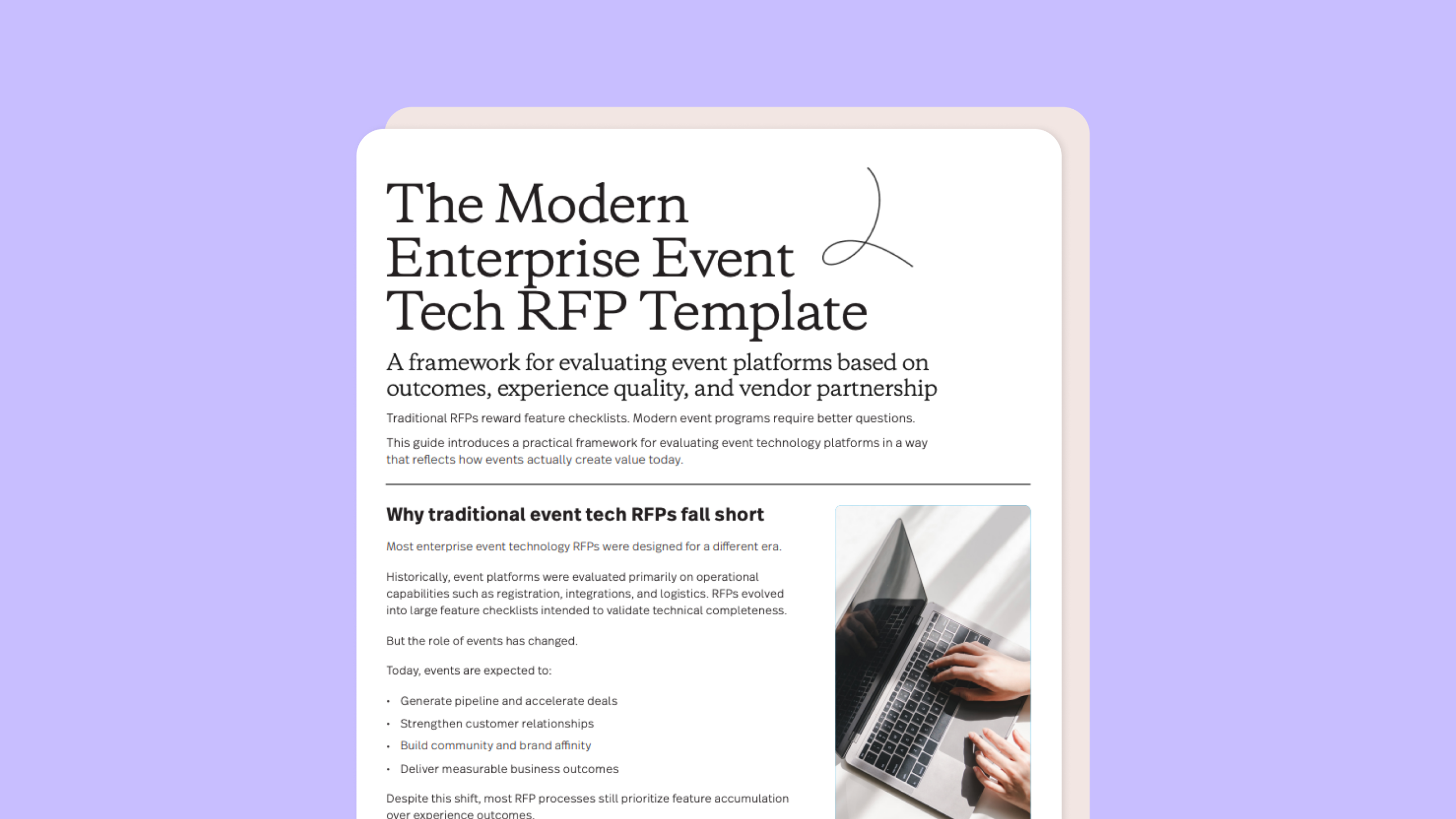
To help address this gap, we developed a Modern Event Tech RFP Template, designed to help teams evaluate vendors based on outcomes, experience quality, and long-term partnership.
What you’ll learn
In this article, we will explore:
- Why traditional event technology RFPs often fail to identify the best platform
- How checklist-driven evaluations reward complexity instead of experience
- What modern event leaders should evaluate when selecting event technology
- How to use our Modern Event Tech RFP Template to run a more effective vendor evaluation
The structural problem with most event tech RFPs
Enterprise RFPs rarely start with the intention of becoming massive documents. Instead, they grow over time as multiple stakeholders contribute requirements.
Marketing teams add campaign needs and branding requirements. IT teams introduce security, compliance, and integration questions. Procurement adds vendor governance criteria. Legal teams layer on additional risk considerations.
The result is often a document containing hundreds of questions.
In some cases, event technology RFPs exceed 500 individual capability checks. At that point, the process begins to measure whether a platform technically supports a feature rather than how effectively it helps event teams deliver successful experiences.
Most questions follow a simple format.
- Does the platform support feature X?
- Can the system integrate with platform Y?
- Is capability Z available?
These confirmations provide limited insight into how a platform performs in practice. Vendors may technically support a capability while still delivering a poor user experience or requiring complex workflows to use it effectively.
Meanwhile, platforms designed for simplicity and operational speed may score lower simply because they prioritize usability over feature expansion.
When you measure feature volume, complexity wins
Traditional RFP scoring models often reward the number of capabilities a platform can demonstrate.
The more boxes a vendor checks, the higher their score.
This approach unintentionally favors platforms that accumulate large feature sets over time. It also disadvantages platforms that focus on usability, workflow efficiency, and cohesive experience design.
Consider a few common examples.
A platform may technically support networking features. That does not necessarily mean it helps attendees make meaningful connections.
A platform may offer extensive customization capabilities. That does not mean event teams can easily create branded experiences without heavy technical work.
A platform may integrate with CRM systems. That does not guarantee event data is actually usable for revenue measurement.
These distinctions matter because event teams are increasingly responsible for demonstrating business impact. Many organizers still struggle to clearly measure event ROI and connect event engagement to revenue outcomes. For event leaders looking to improve measurement, our guide on Maximizing Event ROI: How to Measure, Optimize, and Prove Event Success explores practical frameworks for tying event performance to business goals.
When RFPs focus primarily on feature validation, they rarely reveal how well a platform supports these outcomes.
The hidden cost of checkbox-driven evaluations
The consequences of this misalignment typically appear after the platform is selected.
Event teams may discover that launching new events requires complex configuration. Branding adjustments may require technical support. Operational workflows may feel slower than expected once teams attempt to scale their programs.
Support interactions can also become more transactional than strategic when vendors are evaluated primarily on technical capabilities rather than partnership models.
This becomes especially challenging for organizations running diverse event portfolios. Teams responsible for flagship conferences, field events, and customer programs need technology that supports different formats without adding operational complexity.
Many teams are now investing in smaller, more targeted formats between major conferences. If this approach is part of your strategy, our article on Scaling Micro Events With AI: A Practical Playbook For Event Leaders explores how you can use AI to scale smaller events, strengthen community engagement, and accelerate pipeline.
Technology decisions play a critical role in enabling these strategies.
A better way to evaluate event technology
Modern event programs require a different approach to evaluating event technology platforms.
Instead of validating hundreds of isolated features, event leaders should focus on the capabilities that actually drive event success.
The first step is defining the strategic role events play within the organization. Technology should support clear business outcomes such as pipeline generation, customer retention, or community building.
Next, evaluate platforms through the lens of core event use cases. Most organizations operate a limited number of event formats, such as flagship conferences, field marketing events, or customer engagement programs. Vendors should demonstrate how their platform supports these specific scenarios.
It is also important to replace yes or no feature questions with evidence-based questions. Instead of asking whether a platform supports a capability, ask vendors to provide examples of how customers use that capability to achieve measurable results.
Equally important is evaluating the vendor relationship itself. Implementation support, customer success engagement, and strategic guidance often determine whether a platform succeeds over time.
Event leaders should also assess how vendors help customers stay informed about industry trends and new event strategies. Networking remains one of the top reasons people attend events, yet many organizers struggle to deliver meaningful connections. Insights from our Event Networking Report show that structured networking formats and technology-supported matchmaking can significantly improve attendee engagement and satisfaction.
Understanding trends like these should influence how technology platforms are evaluated.
For organizations already running events on another platform, evaluating a new system may also require planning for migration. Our guide on how to migrate event technology platforms successfully outlines key steps for making that transition smoothly.
Introducing the Modern Event Tech RFP Template
To help event leaders apply this approach, we created the Modern Event Tech RFP Template.
This framework replaces traditional feature-heavy RFPs with a more focused evaluation model built around the factors that matter most for modern event programs.
The template includes:
- A structured process for defining event strategy and core use cases
- Outcome-based evaluation questions that require proof and real-world examples
- Guidance for assessing planner workflow and operational efficiency
- Questions that evaluate attendee experience and sponsor value
- A framework for evaluating vendor partnership, education, and community support
- A simple vendor scorecard to compare platforms more effectively
Rather than asking hundreds of technical questions, this approach helps organizations identify the platform that will best support their event strategy and operational needs.
Download the Modern Event Tech RFP Template
If your organization is preparing to evaluate event technology, the Modern Event Tech RFP Template provides a practical starting point.
Instead of working through massive feature checklists, you can focus your evaluation on the areas that most influence event success.
Download the template to:
- Replace feature checklists with outcome-focused evaluation questions
- Run a more strategic and efficient vendor evaluation process
- Identify the platform that will best support your event strategy

How Bizzabo helps enterprise teams run better event programs
Choosing the right event technology platform is not just about features. It is about enabling teams to design better experiences, operate more efficiently, and measure meaningful outcomes.
Bizzabo is the Event Experience OS built for enterprise organizations managing complex event portfolios. The platform brings together registration, engagement, networking, and event data in a unified system that supports both operational efficiency and experience quality.
With capabilities like AI-powered networking and attendee engagement tools, teams can create more meaningful connections while capturing valuable engagement insights across their event programs.
By connecting event engagement directly to marketing and revenue systems, Bizzabo also helps organizations measure how events influence pipeline, customer relationships, and business growth.
If you are exploring ways to modernize your event technology stack, learn how Bizzabo can help enterprise teams run successful events at scale.

FAQs about event technology RFPs
An event tech RFP is a request for proposal used by organizations to evaluate and select an event technology platform. It typically includes questions about platform capabilities, integrations, security, and vendor support.
Why do traditional event technology RFPs fail?
Traditional RFPs often focus heavily on feature checklists rather than real-world outcomes. This can lead to selecting platforms that appear comprehensive but introduce operational complexity or fail to deliver strong attendee experiences.
How should event leaders evaluate event technology platforms?
Event leaders should evaluate platforms based on factors such as event outcomes, operational workflow efficiency, attendee experience quality, and vendor partnership. Real customer examples and measurable results are more valuable than simple capability confirmations.
What should a modern event tech RFP include?
A modern event tech RFP should include a clear event strategy, core event use cases, outcome-based evaluation questions, vendor partnership evaluation, and a structured scoring framework.
Where can I find an event tech RFP template?
You can download the Modern Event Tech RFP Template included in this article to help structure your evaluation process and focus on the factors that matter most for successful event programs.