Get a reusable event planning checklist and event management checklist template for in-person, virtual, hybrid, and field events, plus free planning kits.
Key takeaways
- A single event planning checklist template can flex across in-person, virtual, hybrid, field, and internal events, rather than covering conferences alone.
- On Bizzabo's platform, category-leading programs run an average of 25 events a year, and conferences and conventions make up only 22 percent of that mix, behind meetings and networking events at 29 percent and webinars at 23 percent, so a checklist built for one format leaves most of the portfolio unsupported.
- The strongest checklists assign owners, due dates, and KPIs to every section, not just tasks, so leaders can see progress before event day.
- Ready-to-use in-person and hybrid production kits are available to download further down this checklist.
An event planning checklist, sometimes called an event management checklist, is a reusable, sectioned list of pre-event tasks, owners, and deadlines that keeps every stakeholder aligned no matter the event's format.
Most event teams don't run one big conference a year. They run a portfolio: a flagship, a handful of field dinners, a stack of webinars, and an internal kickoff or two, often with the same three to five people accountable for all of it. According to Bizzabo's 2026 State of Events Benchmark Report, organizations running mature, multi-event programs average 25 events a year, and conferences and conventions account for only 22 percent of that mix, trailing meetings and networking events at 29 percent and webinars at 23 percent. A checklist built only for conferences leaves most of that portfolio unsupported.
That's why this event planning checklist template is built to flex. Use it as a shared starting point for any format, then adapt the specifics section by section.
What to include in every event planning checklist
Before you get into format-specific detail, give your team a few sections that belong in every checklist, so it works the same way whether you're staffing a flagship, a partner dinner, or a virtual product update. Store it in a shared workspace, map each section to an owner, and connect it to the tools your team already uses every day.
- Event brief and goals: purpose, audience, value proposition, top KPIs, and scope, whatever the event's size.
- Roles and RACI: decision makers, approvers, contributors, and reviewers, plus a clear escalation path.
- Budget and approvals: working budget, funding sources, and checkpoints for scope changes.
- Timeline and dependencies: milestones by week, with dependencies and critical path.
- Risk and contingency: scenario planning for venue or platform, travel, technology, health and safety, and speakers.
- Tech stack and integrations: registration, badging, mobile or web app, A/V or streaming, marketing automation, CRM, and the data flows between them.
- Measurement plan: how you will capture registrations, engagement, meetings booked, pipeline, and satisfaction, so leadership can see progress before event day.
Tip: standardize the brief first, then the checklist. Use the same core sections whether you're planning a global conference or an internal kickoff, then adjust for size, format, and audience. If you're scaling a full calendar of enterprise programs rather than a single event, Bizzabo's guide to corporate event planning walks through the operating model behind that.
Event planning checklist for in-person events
In-person events, from flagship conferences to smaller field dinners, remain central to relationship building and brand trust. Your checklist should balance program design, onsite logistics, and attendee experience, and grouping tasks by theme makes ownership and orchestration much easier.
Event design and program
- Set the event name, dates, and length, then choose a theme that speaks to your audience's needs.
- Define target audience segments, attendee personas, and attendance goals by segment.
- Draft your program architecture, including tracks, sessions, keynotes, and networking formats.
- Write a concise event description and positioning statement for every channel.
- Establish success metrics and KPIs, such as qualified meetings, session attendance, and NPS.
- Build a working budget with contingency, and identify shared funding with partners where relevant.
- Determine your pricing strategy for passes and discount tiers, if the event is paid, and validate it against comparable events.
Venue and onsite logistics
- Secure a venue that fits your audience profile, and request updated floor plans and walkthroughs.
- Decide on seating and room sets by session type. Hold rooms for green rooms, quiet space, and family needs.
- Confirm technology: Wi-Fi coverage, A/V packages, lighting, microphones, stage furniture, and cybersecurity standards.
- Outline load-in and load-out windows, freight access, and storage.
- Finalize branding and fabrication, including wayfinding, stage design, and signage.
- Book printing and promotional vendors with cutoffs that match your show timeline.
- Confirm health and safety protocols and security staffing with the venue.
- Plan for accessibility and inclusion, including ramps, clear sightlines, captioning, interpreters, and accessible restrooms.
- Assign sponsor meeting rooms and onsite hospitality, and confirm sponsor deliverables against what you promised. If sponsorship is a growth lever for your event, Bizzabo's guide to enterprise sponsorship strategy covers how to structure those deliverables for measurable ROI.
- Obtain a certificate of insurance, and confirm every vendor is covered.
Experience, registration, and networking
- Choose your registration flow and confirm it captures the data your team needs downstream. A slow or clunky flow is one of the most common reasons events lose attendees before day one, so tightening the registration experience pays off early.
- Select engagement tools for Q&A, polling, live chat, and meeting scheduling.
- Offer structured formats that increase serendipity, such as hosted roundtables or small-group workshops.
- Hold time for rehearsals, room checks, and a full show flow run-through.
- Give onsite staff a clear comms plan, including Slack channels and radio call sheets.
- Prepare onsite escalation guides for speaker issues, tech incidents, or schedule changes.
- If improving connections is a priority, explore Bizzabo's Event Networking Platform to power AI matchmaking, 1:1 scheduling, hosted buyer workflows, and measurable meeting outcomes onsite.
Want plug-and-play templates for your onsite program, show flow, and comms? Download Bizzabo's In-person Event Production Kit.
Event planning checklist for virtual events and webinars
Virtual formats, whether a full virtual conference or a single-session webinar, widen your reach and generate rich engagement data, but they demand disciplined production and redundancy. Use this checklist to keep your team aligned regardless of scale.
Platform and production
- Evaluate virtual event platforms against your requirements, prioritizing reliability, engagement tools, sponsor inventory, and CRM or marketing automation integration.
- Run bandwidth tests and streaming simulations for each content format.
- Build a redundancy plan for encoders, internet, speaker connections, and MC handoffs.
- Create branded graphics packages, lower thirds, countdowns, and holding screens.
- Standardize session templates to speed up presenter prep and QA, which matters even more if you're running a recurring webinar series rather than a single event.
Speakers, sponsors, and stakeholders
- Build speaker portals with deadlines, tech checks, and content guidelines.
- Collect assets early, including bios, headshots, pronouns, and correct spellings.
- Assign moderators for chat and Q&A.
- Define sponsor deliverables, session formats, and SLAs for lead capture and meetings.
- Schedule rehearsals to validate lighting, audio, and environment for each remote presenter.
Promotion and enablement
- Launch an event site with a clear value proposition, FAQs, and accessibility info.
- Map email and social cadences with segmented messaging by audience type.
- Create UTM structures to attribute registrations across paid, partner, and sales motions.
- Draft copy and creative for owned, earned, and paid channels, then schedule and QA.
- Provide toolkits for internal teams and partners with approved assets and messaging.
Event planning checklist for hybrid events
Hybrid events aren't simply the sum of in-person plus virtual. They require intentional parity so both audiences feel valued, engaged, and connected. The goal is to remove friction and unify the experience wherever possible.
Unifying the experience
- Enable networking across audiences with shared directories, AI matchmaking, and 1:1 scheduling.
- Plan equitable Q&A and chat so remote and in-person attendees feel equally seen and heard.
- Align content access and your on-demand strategy to avoid FOMO between audiences.
- Segment pre-event communications and automations so each audience gets the right guidance at the right time.
- Provide clear wayfinding for both venues, physical and digital.
- If you're weighing platforms for a hybrid program, this guide to choosing hybrid event software walks through the criteria that matter most for enterprise teams.
- For a ready-made starting point, use the Hybrid Event Production Kit.
Tech and talent
- Map an integrated run of show for onsite and remote presenters, including handoffs.
- Staff both an A/V crew and a virtual production team with clear roles.
- Schedule comprehensive rehearsals with all presenters and moderators.
- Build contingency paths for power, internet, and platform incidents.
- Define KPIs that compare engagement across audiences and inform future format choices.
Event planning checklist for field events and internal events
Not every event on your calendar is a flagship. Field dinners, regional roadshows, and internal events like sales kickoffs carry many of the same planning risks on a smaller footprint, and they're easy to under-plan because they feel low-stakes until the week of the event.
- Confirm the guest list and account targeting with sales or customer success before you lock the venue, especially for account-based field events.
- Keep the program tight. Field events and internal meetings typically run shorter and more conversational than a flagship, so build the agenda around a small number of moments that matter rather than a full track structure.
- Assign a single owner for follow-up, since field and internal events often lose momentum once the room empties.
- Plan a lightweight version of your measurement section. Even one meetings-booked or feedback metric keeps these events accountable. For a full framework on planning field programs end to end, see Bizzabo's guide to planning a hosted field event.
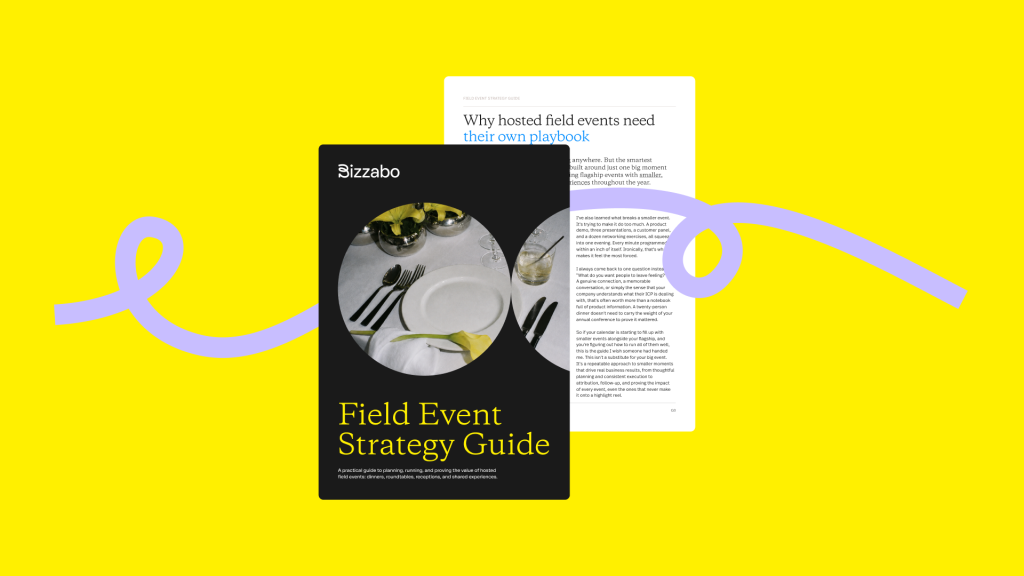
Download the Field Marketing Event Kit for speaker one-pagers, email templates, and a planning template built for account-based field programs.
How enterprise teams execute this with Bizzabo
A checklist is most useful when it connects to the systems your team already runs on. Here's how enterprise teams typically operationalize it in Bizzabo.
- Centralize the checklist and assign owners. Link each section to an owner and due date in your project tool, and mirror that structure in Bizzabo so registration, agenda, and sponsor tasks live next to the event itself.
- Connect registration, badging, and engagement data automatically. Sync attendee data, check-in status, and engagement signals into your CRM as they happen, instead of exporting spreadsheets after the fact.
- Monitor progress in real time. Set a daily reporting cadence that surfaces registration pace, speaker readiness, sponsor deliverables, and budget health, so leaders can act on risk before it becomes a fire drill.
- Close the loop and reuse what worked. Debrief against your original goals, then update the checklist template based on what you'd change, so the next event on your calendar starts from a stronger baseline. If ROI is the hardest part of that debrief to defend, this framework for presenting event ROI to a CFO or CRO is worth reading before that conversation.
Download fully built planning kits and templates
If you want plug-and-play checklists, agendas, and templates, start with Bizzabo's production kits. Each one includes editable checklists you can copy straight into your workspace.
- In-person Event Production Kit
- Hybrid Event Production Kit
- Comparing virtual platforms first? Start with Bizzabo's roundup of the best virtual event platforms for enterprise and hybrid programs.
- Field Marketing Event Kit for speaker one-pagers, email templates, and a planning template built for account-based field programs.
Ready to see how your event planning checklist could run inside a connected platform? Request a Bizzabo demo, and we'll walk through it for your event portfolio.

Recap
High-performing event teams don't start from scratch for every format. They build one reusable event planning checklist, assign owners and timelines, and connect it to the systems that power registration, content, networking, and revenue. With the right structure in place, your team can deliver consistent, high-quality experiences across your entire event portfolio, quarter after quarter, while building the data trail that proves impact.
FAQs about event planning checklists
An event planning checklist, sometimes called an event management checklist, is a reusable document that organizes everything you need to do before event day, from goal-setting and budgeting to venue or platform selection, marketing, accessibility, and measurement. The strongest templates assign owners and due dates, link to your systems, and include contingency plans.
Not meaningfully. Most teams use the two terms interchangeably to describe the same reusable pre-event task list. Some teams reserve "event management checklist" for a version that also includes post-event and reporting tasks, but there's no fixed industry standard, so it's worth confirming what your own team means by each term.
Lead times vary by scope and format. Many teams start the brief and venue search three to twelve months out for in-person conferences, while webinars, internal meetings, and smaller field events often run on a much shorter cycle, sometimes just a few weeks. Use your checklist to work backward from the event date, then map dependencies and critical path.
Include cross-audience engagement and networking plans, a unified run of show, segmented communications, platform integrations, and redundancy for both onsite and virtual production teams.
Use a simple RACI for major workstreams. Assign one owner per checklist section, set milestone dates, and establish a reporting cadence so leaders can remove blockers early.
Add pre-event KPIs to your template, such as pipeline from targeted accounts, meetings scheduled, or sponsor deliverables. Connect your registration, app, and meeting data to your CRM so revenue teams can act on engagement signals before the event even starts.