
Hosted field event planning is the process of organizing small, in-person gatherings, such as dinners, roundtables, user groups, and regional meetups, so that every stage, from the invite to the ROI report, connects back to measurable pipeline impact.
Key takeaways:
- Hosted field events get judged on pipeline and ROI, not brand lift, so they need a different measurement approach than flagship conferences.
- A repeatable, format-specific planning process makes running several field events a quarter manageable.
- CRM sync, UTM tracking, and structured post-event follow-up are the details that actually prove ROI to leadership.
- A free kit with templates for every stage of this process is available at the end of this guide.
Hosted field events don't get judged the way flagship conferences do. Leadership wants pipeline numbers and something they can point to in the CRM, not brand lift or the energy in the room. Most field marketing teams are still proving that value with spreadsheets, generic email templates, and planning docs rebuilt from scratch every time.
That gap has gotten harder to ignore as event portfolios expand to include more regional events, executive dinners, and smaller, targeted experiences alongside the flagship conference, not instead of it. Bizzabo's 2026 State of Events Benchmark Report reaches a similar conclusion from the leadership side: high-performing organizations are increasingly building local event ecosystems tied to account strategy, sales priorities, and customer success, as a complement to their flagship events rather than a replacement for them. See our guide on why field marketing is reshaping distributed event strategy for more on that shift.
This field event planning guide walks through the lifecycle of planning a hosted field event: plan, invite, prep speakers, and report. Along the way, we'll point to the specific templates that make each stage faster, all pulled from Bizzabo's free Field Event Production Kit.
| Stage | What it fixes | Kit resource |
| Plan | Rebuilding the plan from scratch for every event | Format-specific planning template (dinner & roundtable, regional & local meetup, user group, and multi-stop event tabs) |
| Invite | Generic, untracked, one-size-fits-all outreach | Six-email sequence with UTM tracking and RSVP-based segmentation |
| Prep speakers | Speakers showing up underprepared for the room, and prep never connecting to execution | Seven-section speaker one-pager, used on-site to guide the actual event |
| Report | ROI that never makes it back to the CRM | Pipeline tracking tab (goal, CRM campaign, UTM source, pipeline value) |
How to plan a hosted field event
Every hosted field event starts with the same basic building blocks: a budget, a task list, a session flow, and a way to capture what worked once it's over. Most teams rebuild these from scratch each time, which eats time that should go toward the event itself.
A planning template built around specific formats solves this. The Field Event Production Kit's planning template includes a dedicated tab for each format: dinners and roundtables, regional and local meetups, and user groups, plus a tab for multi-stop, multi-city events that adds a master template and clone instructions for that format.
Each tab covers the same core pieces: a quick overview, a simple budget, a single-owner task list, a session flow, and a one-page debrief template. That task list is deliberately not a full RACI chart. For a hosted field event, one person owning the plan end to end tends to move faster than a matrix of stakeholders reviewing every line.
A lightweight, format-specific structure is what makes running a dozen or more of these a year sustainable instead of exhausting. For the strategic case behind investing in this kind of program, our guide on field marketing events covers why these smaller, targeted formats matter for enterprise portfolios.
How to invite and promote a hosted field event
The invite and follow-up sequence is often the weakest link in field event execution: generic, untracked, and sent the same way to every registrant regardless of whether they've RSVP'd, declined, or gone quiet.
The kit's email templates fix that with a six-email sequence: invitation, invitation follow-up, RSVP confirmation, 24-hour reminder, post-event follow-up for attendees, and post-event follow-up for no-shows. Each email includes UTM tracking guidance, so clicks trace back to this specific event instead of getting lumped into general campaign traffic. A send-timing table and segmentation guidance are built in, too, so follow-up changes based on where someone sits in the RSVP funnel instead of treating every registrant the same.
That kind of structure pays off at scale. Across category-leading event programs running well over 100 scheduled email campaigns a year, scheduled email open rates still average 40%, according to Bizzabo's 2026 State of Events Benchmark Report. Consistent segmentation and timing, not volume alone, is what keeps performance high even as the number of events and emails grows.
The templates also include AI prompt boxes to help customize copy quickly for each event's audience and theme, an "add to calendar" CTA to reduce no-shows, and a feedback survey ask built into the post-event send.
Want the full sequence, ready to customize? Grab the Field Event Production Kit for the complete set of email templates, along with the planning and speaker resources covered below.
How to prep speakers for a hosted field event
Smaller, more intimate formats like dinners and roundtables put a different kind of pressure on speakers. There's no stage to hide behind and no slide deck to lean on. Speakers need to understand who's actually in the room and be ready for a conversation, not a presentation.
The kit's speaker one-pager is built for that context. It covers seven areas: an event snapshot, the speaker's specific session, who's in the room, key talking points, anticipated questions, day-of logistics, and an optional panel or fireside chat outline.
This solves a common problem at hosted formats: speakers who show up with a generic pitch instead of something tailored to the specific group they're addressing. A one-page brief that covers audience makeup and likely questions takes a fraction of the time to prepare and puts speakers in a much stronger position once they're in the room, carrying that prep directly into how the event actually runs.
Bizzabo's own Bizzy Dinners series is a useful example at a small scale: 25 to 30 senior event and marketing leaders, a local host model, and no stage or slides. The format works because the planning and speaker prep happened well before anyone sat down at the table, a pattern explored further in our look at how event leaders are experiencing events in 2026.
How to track and report hosted field event ROI
This is the stage most field event plans skip entirely, and it's the one leadership actually cares about. Attendance counts and a few photos aren't enough to defend a field event budget in front of a CFO or CRO. What they want is a connection between the event and a dollar figure in the pipeline.
The kit's pipeline tracking tab is built around four fields: the event's goal or KPI, the associated CRM campaign name, the UTM source used in outreach, and the resulting pipeline value. Filling this out for every event, rather than only the flagship ones, is what makes it possible to show a cumulative case for the field event program rather than defending each event one at a time.
For a deeper look at attribution models and how to build a full measurement framework, our guide to event marketing attribution and ROI covers the different approaches in detail. And since ROI reporting depends entirely on clean data reaching the CRM in the first place, our breakdown of how enterprise teams use a lead capture app to convert events into pipeline is worth a look for teams still relying on manual sign-in sheets or spreadsheet exports.
How enterprise teams execute this with Bizzabo
The lifecycle above, plan, invite, prep, report, works whether or not a team uses Bizzabo. For teams already managing a broader event portfolio on the platform, a few pieces connect directly:
- Centralize each field event alongside the rest of the portfolio, so a regional dinner and a flagship conference live in the same system instead of separate spreadsheets.
- Sync registration and attendance data to existing CRM and marketing automation tools. Bizzabo is built as an event operating system designed to connect with tools already in place, including Salesforce, HubSpot, and Marketo, rather than asking teams to replace what's working. See our product integrations page for the full list.
- Use the same reporting structure across every event size, so a 30-person dinner and a 500-person, multi-stop event roll up into one pipeline view.
Teams evaluating dedicated field event support can look at Bizzabo's field marketing events software, built around this kind of portfolio management.
Get the free Field Event Production Kit
Hosted field events are only going to make up more of the enterprise event portfolio, alongside flagship conferences, not in place of them. The teams that handle this well aren't reinventing the process every time. They're running a repeatable version of plan, invite, prep, report, backed by templates that make each stage faster and CRM-connected data that makes the ROI case for them at the end.
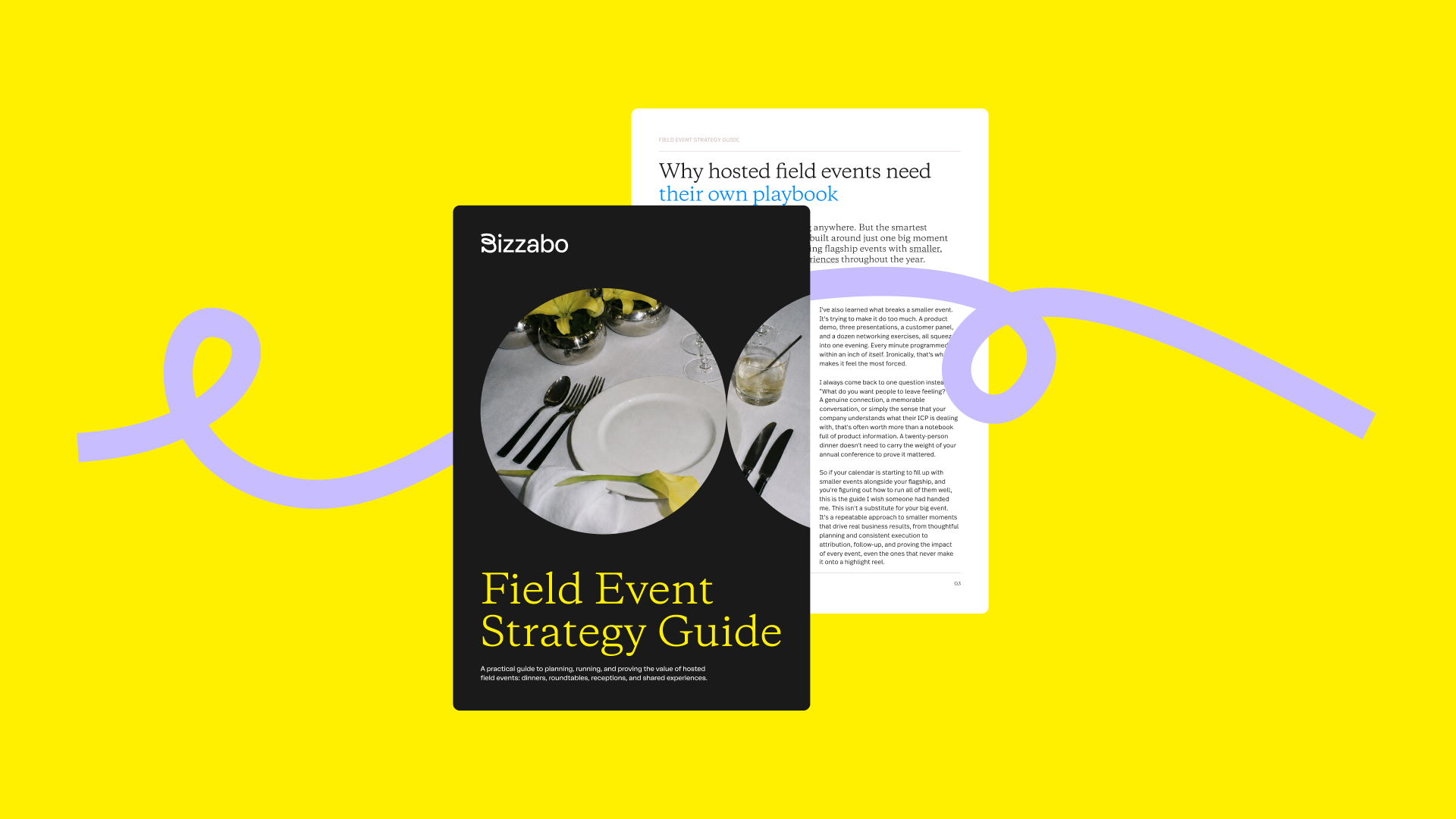
The Field Event Production Kit bundles everything covered above into one download: a Field Event Strategy Guide, the Planning Template, the full set of Email Templates, and the Speaker One-Pager.
Frequently asked questions about hosted field event planning
A hosted field event, such as a dinner, roundtable, user group, or regional meetup, is typically open to a broader group of prospects and customers within a region or industry. An account-based briefing is narrower and built around a single target account or a small handful of stakeholders from one organization. Hosted field events build relationships and pipeline across a region or segment, while account-based briefings go deep on one specific account.
How many field events should a team run per quarter?
There's no universal number, since it depends on team size, regional coverage, and budget. What matters more than the count is consistency: a smaller number of well-planned, well-tracked events run on a repeatable process tends to outperform a larger number of ad hoc ones that don't get measured the same way.
What's the best way to track ROI on a small field event?
Connect each event to a CRM campaign and a UTM source at the invite stage, then track pipeline value against that campaign after the event. Doing this consistently, even for small events, is what allows a team to show a cumulative pipeline number across the full field event program rather than trying to defend each event individually.
Do these templates work for virtual or hybrid field events, or in-person only?
The Field Event Production Kit is built specifically for in-person, hosted formats: dinners, roundtables, user groups, and regional meetups. It doesn't cover virtual event formats.