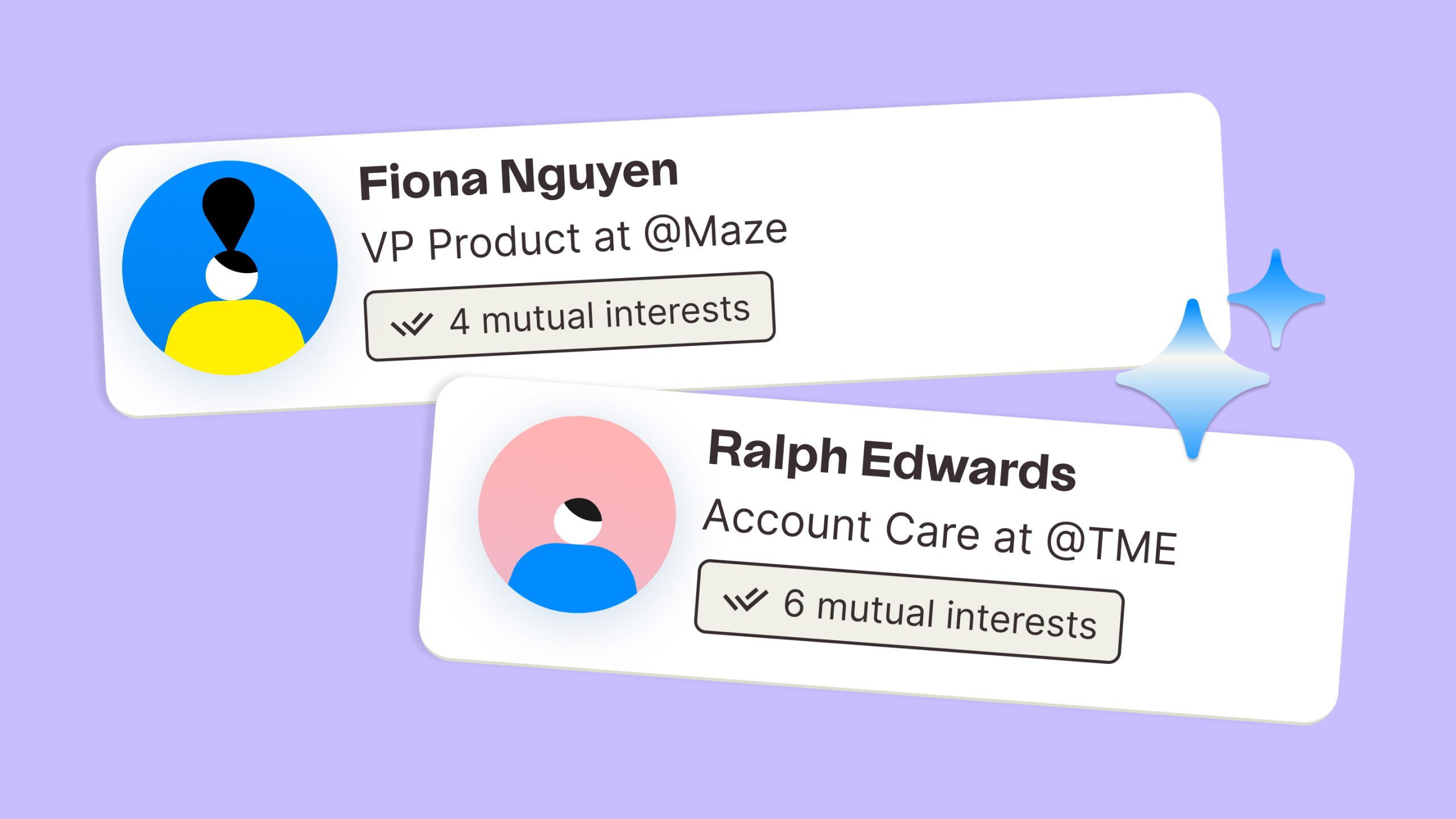

AI-powered matchmaking in mobile event apps helps enterprise event teams connect attendees based on data, behavior, and intent. Instead of relying on random interactions, the mobile event app becomes the system where connections are discovered, recommended, and activated.
By analyzing registration data, in-app engagement, and CRM signals, AI surfaces relevant introductions and enables seamless meeting scheduling. This leads to higher-quality conversations, increased meeting volume, and stronger pipeline outcomes.
For enterprise teams, matchmaking is not a standalone feature. It is a core capability within the mobile event app that transforms networking into a measurable, revenue-impacting workflow.
Networking breaks at scale
Networking is one of the primary reasons people attend events, yet it consistently underperforms at enterprise scale.
Attendees scan long lists, rely on chance encounters, or attempt to schedule meetings without enough context. High-value conversations are often missed, not because demand is low, but because discovery is inefficient.
Even early operational moments impact this experience. When arrival and onboarding are slow or disconnected, they reduce the time and energy available for meaningful engagement. This is why many teams are rethinking foundational workflows like check-in, starting with tools such as a mobile event check-in app.
The result is a persistent gap between networking intent and actual outcomes.
The mobile event app is where networking happens
The mobile event app is no longer a supporting tool. It is the central hub of the attendee experience.
This is where attendees:
- Discover who is attending
- Explore profiles and shared interests
- Send messages and connection requests
- Book meetings
- Navigate the event in real time
At enterprise scale, networking does not happen around the event. It happens inside the mobile event app.
Modern platforms have expanded the role of the app beyond logistics. They now support real-time engagement, personalization, and interaction. This evolution is reflected in how teams approach mobile event app attendee engagement as a core part of event strategy.
Explore how a modern mobile event app enables networking, communication, and engagement across the entire attendee journey.
From static tools to intelligent systems
Mobile event apps have evolved in three distinct stages:
- Static agendas
- Engagement platforms
- Intelligent, data-driven systems
Today’s leading apps operate as dynamic systems that respond to attendee behavior in real time. They capture signals, adapt recommendations, and guide interactions.
This shift aligns with a broader industry trend. Events are now expected to drive measurable outcomes, not just attendance. As a result, the mobile event app has become both the engagement layer and the data engine behind event performance.
AI matchmaking: a natural evolution of the mobile event app
AI matchmaking builds on the data already captured inside the mobile event app.
It transforms that data into actionable recommendations that help attendees connect with the right people.
This is not a standalone feature. It’s a capability embedded within the app experience that increases its overall value.
Instead of searching manually, attendees receive curated suggestions aligned with their goals, interests, and intent.
How AI matchmaking works inside the mobile event app
AI matchmaking operates across three core components:
1. Data inputs
The system pulls from multiple sources:
- Registration data
- Attendee profiles
- CRM enrichment
- Session selections
- In-app engagement behavior
This creates a unified view of each attendee.
2. Matching logic
AI evaluates:
- Shared interests and roles
- Complementary intent, such as buyer and seller alignment
- Behavioral signals that indicate engagement
The goal is to prioritize relevance, not volume.
3. In-app activation
Recommendations are delivered directly inside the mobile event app through:
- Suggested connections
- Messaging prompts
- Meeting scheduling workflows
This is where matchmaking becomes actionable. Attendees can immediately act on recommendations without leaving the app.
Business impact: from engagement to pipeline
AI matchmaking changes how networking performance is measured.
Instead of focusing only on attendance or session engagement, teams can track:
- Number of meetings scheduled
- Quality of connections
- Follow-up activity
- Influence on pipeline
More relevant connections lead to more productive conversations. These conversations drive stronger relationships and better business outcomes.
The real value emerges when engagement data is captured and connected to downstream systems. Insights from the app can be tied to pipeline and revenue, as explored in discussions around event app ROI and engagement data.
Enterprise challenges
Despite the potential, many organizations struggle to fully realize the benefits of AI matchmaking.
Common challenges include:
Low app adoption
Even advanced features have limited impact if attendees do not engage. Driving usage requires deliberate strategies such as those outlined in event app promotion best practices.
Fragmented data
Disconnected systems reduce the accuracy of recommendations and limit measurement.
Legacy platform limitations
Static attendee lists and manual workflows prevent meaningful connections at scale. These gaps become more visible when comparing modern platforms with legacy solutions, such as in this Cvent vs Bizzabo comparison.
Without an integrated system, networking remains inconsistent and difficult to measure.
Framework: mobile event app intelligence model
To understand how AI matchmaking fits into the broader event ecosystem, enterprise teams can use a three-layer model:
1. Data layer
Captured through the mobile event app
Output: Unified attendee profiles and behavioral signals
2. Intelligence layer
AI analyzes data and prioritizes connections
Output: Relevant, high-value matchmaking recommendations
3. Activation layer
Connections are executed inside the app
Output: Meetings, conversations, and engagement data
This model positions the mobile event app as the foundation for connection intelligence.
How enterprise teams execute this with Bizzabo
Enterprise teams operationalize AI matchmaking through a connected, app-first workflow.
Step 1: Centralize attendee and behavioral data
All registration, CRM, and engagement signals are unified into a single system.
Step 2: Activate AI matchmaking within the app
AI identifies relevant connections based on intent, behavior, and profile data.
Step 3: Enable in-app meeting scheduling
Attendees can message, connect, and schedule meetings directly within the mobile event app.
Step 4: Capture and measure outcomes
Engagement, meetings, and interactions are tracked and connected to reporting and revenue systems.
These capabilities are delivered through an integrated event networking platform, where matchmaking, messaging, and scheduling operate within a single environment.
For a broader view of how these capabilities come together, explore how modern teams leverage an AI-powered event networking suite to drive connection outcomes at scale.
Decision Criteria for Evaluating AI Matchmaking
Enterprise teams should evaluate solutions based on:
- Mobile event app usability and adoption
- Depth of data integration
- Real-time adaptability of recommendations
- Connection to CRM and revenue systems
- Support for sponsors and exhibitors
These factors determine whether matchmaking drives real business impact or remains a surface-level feature.
From networking feature to revenue system
AI-powered matchmaking transforms the mobile event app into more than an engagement tool. It becomes a system for driving meaningful connections and measurable outcomes.
For enterprise teams, the shift is clear. Networking is no longer a passive experience. It is a structured, data-driven workflow that contributes directly to pipeline and revenue.
When powered by a modern mobile event app, AI matchmaking enables teams to scale connection quality, improve engagement, and demonstrate real business impact.
The next step is to see how this system operates in practice.
Request a demo to see how AI-powered matchmaking works inside the mobile event app, from connection recommendations to meeting scheduling and pipeline attribution.

FAQs: AI matchmaking in mobile event apps
AI matchmaking uses attendee data and behavior to recommend relevant connections directly within the mobile event app.
How does AI matchmaking improve event ROI?
It increases the number and quality of meetings, which leads to stronger relationships and measurable pipeline impact.
What data is used for matchmaking?
Typical inputs include registration details, attendee profiles, session selections, CRM data, and in-app engagement behavior.
How do you drive adoption of matchmaking features?
Adoption depends on clear communication, onboarding, and in-app prompts that guide attendees to take action.
Does AI matchmaking work for enterprise-scale events?
Yes. It becomes more valuable at scale, where manual networking is inefficient and high-value connections are harder to identify.