
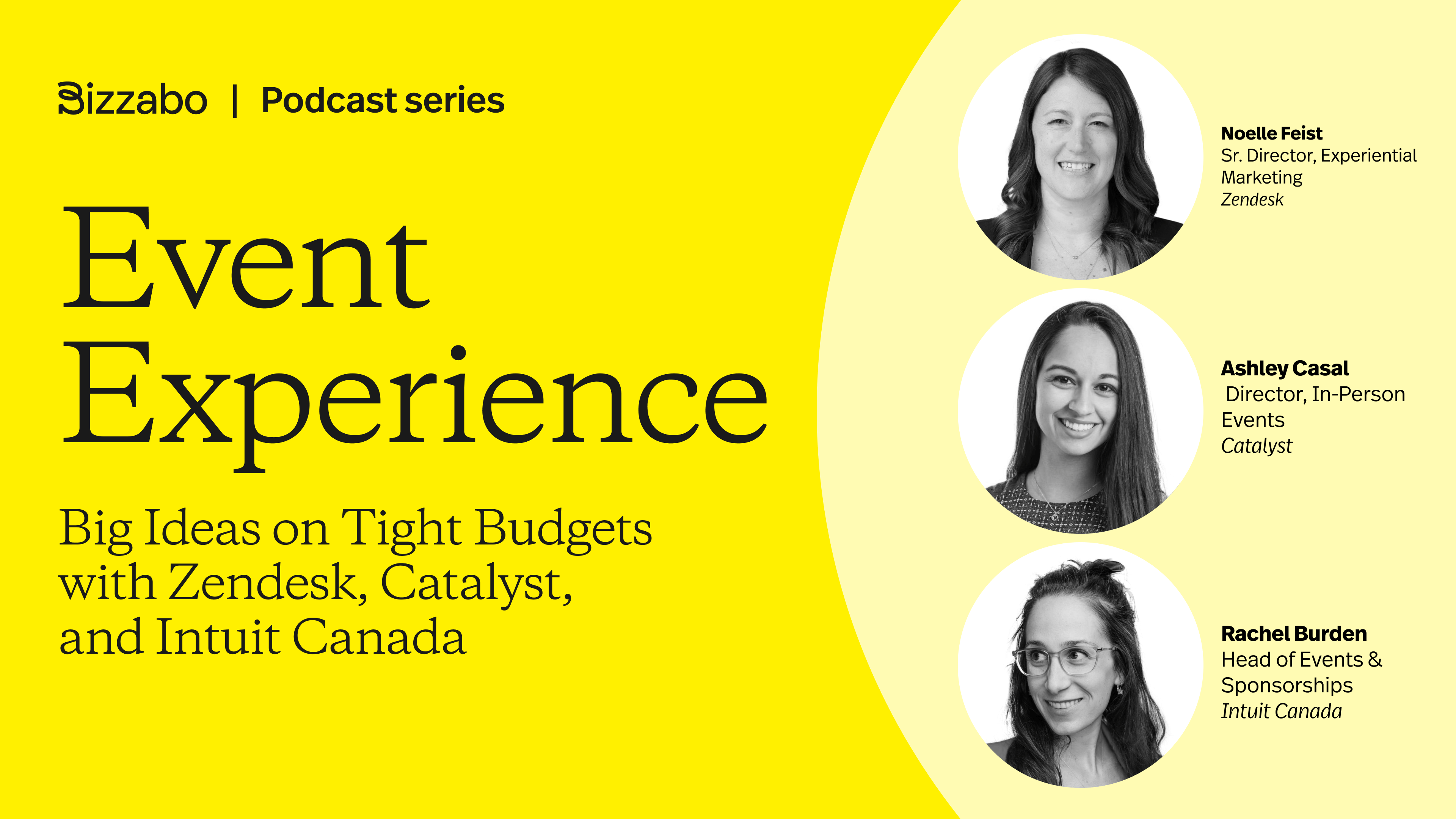
In this episode of Event Experience by Bizzabo, host Rachel Moore discusses tips for effective budgeting in 2025 with Noelle Feist, Senior of Global Strategic Events at Zendesk, Ashley Casal, Director of In-Person Events at Catalyst, and Rachel Burden, Head of Events and Sponsorships at Intuit Canada.
They highlight the importance of contingency planning, how creative thinking is the key to creating exceptional experiences on a tight budget, and how to manage-up when budgets are stretched thin.
Noelle Feist is the Senior of Global Strategic Events at Zendesk. In case you’re not familiar, Zendesk is a service-first CRM company that builds powerful and flexible software to meet the needs of any business.
Ashley Casal is the Director of In-Person Events at Catalyst, the go-to resource on advancing gender equity at work, leading women's inclusion and advancement and helping organizations drive systemic change.
Rachel Burden is the Head of Events and Sponsorships at Intuit Canada. Serving approximately 100 million customers worldwide with TurboTax, Credit Karma, QuickBooks, and Mailchimp, Intuit helps put more money in consumers’ and small businesses’ pockets, saving them time by eliminating work, and ensuring they have confidence in every financial decision they make.
Here’s what you’ll learn in this conversation:
[00:00:09] Rachel Moore: / Welcome to Event Experience by Bizzabo, the podcast where we bring the best and brightest event experience leaders together to share stories, tips, and lessons learned from creating some of the world's biggest events. I'm Rachel Moore, your podcast host. In this recap of our recent webinar hosted by Bizzabo, I welcome three expert event planners to figure out how to future proof event budgets.
[00:00:42] You're about to hear the best budget hacks and advice from Noelle Feist, Senior of Global Strategic Events at Zendesk, Ashley Casal, Director of In Person Events at Catalyst, and Rachel Burden, Head of Events and Sponsorships at Intuit Canada. Hang tight for how you can manage unexpected costs, face economic factors outside of your control and build in contingencies for your Event Experience budgets.
[00:01:11] /
[00:01:13] Rachel Moore: Hello, everyone. Welcome to React, Adapt, and Grow: Future proof your event budget for 2025. I know, it's almost here. It's wild.
[00:01:24] This webinar will be available on demand for your convenience. In this session, we're going to explore the actual currency of event planning and learn to drive it instead of having it drive us. Our goal is to equip you with knowledge and practical tips to help you with cost saving hacks that trim expenses, prioritize investments for maximum impact and stretch that budget.
[00:01:48] We're also going to teach you how to adapt on the fly. We're all used to that. Manage surprise costs and ensure your budget is responsive to the unexpected. And we'll guide you into confident budget planning for 2025 with techniques for forecasting, fund allocation, and stability, dare we say growth, for the next year.
[00:02:08] We're going to talk about how sponsorships can be an infusion into your budget, as well as the more intangible success for your event. And we're also going to dig into how global and economic factors, those things that are all outside of your control, how those impact your budget planning and what you can do to stay stable and even profitable in the face of uncertainty.
[00:02:31] All right, without further ado, Let's begin the journey together.
[00:02:35] It's my pleasure to introduce today's webinar speakers. First we have Noelle Feist. Noelle is the senior director of global strategic events at Zendesk, where she leads the vision and execution of impactful events that drive brand engagement and business with extensive experience in strategic event planning.
[00:02:55] Noelle is known for creating memorable, high impact experiences that resonate globally and elevate Zendesk's presence in the market. Her go to event day shoes are comfy white sneakers. Noelle, welcome to today's discussion. Thanks for having me excited to be here. Yes. We're excited to have you as well.
[00:03:14] Next we have Ashley Casal. Ashley is the director of in person events at Catalyst, where she excels in crafting immersive event experiences that foster community and drive engagement. Known for her expertise in live event strategy, Ashley brings a creative and results focused approach to connecting audiences with Catalyst's mission.
[00:03:35] Her shoes of choice for the all day events are Cole Hahn Oxfords. Welcome, Ashley. for having me. Awesome to have you.
[00:03:44] And finally we have Rachel Burden. Rachel is the head of events and sponsorships at Intuit Canada, where she leads innovative strategies to deliver impactful events and strengthen partnerships across the country.
[00:03:57] With a deep commitment to audience engagement, Rachel is known for creating memorable experiences that elevate the Intuit brand and connecting with Canadian communities. She's wearing Vessies for all day events. Rachel, pleasure to see you here too.
[00:04:10] Rachel Burden: Thanks for having me.
[00:04:12] Rachel Moore: Of course, got quite a line up today.
[00:04:15] Let's get started. Shall we? Before we dive into our key topics, let's check in. I'm going to ask everyone to be very vulnerable in your answers to this poll the year 2025 and its budget loom before us when you plan for a new annual event budget.
[00:04:31] Where are your biggest knowledge or forecasting gaps? Is it knowing which areas to prioritize for your budget? Maybe it's predicting global or regional economic impacts. Maybe it's baking in areas where you can pivot without derailing everything. Or if it's none of those three or all of those three or some fourth thing, what are, what do you feel like are people's biggest misses when they are addressing them kind of trying to plan ahead for a budget? And Noelle, I'll start with you.
[00:05:00] Noelle Feist: Yeah, I mean, I'll talk about it often, but contingency planning is such a needed part of every event budget.
[00:05:08] We cannot predict everything that's going to happen, especially when it comes to those economic impacts. So, there's quite a few creative ways to do that. And that could be in every line item or one specific line item, but you really do need to prepare for things to come up.
[00:05:24] Rachel Moore: Absolutely. Yeah. And then over to Ashley or Rachel, Ashley, why don't you go next?
[00:05:28] What do you think is the people's biggest gap when they're planning for budget 2025?
[00:05:32] Ashley Casal: I echo what Noelle just said. It's contingency planning. You need to know. How to plan for any emergency or anything that can derail your event.
[00:05:41] Rachel Moore: Yeah. Rachel, how about you?
[00:05:43] Rachel Burden: I'll echo the sentiment as well, but I think it also just to add to that is around the planning for uncertainties.
[00:05:50] And so the contingency planning is definitely a component of that, but it's predicting how you can apply your budgets. And we'll be talking and diving deeper into how you can plan accordingly. for those unexpected changes.
[00:06:03] Rachel Moore: That's where I think we're going to have the money, literally, money of this webinar is the prediction part because my goodness, when we all like to be forecasters there.
[00:06:10] So now let's show the results and what we're going to see where you all answered and what where our biggest gaps actually are. I think y'all hit the nail on the head, baking in areas where you can pivot. So almost having those plan. Plans B, C, D, you know, knowing that you've got maybe different ways you can kind of move around, but I think we all want to do it to where nobody knows that we're having to do that.
[00:06:34] It's like all behind the scenes that everything still comes off beautifully. No one's the wiser, but we were able to pivot. So thanks to everybody for answering those those the poll questions and, you know, keep the conversation going as well, because as we keep the discussing with our speakers today, you're going to hear ideas and maybe come up with your own and be able to share those.
[00:06:53] All right, let's dig into it. I'm going to kick things off with this. Admittedly, I got into marketing because I didn't want to do math. Can anyone relate with that? Did you like pick a profession? You're like, Oh, good. I'm not going to have to do math. Yet I think we all found out that budget is absolutely part of that profession and pretty much any profession, but it's certainly a major part of any event planners world.
[00:07:15] Some of you here may be great at math and budgeting. I think that's awesome. But chances are you're here today because you need help in this area and that's why we're all here today. We won't delay the insights you came here for any further. Let's dive right in with creative budget hacks.
[00:07:29] If I can say that correctly. Noel le I'm going to kick it over to you before I keep messing up the word hacks. Can you share any out of the box creative budget hacks that you tend to use when the pressure's on?
[00:07:42] Noelle Feist: Yeah, well, first of all, the pressure's always on for us. And managing a budget is an annual year round process that we do.
[00:07:50] It's not just this time of the year where we're setting next year's budgets, but it is truly a weekly, monthly exercise for us. When you say hacks, I wish there were hacks, right? I think we're ultimately talking about using our budget in the most efficient way possible and having that being top of mind at all times.
[00:08:08] I think budgeting is often about trade offs and we need to create an exceptional experience at the highest level. That's what we're doing. We are also expected to up level that experience every year that we put on the same event. That can be extra challenging if you have a reduction in budget or even a flat budget, but your expectations are to continue to up level.
[00:08:28] With that becomes, you know, the need for a lot of creative thinking. So, something that comes to mind to me is that, you know, just because you did something really well the year before doesn't necessarily mean you have to do it the exact same way. We tend to want to rinse and repeat when we have success, but I think the most important part is to dig into why something was super successful.
[00:08:52] And if that thing did cost a lot of your dollars and your budget, you know, expect, you know, attendees want you to mix it up. So look into the data, understand why attendees found that experience or that element of your event so impactful. And that's where you can dive into the creative thinking of how can we still have that same outcome by trying it in a different way, potentially a more impactful way, potentially that's even looking into different vendors or finding a way to do it at a more affordable price.
[00:09:18] And then if that doesn't resonate, I have, you know, some of my tried and true hacks, which is maximizing the way you show up with high impact areas. You do not need to brand every part of your space, but really invest in creating in a memorable moment that when people walk in, they're like, wow, they invested in me.
[00:09:38] You can also focus on working with local vendors. I think that's a huge way to cut down cost. We tend to love to work with the same vendor year over year. But if you change locations, you're going to get a lot better rates.
[00:09:50] And I tend to always be able to get a better price when I come with knowledgeable data .
[00:09:55] Rachel Moore: Ashley and Rachel any other thoughts or hacks that you have to offer or want to echo on.
[00:10:00] Rachel Burden: Yeah, I can elaborate a little bit on the strategic partnership piece. So whether it's a vendor that you've used year over year, or we were looking and exploring new potential vendors, it's about having those engaged in strategic conversations that allow you to dive deeper into what is the right Is the realm of possibility for your events.
[00:10:19] And when you start to look at what you've experienced, even maybe in your own personal event experience just by attending events yourselves, you can also pull that insight into having those strategic conversations to be able to determine something that you've seen at other events or you've done previously and scale them into different facets that might be more applicable based on the budgets that you have available.
[00:10:44] Ashley Casal: Well, if you're going to use the same venue year after year try to negotiate a multi year contract, lock in those rates today to avoid the inflation prices. And if the venue, if your contract says, Oh, well, you know, next year or the year after our pricing is going to increase 6%, 10%, 12%, well negotiate that as a discount, whether it's for your FNB or your AVL or just your sleeping rooms negotiate additional concessions.
[00:11:10] Rachel Moore: Those are great tips. Thanks. See, you all have, you came in with the hacks right off the first question. This is great. I hope everybody is taking notes and echoing this.
[00:11:19] Ashley, I'm going to come over to you. This actually kind of pivots off of something Noelle mentioned, but it's my question starting with you next.
[00:11:24] There are some line items that eat the most budgets and then others just snack on the budget. Which areas do you think deserve the most budget allocation and investment when it comes to your event plan?
[00:11:37] Ashley Casal: So this question is open to interpretation. It depends on what type of event you're planning, right?
[00:11:43] So if you're planning a conference, most people will say, obviously, you need to invest in your keynote and your staging. I'm a believer that F&B is where you have to invest in as well as your AVL. You know, F&B will leave a lasting impression on your attendees. So if you have bad food, you're going to get bad reviews.
[00:11:59] People are not going to want to come back the following year. If you have great food, they're going to look forward to it the next year, the next year and they're also going to be talking about it. And then your AV, you can't have an event without great AV. You need to have a great AV partner. One of the ways that we like to maximize our budgets when it comes to AV is create a partnership with your AV company.
[00:12:18] So, you know what you're spending, you know what your needs are year after year. So, create a partnership with them and ask them, are you willing to sponsor the event in order to get some out of it, or some discounts out of it as well, because I know that for my events. I met. 50 percent of my budget is AVL.
[00:12:36] Rachel Moore: Yeah I can imagine. How about you, Noelle and Rachel? Any of those line items you're like, Ooh, you know, definitely go hard on this one, but maybe not so much on these.
[00:12:45] Noelle Feist: Yeah, I'm happy to jump in. AV is by far also one of my largest line items. And you know, when you work for technology companies, your attendees do expect you to be showcasing everything, the state of the art technology.
[00:12:58] And if you're utilizing, you know, old technology, you're not putting the investment in there. You're not really creating the confidence and experience in the company that you're really showing that you are. So we have exceptional technology, but if we're not showcasing that on exceptional technology, it really misses the mark.
[00:13:15] So that's truly a high priority focus for me. And I couldn't agree more finding long term relationships with those vendors that hit that long term align item. They know what's important to your company. Long term, they can help think about negotiating the right equipment for you, even early, knowing they have that next year with you.
[00:13:33] Rachel Burden: Yeah, I definitely agree with both of the comments so far. I think one area that we want to do is also take a step back. You have to look at the strategic objectives of your event program to actually define how you're allocating the budget across that program or portfolio of events.
[00:13:50] When I think about our hospitality events, of course, food and beverage and experience are going to be the highlight of that. And that's going to be where you're allocating your budget. Whereas when you're thinking about your annual conferences, you know, AGMs, et cetera, the factor around technology, food and beverage will still come into effect there.
[00:14:08] But again, just understanding what that objective is of that program will help you further refine and define how you're allocating budgets.
[00:14:17] Rachel Moore: Yeah. And now I want to wrap this segment with one and I'm going to ask you all to narrow it to one.
[00:14:23] Let's leave this segment with just one of your go to tips to stretch the budget when you need to make a quick decision like are I'd like to know like are you going to a specific pot of money? Are you pulling from a specific line item? So I want to hear one tip you have for stretching the budget.
[00:14:40] Who wants to go first?
[00:14:43] Rachel Burden: I can definitely jump in here and find one tip that's really hard to narrow down, but I will try. I do want to start Rachel going back to what you highlighted at the very beginning around, you know, budgets not being everyone's jam, their favorite thing to do. I really do love budgets.
[00:15:00] I almost went into accounting. So it's a little bit ironic that I ended up at an accounting software platform as a global technology. So for me, budgets, I love going through them and really thinking through the strategic element of how we are allocating across our different programs. So budget management is a really important aspect of the work that we do as event professionals.
[00:15:21] And one of the things to keep in mind is creating flexibility. And I think that's the biggest tip that I have going forward when you're looking at your budgets. How do you think about repurposing, reallocating across your budgets against the different programs and how you can create that overall experience to match those objectives that you have?
[00:15:40] And sometimes we know that there's changes in the market changes from strategic priorities, leadership sometimes comes in with new directions, and there could be other implications that take place as well. And in order to stretch that budget, it's a little bit of a give and take. And that's why you need that flexibility.
[00:15:58] And so having space to allow for those last minute changes or decisions, even just to be made is absolutely critical. One tip it's about creating for me, I break down my budget into two facets. I look at one where it is about having the essential items required for this program.
[00:16:16] And then my secondary component is the non essentials, those nice to haves. And for me, by breaking it down into those two key areas, I can really define how we go about thinking about the event, what that attendee experience is going to be, what those goals and objectives are. Also ensuring that they ladder up to the overall objectives of your company.
[00:16:37] In terms of those variable costs, if you know that you can reduce a swag item by a dollar or two or potentially remove a single food and beverage item off of a menu, those again have a few dollars that you can save that can add towards the other items that you're trying to bring into the overall event experience.
[00:16:59] Otherwise, contingencies, absolutely lean into your contingencies.
[00:17:03] Rachel Moore: Ashley, I'm going to hop over to you and I saw you giggling and I don't know if it's cause I made a comment about, I love my more flexibility in my personal budget.
[00:17:09] My husband says no. But but would love to go to you what do you got?
[00:17:13] Ashley Casal: I was giggling because I feel like Rachel just took the words out of my mouth. It's my advice is always prioritize essentials versus non essentials.
[00:17:22] So do you really need that photo booth? Do you really need 10 activations or can you go with five? Do you really need the large floral arrangements? So if you're low on budget, but you still want to make your event nice. So let's say for your conference, ask your florist, well, can I make my arrangements a little bit smaller and take off five, 10 off of the cost of the arrangement and save money there?
[00:17:44] I know I've done that a few times and it's actually turned out lovely. You also want to remove items that are non needed. Like, so is the open bar really needed or can we go with, instead of full bar, beer, wine, and champagne? Appetizers on your FNB. Do you need six? Maybe you can go with four or remove an item from the buffet.
[00:18:05] So there's a lot of ways that you can maximize your budget. But again, it's like take your bucket of money and allocate it into the line items where you know you have the most spends, where you know that these are your needs to put on the great event. Your event cannot go on without a B, without FNB, but it can go on without flowers and affordables.
[00:18:22] Noelle Feist: Couldn't agree more with Rachel and Ashley.
[00:18:24] I mean, even diving deep into like, when you look into the food and bev item, I've worked for a company where at events we had to negotiate a flat rate for our alcoholic beverages for the evening because it was a very active crowd going to a new company realized that's not a priority for attendees.
[00:18:41] We actually want to do it by consumption, which would have been mind boggling for a previous event, but is the right one for this one because it turns out that's not a priority for attendees and we actually pay less for that. So just making sure that you understand your audience when you're doing this budgeting is truly important, but I'd say a one to one go to that is very underrated when it comes planning an event, but it makes a true impact on it and as such a low cost item is networking. The ultimate goal of attendees are to make connections and learn new information that they can bring back to their own company after attending your event. And sometimes you can bring the best content out there, pay for the most incredible speakers.
[00:19:22] But that one hack they learned from that other attendee is that one that's going to go solve a huge problem for them. So networking is one of the lowest cost parts of your event to design an experience around. You can utilize already provided roundtables and do that roundtable thinking. You can make sure you just think of new activities that are very low cost where you pair people up and have them engage in a strategic conversation. So always just continue having designed planning around networking, and that will create such an impact to the overall success of your event at such a low cost. So I think that's one of the most underrated go to tips to stretch your budget and still create such a memorable impact for your event.
[00:20:05] Rachel Moore: Wow. Excellent way to close out that segment. That was a great one. I don't know how we're going to top it, but we're going to try.
[00:20:11] There is a reason the word budget includes the word "budge." Change is one of the constants in the world, but it hits events a bit differently because of how visible and how immediate changes can impact the entire experience.
[00:20:24] Often the budget can determine how easily an event planner can adapt. So I'm going to take this first question to Rachel. Can you share a time when plans changed and you had to quickly make sure your budget adapted and what did you learn from that experience?
[00:20:40] Rachel Burden: Absolutely, and I'm sure everyone has gone through an experience similar to mine.
[00:20:45] I'll take you to an example that I have from Intuit's almost a decade ago. We were in the planning process for our annual conference and we, of course, experienced an unexpected change.
[00:20:57] Our leadership decided that they wanted some new, fresh ideas to be implemented into the event, and we were just a few weeks out from the event itself. And, of course, this had implications that scaled beyond just launching something new and innovative. But also with the agenda, the planning process, our team, the budget constraints.
[00:21:18] Of course, there were lots of additional pressures that came into this that we had to think quick, but also implement quick. And in order to adapt, we again, looked at the assessment across all of our departments, budget allocations and we identified areas that we could potentially scale back without compromising the overall quality of the event.
[00:21:37] And I think that's absolutely critical to highlight without compromising the quality of the event. And so with that we decided to reduce our spend on a non essential item and we reallocated those funds towards those new fresh ideas. Now, when I think about it, it's a little bit of an outdated and antiquated idea, but I still actually love it.
[00:21:58] We built the catch boxes into the framework of using AV and the integration and just making it more fun and engaging for our customers. I still love using catch boxes, but again, this is going back a decade already. For me, just keeping that open line of communication with our team and the various stakeholders that are involved in the planning process helped us with making those.
[00:22:20] Quick decisions and also having transparency to ensure that there was awareness of the given takes that need to transpire coming out of those decisions.
[00:22:29] Rachel Moore: I love it too. And excellent advice there. Thanks for sharing that too. And even, like you mentioned, might have happened 10 years ago. This is a reality today everybody's dealing with. So, really good advice there.
[00:22:40] I'm going to go to Noelle for this next question. I love surprises said no event planner ever not when plans are in place and budgets are set which drives back a little bit to that. Like, hey, surprise new, fresh ideas coming your way. What is your advice? Noelle, for when an unexpected impact hits your budget.
[00:22:59] Noelle Feist: Well, I think the only thing event planners can for sure plan on is surprises. It's just a part of our job by nature. We're problem solvers scenario planners. It just comes out. I have a very memorable example that will be ingrained in my body for life, which is needing to completely move venues for a 1500 person three day event exactly 14 days before our event. For, you know, unforeseen reasons, we were faced with this scenario. And as you can imagine, 14 days before an event, branding has been printed, orders have been placed, and shipped, communication has been sent, maps have been printed. There's no possible way to pull off a surprise scenario like this without additional investment and still create an exceptional experience.
[00:23:54] So, because this was such a last minute, near impossible situation to get very specific quotes for what I had to do was create. You know, first prioritize transparency. I needed to make sure leadership understood all the implications and possible scenarios that would come from doing a move like this. But I also had to be confident that in order to do it, I can create not only the same exceptional experience, but a better one by, you know, all of the exceptional team that I have and our amazing partners that we did it with.
[00:24:28] So. You know, had to sit down at the table, level set, but what I really had to do was make sure they had all the all of the information in front of them. And to do that, create a best case, a worst case, and a most likely case scenario budget. It was really important to go through that exercise to do all three of them.
[00:24:47] We have to just shift with everybody, we are all doing this last minute and we are going to put our heart and soul into making sure it goes off. Well, the best case, it might only be an impact of this much over at a worst case. It could be this.
[00:24:57] Here's what I'm expecting. By sitting down and sharing all of those scenarios, I know that I'm confident to make the right decisions on the fly for the event because I have that bought in support from our leadership. But also what's really helpful is that exercise goes through and helps me scenario plan for each vendor.
[00:25:15] What I think it could go into and I can set really clear expectations like we cannot go over this amount. So we're going to have to prioritize our most important parts and make those right tradeoffs. At the end of the day, that budgeting scenario and transparency of where we were going to go led to us being able to successfully pull off such a, you know, wild maneuver and, you know, spoiler alert, did it really well to the point where even attendees were, you know, shouting out and applauding how exceptional an event it was and couldn't believe that we, you know, switch that venue and we were able to do that because I had full transparency and buy in on anything that could happen for that event.
[00:25:54] And, you know, we're able to come in right around the expected scenario budget, which was also really helpful and showed true partnership with our vendors that we worked with.
[00:26:03] Rachel Moore: Wow. What a story. Final question for this segment and this y'all we're gonna, we're gonna all just, you know, simultaneously cringe at the mere thought of this. How do you approach global and or economic winds of change that threaten your best laid event budget plans. And like I said, cringe and then answer. But how do you approach that?
[00:26:24] Ashley Casal: I think we all might have experience with this. I mean, look at COVID. It sent us all reeling. We all had to start looking at our contracts to see what were the cancellation fees? What were the cancellation clauses?
[00:26:36] What are the penalties that we have to pay? How is that going to impact our budget moving forward? Can we even proceed with like having the event somewhere else? Moving the event. What will our budget look like then? Right? How much money do we have left over? So I think in a short and sweet answer, it would be stay informed.
[00:26:54] It's very important to one, be proactive, be adaptable and be flexible, but also stay informed. Keep up with global trends, any potential disruptions. You don't want to go to a venue where in a city where, you know, there's protest plans or political unrest, civil unrest, You also want to make sure that if there's a major supply chain impact, anything that can happen that can impact your event, that'll impact your costs as well.
[00:27:20] So if there's a disruption that'll impact your swag or anything that you have to order from overseas or any shipping timelines as well, that all will impact your budget because it could increase costs, right? So short and sweet, stay informed. Make sure that you understand costs associated with any disruptions, and forecast.
[00:27:41] Be flexible.
[00:27:42] Rachel Moore: Rachel, how about you? How do you react and approach to global headwinds?
[00:27:48] Rachel Burden: For me, it's about planning for contingencies. And again, no one could have predicted that COVID, a global pandemic was going to happen, so it was a learning curve for I think the majority of us.
[00:27:58] But when we think about the ongoing annual contingencies that we need to plan for, whether it's inflation, rising costs that are associated with different vendors that you use food and beverage as an example, venues now on an ongoing basis, hotel costs are going up significantly, even insurance. And of course, every time we have a, an election, a new government changes these have significant impacts to the global economy.
[00:28:26] And to the travel and tourism and events industry. So planning for those in your contingencies and understanding how on an annual basis will continue to need to apply an increase in budget year over year to accommodate for those ongoing economic impacts.
[00:28:44] Rachel Moore: Noelle, a final word on this about those global things.
[00:28:48] Noelle Feist: Contingency more. That's really where I would dive into, you know, navigating global and economic uncertainties require both flexibility and like proactive mindset in that budget planning.
[00:28:59] I plan for that agility from the start by setting aside a very healthy contingency line item into my budget. But you really need to articulate the importance of that healthy contingency budget to leadership. I think often we are faced in some situations where when we show this detailed budget and finance or leadership sees a very large line item that says contingency and it seems like Oh, you're just having a bunch of money that you don't have a plan for.
[00:29:27] That is absolutely not the case. And you do need to clearly articulate exactly for this reason with economic uncertainties, we need to be able to plan, to be able to put on this event upfront and you know, this is such a vital part of it. If that still is a problem and I've had it before, or that's the line item that gets cut, Oh, we need you to reduce money.
[00:29:47] Take it out of the contingency, build it into each of your line items. Have a contingency for AV, have a contingency for food and bev, have a contingency for your other vendors and pad it that way because you know that at the end of the day it is your job to manage this budget and you cannot control those external economic factors and you have to have that built in.
[00:30:07] So do what it takes. Ideally, I love being at a company where a contingency is supported and understood. That I've had to do it both ways. And at the end of the day, it is always used. It is never just fluff money that I return at the end. It is absolutely imperative for all these situations that come up to be able to have that.
[00:30:25] And then the last quick tip is make sure you do sign quotes early. Get vendor quotes way ahead of time in your planning process that locks you into rates because that'll help you longterm to not be hit by unexpected increases in pricing right before.
[00:30:41] Rachel Moore: Wow. You know, I said at the beginning of this segment, I'm like, how are we going to top the last segment?
[00:30:45] We, we did that was, those were amazing tips and my goodness padding. Padding being the key phrase in that segment. Very great.
[00:30:53] We're going to get into the final segment. Everybody get out your crystal ball oh wait, we don't have those. But it is that portion of this event. We all do our best. And we listen to very smart people make predictions. Some people are offering in the chat where they go to stay up on those trends and what's happening and how to stay up to speed on changes that might be afoot.
[00:31:13] But budget forecasting is an incredibly gray area for a multitude of reasons and influences that we all face. So, I'm going to start this off with Ashley, please talk to me like I'm five. What is budget forecasting and how do you tackle it each year?
[00:31:28] Ashley Casal: Okay. So like you're five, so I'm going to talk as if I was talking to my children. Do it. Okay. So we're going to Disney world, our favorite place, right? Where our budgets don't exist, by the way, in Disney World. Right. I'm going to give you 20. How are you going to spend those 20? Are you going to spend them on snacks?
[00:31:48] Are you going to spend them on toys? A mix of both. If you spend it on the first day, you're not going to have any money tomorrow. So you need to think about how do you want to spend your money. So, break it up. On day one, I want to spend 5. Tomorrow, I could spend another 5. And then the last day, I have 10 to spend it on whatever I want, right?
[00:32:07] So, budget forecasting is essentially that. It's knowing how much money do you need for what you want to do. So you need to plan, look at what you spent last year or at the last event, and then forecast, add a, what, a percentage, maybe 6%, 10 percent for inflation, if it's the following year, if it's on the same year pad it a little bit, as we said earlier.
[00:32:29] And then you'll have your budget for the following year.
[00:32:33] Rachel Moore: That actually, that made a lot of sense to my five year old persona right now. Thank you for that. I do want to take it over to the, to our other speakers too. Noelle, how about you? Again, you can still pretend like I'm five. That would be great.
[00:32:45] Totally be fine. But
[00:32:46] Noelle Feist: yeah, I mean, I have a five and sorry, no, I don't have seven and nine year old birthdays. And yeah, it's really important to be able to clearly articulate and explain in my opinion the ability to manage money from an early age. So, If I was to explain what I, you know, do as far as budgets go in forecasting, it would be very simply clearing out that, you know, forecasting is when you have an agreed amount of money that you can spend at a determined amount of time.
[00:33:14] Let's say that's one year. And the best way to decide what you're going to do for that future year with that exact amount is look at what you know, spent the last year. But then think about what might change. What are your priorities? Are there things that you'd like to do differently this next year that maybe you didn't do the last year?
[00:33:34] And then with those priorities, you're able to see, okay, I probably can't do this, but I can do that. And that's what I'm most interested in doing. And then, of course, plan to keep that padding, that cushion, that Ashley mentioned to be able to help you still do what you want to do, but there's always going to be unexpected things that arise.
[00:33:54] And it's an important part of, you know, thinking through how you want to most efficiently use your money that you get from that tooth fairy.
[00:34:02] Rachel Moore: Ooh, now we got tooth fairies. Yeah. Disneyland and everybody's on board with the, with this, right. I do appreciate this too. I wasn't kidding when I said pretend like I just don't know anything and but this is all super helpful.
[00:34:14] Rachel over to you again. Budget forecasting. What's kind of your approach and anything you want to echo or add?
[00:34:22] Rachel Burden: Yeah, we'll echo all the sentiment, but if for the Canadians who are joining us, Disney is maybe a little bit out of reach for us sometimes, so I would scale it back to the dollar store. I take my nephews to the dollar store quite often, and we give them a set amount of dollars, whether it's 10 let's say and it's how do you want to spend this?
[00:34:41] How do you be strategic that you can maximize your spend and one of my nephews is great with numbers and he will go around and calculate absolutely everything to make sure that he has spent his full 10. And otherwise, my son would just be, you know, 10 balls because that's all he wants to play with.
[00:35:00] And so when you think about the forecasting, it's about both that contingency planning, it's about understanding the overall goals and objectives, it's about understanding your essentials and non essential line items, and how you want to take that attendee experience and build it into your budget.
[00:35:17] And again, always putting your customer first will allow that lens to ensure that you're delivering delightful experiences to your customer and not just putting it as the internal stakeholders as the only objectives to making those ultimate decisions around how you forecast and plan for your events.
[00:35:36] Rachel Moore: Really? Excellent. And I love that. You could see I gesture. I love that point you made at the end to stakeholders obviously matter, but your attendees absolutely are going to kind of win the day there for the prioritization.
[00:35:47] So, one thing that we mentioned that this webinar was about was budgeting, but also sponsorships. So I do want to talk about that sponsorship for 2025. How are sponsorships incorporated into your planning and budgeting process? Kind of like how important are they how to use them to offset costs, maybe protect that budget.
[00:36:04] We talked about padding trends, best tips best practices or tips. Rachel, I'm going to go right back to you first for this, but yeah, talk to me about sponsorships and how that figures into your budgeting.
[00:36:15] Rachel Burden: Yeah, absolutely. So we look at sponsorships in two facets. So one where we go out and sponsor our events, other events, and then, of course, the sponsorships for our events as well.
[00:36:25] And when we look at them, there's two different components to that. And again, I do come from a world of sponsorships. So please do not just sell a logo placement on a signage that does not add value to a prospective sponsor, making sure that we're building opportunities that can maximize experience.
[00:36:43] I'm going to talk a little bit about how you can make sure that your events have the right exposure and meet their goals and objectives. So please keep that in mind when you're sponsorship planning, but when you're thinking about it from a budget perspective, when we look at it internally, when we're selling sponsorship for our events, we, of course, look at it as ways that it can offset our budget.
[00:36:58] That means that it gives us the opportunity to spend additional dollars to maximize our overall dollar spend. So if you have $10 as a total budget and you get $5 of sponsorship, you now have $15 to spend. Again, very small dollars to start with, not realistic dollars. But again, that gives you the sense of how we continue to allow and have that flexibility to have those nice to haves, those incrementals, those wow factors that can be incremental to what you originally planned for.
[00:37:30] And then, as I mentioned on the other side, when we are sponsoring, looking for opportunities that create engagement to ensure we're maximizing exposure and granting us the overall goals and objectives that we have for our events to ensure that, again, we're meeting our goals and objectives of how we're allocating those dollars.
[00:37:49] Rachel Moore: And then Noelle yeah, sponsorships ending this segment, ending this question.
[00:37:52] Noelle Feist: Sponsorships are very important. I think there is super, you know, valuable for that sense of yes, it offsets costs so you can do more things, but truly, it actually grows the experience and brings a larger ecosystem to your attendees.
[00:38:06] So it's super important to be able to have sponsors at your event. But there's quite a few factors that play into it for me. One is it needs to be a win win situation. You prioritizing opportunities for our sponsors that will really make them feel like they got the outcome they were looking for out of it, which is engaging with your attendees is huge.
[00:38:27] So it's really important to be able to find creative ways to make sure they're having those conversations at the end of the day, that's it. They want to reach as many people as possible. So designing out experiences it doesn't even have to be too much of an impact to your budget. Maybe that's the passport program where you send people around to every sponsor and make sure they see it in order to get a raffle.
[00:38:47] But those are such effective ways to make sure that your sponsors are getting value out of it. When they do, they're the first to sign up the following year and you'll see continued growth because your high value dollar sponsors already sold out and there's a lot of interest and it creates that buzz to grow and grow your sponsorship program. So, yeah, to me, it's definitely an offset and a huge part of our budget.
[00:39:08] But the bigger part is that it's bringing a valuable experience to our attendees. We are giving them you know, new outlets to learn new technology and new opportunities even beyond what we're bringing them. They're getting excited ways to engage with other people and potential, you know, prizes for doing so and it just becomes a big baked in part of our experience as well, but it has to be good.
[00:39:30] Rachel Moore: Yes. Well, and that segues or that goes back to what you were saying. You know, as you're all looking at those trends and those global factors and stuff, you also need to be looking at how your sponsors being impacted by those things as well. What are their plans? Are they? Do you see them dialing back?
[00:39:45] Do you see them shifting pivoting? Are they staying tried and true? And, you know, Keeping on with the same investment. So all of that, again, makes all of you event planners masterminds because you're tackling this and owning this budget. I want to ask this question. Is there a standard percentage of the budget that any of you set aside for those contingencies are like, is there like always it's going to be 10 percent or always whatever.
[00:40:07] Does anyone have a hard, fast answer?
[00:40:09] Noelle Feist: Yeah, I mean, I would absolutely say that there is no standard because all budgets are not created equal when I'm working with high dollar budget in the multi millions. It's a smaller percentage because I know that I don't need a huge percentage of that budget as a contingency.
[00:40:25] But when I'm working with a smaller budget, there's just all of those unexpected things that you know are going to come up that you need. Maybe that'll be a larger percentage. So I think it's actually something that will flex. You know, I can say in my large multimillion budget, it's under 10%. But if I have a smaller budget, it's probably more like 20, because I don't know what I'm about to do in this smaller space.
[00:40:45] And I'm going to like those dollars go longer when it's a smaller budget. So hopefully that helps.
[00:40:51] Rachel Moore: Yeah, Ashley and Rachel. I saw you shaking your heads. No, it's not always a hard and fast percentage.
[00:40:56] Rachel Burden: Yeah, no, you took the words out of my mouth. I think for us, it really can vary depend and significantly across the different event portfolios that we have from large to small.
[00:41:06] It could be anywhere from 1%. It could be up to 3%. 30%. And again, it's about understanding your program year over year and how you're actually applying that contingency, kind of be reallocated to the various either essential or non essential line items, and then building in a new buffer for what a contingency should be.
[00:41:23] And again, ensuring that you come armed with the information, having that data backed information to make those again, informed into strategic decisions.
[00:41:33] Ashley Casal: It all depends on your event. Right? You never know what you're going to need and what you're not going to need.
[00:41:38] If your event is stagnant, as in, it takes place every year, same location, same place that, you know, you can do a certain percentage just to for inflation. But if it's an event that moves every year, you also need to take into consideration geographical factors. Like, for example, we all know New York City is a lot more expensive than Texas.
[00:41:56] So you need to take all those into consideration as well.
[00:41:59] Rachel Moore: Excellent. And then I guess what I want to try to cram in one last question that we got what change did you do to survive during COVID? And did you take any of that change into the future? Like, you're still using that today. Cause we did reference COVID earlier.
[00:42:15] I mean, gosh, who can't? When we talk about global unexpected stuff, but was there anything that any of you learned during COVID that got you through help you survive any of us survive that, but that you're taking through today, anyone want to answer that one?
[00:42:29] Noelle Feist: I mean, I think this is one of the strongest industries that got impacted during COVID.
[00:42:35] And we've all done some major shifts following that, including, you know, different language in our contracts to protect us. The venues have put different language in their contracts to protect them. That's a huge part. That's always, you know, adapted and changed since COVID. I think what's still holding strong is the need for connection is really that ultimate reason why people are coming together.
[00:42:59] And, you know, we've seen changes in the airline industry, the travel industry, flights are now flexible. That has changed when people are signing up for, when people are booking their travel, how to forecast trends. So since COVID, you know, I've really put a, you know, an experienced design standpoint, a huge, Focus on making sure connection is at its forefront, because that is always what's going to end up impacting attendees to want to come back.
[00:43:24] But I have reevaluated our trends for registration as it comes to people booking travel. And what we've also all seen is extremely high rising costs in what all of our what the cost is to put on an event in every single line item. And so that is something that's hard to, you know, make sure everyone understands as we've come out of it is like the events that we put on.
[00:43:47] You know, four or five years ago cannot be done at that same cost anymore with the drastic increase in our vendors. And you can pull some of those stats, like AB costs of the industry have gone up enough, like Fort 20 40%. And you can utilize those you know, stats that you can find in there to articulate why you need a heavier budget moving forward.
[00:44:08] Rachel Moore: Ashley, how about you? Any covid learnings?
[00:44:11] Ashley Casal: Contracting. Make sure that you have flexible terms in your contracts. Read those cancellation clauses, speak to your legal teams and see how you can get around them increase your attrition so that you're not liable for anything that could happen because you never know what could happen, right?
[00:44:27] Yeah, that's the most thing is sure that your contracts are flexible.
[00:44:31] Rachel Moore: Great insight there. And Rachel, finally with you, COVID learnings of today.
[00:44:35] Rachel Burden: Yeah, absolutely. I agree with everything that both Noelle and Ashley have highlighted. With going with the overall COVID experience, yes.
[00:44:42] Contracting liability and insurance. I think that was a critical component. Whereas before you may look at it as having a lower dollar amount attributed to your insurance clauses or to your how you would be purchasing insurance. For your events and now thinking through how do we apply that across all of our events, large and small to ensure that we are covered in all facets of anything that happens, identification, cancellation, et cetera, to make sure that again, you're creating the most meaningful impact on the event for your attendees and your customers.
[00:45:19] Rachel Moore: Thanks again to Noelle Feist, Ashley Casal, and Rachel Burden for joining us on Event Experience and thank you for listening. If you're enjoying the show, we'd love to hear it. Connect with us on social and subscribe, rate, and review us wherever you're listening. Also don't forget to share the show with your colleagues and friends.
[00:45:36] You can find transcripts of each episode and key takeaways on bizzabo. com forward slash podcast. You can also experience this whole webinar on demand at bizzabo. com. [00:45:48] On behalf of the team. Thank you. We'll gather again soon for a new episode of Event Experience.


