
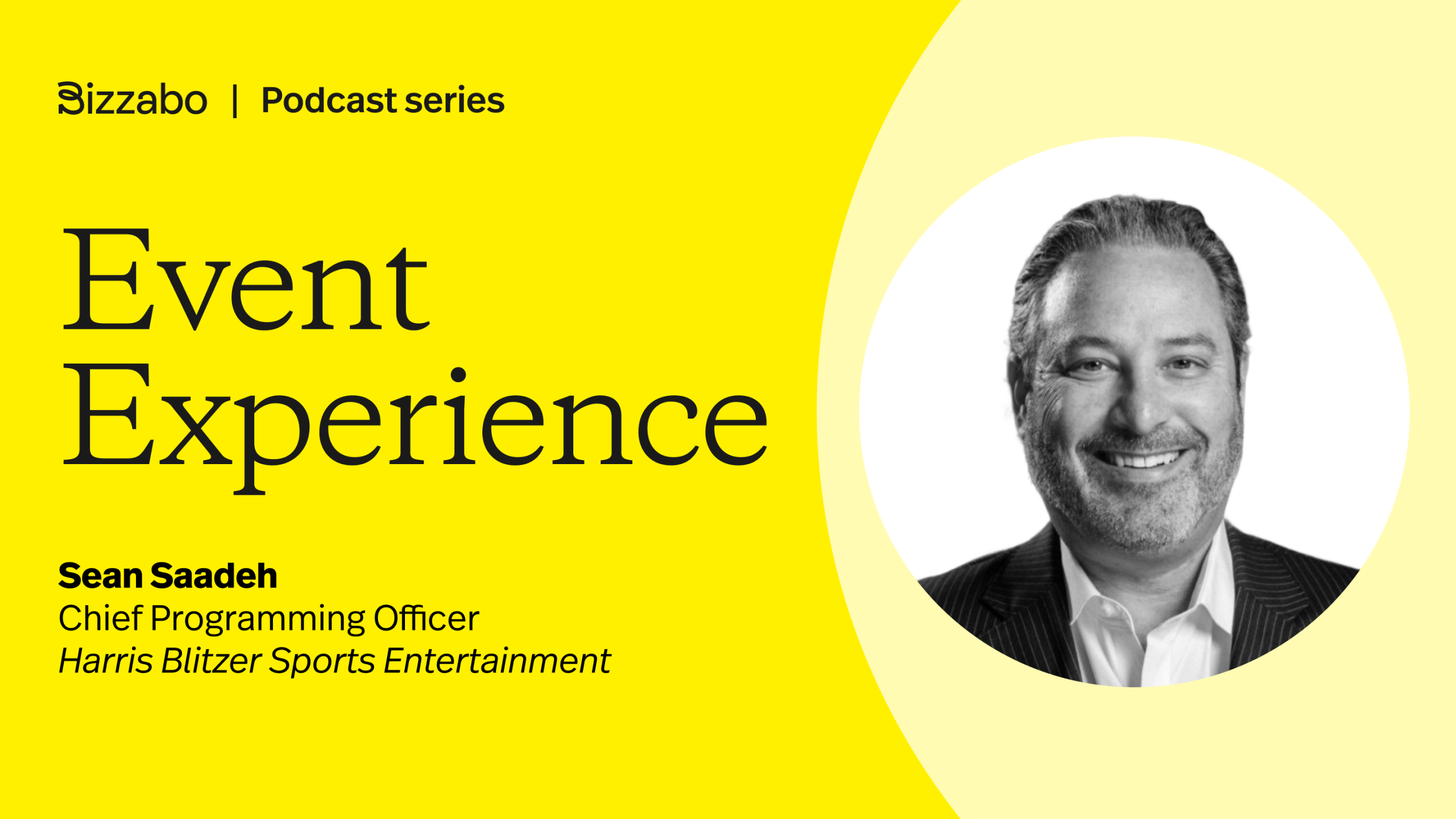
Sean Saadeh, Chief Programming Officer at Harris Blitzer Sports & Entertainment, on building a multi-venue entertainment strategy that drives attendance, ticket sales, and long-term venue growth.
In this episode, Sean Saadeh, Chief Programming Officer at Harris Blitzer Sports & Entertainment, shares how he transformed the Prudential Center from a venue doing 22 to 25 concerts a year into one consistently delivering 65-plus concerts and more than 200 total events annually.
He argues that sustainable venue growth starts with repositioning, not programming, and that understanding your market's identity is what allows you to expand the pie rather than split it. Since HBSE took over entertainment booking at Northwest Stadium in early 2024, the venue recorded a record-breaking summer concert series that drove a 20% jump in attendance and a 12% lift in ticket sales.
For event professionals thinking about venue strategy, market positioning, or how to build programming that reflects the communities they serve, this episode offers a practical framework grounded in nearly 30 years of experience across four major venues.
A multi-venue entertainment strategy is rarely taught and even more rarely executed well, which is what makes Sean Saadeh's career worth paying attention to.
Sean is the Chief Programming Officer and Head of Entertainment at Harris Blitzer Sports & Entertainment (HBSE), the organization behind the Philadelphia 76ers, New Jersey Devils, the Prudential Center, and a growing portfolio that now includes Northwest Stadium in Landover, Maryland, and the soon-to-open Lowe's Jersey Theater in Jersey City. He has been with the company for 11 years and has spent nearly 30 years in total transforming arenas and stadiums across the country, including the San Diego Sports Arena, Glendale's Gila River Arena (formerly home to the Phoenix Coyotes), and Barclays Center in Brooklyn.
In this conversation with host Rachel Moore, you'll hear how Sean approached one of the more counterintuitive challenges in venue management: how to compete in a market as saturated as the New York DMA, where four major arenas, multiple amphitheaters, and Madison Square Garden all compete for the same touring artists. His answer was to stop competing head-on and instead reposition the Prudential Center as a New Jersey destination in its own right, one that artists and promoters could add incrementally to a New York run rather than choosing between.
You'll learn how he translated that positioning into a programming strategy built on genuine market diversity, expanding into Latin music, K-pop, country, comedy, college basketball, and UFC to reflect the demographic reality of the New Jersey audience. You'll also hear how HBSE thinks about its growing portfolio of venues not as separate businesses but as an interconnected ecosystem, where relationships with agents and promoters at the arena level open doors at the stadium level, and where a new 4,000-capacity theater creates an artist development pathway that feeds the whole network.
For enterprise event organizers, the strategic logic here transfers directly: know the audience you actually have, position your program around what makes your venue or event distinct rather than what makes it comparable, and build the relationships that allow you to grow capacity over time.
Here's what you'll learn
Enjoyed this content? Subscribe to our newsletter and get insights like these delivered straight to your inbox.

Sean describes his path through four major venues over nearly three decades, and makes the case for why longevity at a single venue matters more than constant movement up the ladder.
Rachel: Excited to welcome a new guest for you today. Let me give you a little bit of an intro as we get to know him. Since HBSE took over entertainment booking at Northwest Stadium in February of 2024, our guest has transformed the venue into a premier destination for world-class acts headlined by a record-breaking summer concert series that drove a 20% jump in attendance and 12% lift in ticket sales, and everyone listening to this podcast wants that, so this is why you wanna keep tuning in here.
An entertainment industry veteran, he specializes in building artist relationships and curating high-profile performances that elevate fan experiences across HBSE's properties. So, with all that, I'm happy to welcome Sean Saadeh to the pod. Sean, thanks for joining us on "Event Experience."
Sean: Thanks, Rachel. Thanks for having me. I'm really excited to be a part of this today. Thank you.
Rachel: Me too. And listen, as I always say, I give you the barest of, you know, bare bones kind of intros on the podcast, and I always wanna hand it back over to our guest because I really would love our listeners and our watchers, our viewers, to be able to learn more about you and your role. So Sean, back over to you. Tell us more about yourself, your role, kinda what your day, a day in the life of your work life is with Sean Saadeh.
Sean: Sure. So I'm the chief programming officer and head of entertainment for Harris Blitzer Sports & Entertainment, known as HBSE, and I've been with the company for about 11 years, or I just had my 11th year anniversary, so, surpassed a decade, which is great in our business because sports and entertainment is a competitive business, quite frankly.
But I'm super thrilled to be a part of the team here and everything that we continue to do as an organization. I've been in the business for close to 30 years. Getting my start at the San Diego Sports Arena. I was born and raised in San Diego, so for me to be able to work at my local arena for nine years was truly amazing and got my start there and learned everything I could about the business before I left and joined the Phoenix Coyotes, which are no longer, they're now in Utah, but I was able to join their team when they opened up their new arena in Glendale, Arizona, and this was back in 2005. And spent five years with them transforming that arena in a very competitive market in Phoenix. And then I had the opportunity to join the team at Barclays Center in Brooklyn to open up that venue. Back in 2011, I joined the team, and we opened the building in 2012.
And then four years later New Jersey called me and said, "Hey, would you like to come over and work in New Jersey at the Prudential Center to transform that arena?" And that's been my journey in the business for four venues in close to 30 years, which I'm very proud of, by the way, because in our business, you tend to move around a lot, and in order to move up in the business.
And what I love about my career path, I've been able to be at these venues for at least four years, which I think is imperative to transforming a business. It's hard when you're there for one, two-year stints. So I've been very blessed to be able to have the confidence of people that have employed me to stay on for at least four years during my tenure.
So, that brings me to today and so much growth that's happened over the 11 years that I've been working for Harris Blitzer Sports & Entertainment. When I first came, there was no HBSE. It was a team down in Philly with the Philadelphia 76ers and a team up north called the New Jersey Devils and the Prudential Center, which is what they hired me to do, was to bring in content to support the 41 to 44 home games that we have here at the Prudential Center.
And so what I basically do is, and what I've done over these years is I bring all the other events that you see, so the concerts, the family shows, other sporting events such as NCAA basketball or UFC boxing family show programming special events and private events are all part of the makeup of what we do.
So, we're talking about filling, if you could do the math, you have 365 days in a year, you have 44 home games. You net that out, that's what I get to work with every single day. And so what we've been able to do here is transform this arena from doing roughly 22 to 25 concerts a year to consistently doing around 65 concerts a year, over, you know, 200 events net of our hockey team.
And that brings us, you know, into the 225 events a year scenario. It's been a really fun ride and you know, we continue, we'll talk about growth and where we're growing. And you mentioned the stadium, which is something that we're booking as well, which is something over the last couple years we've adopted.
What repositioning the Prudential Center actually meant
Sean explains how he diagnosed a competitive market problem and solved it not with more programming but with a clearer story about what the Prudential Center is and who it serves.
Rachel: What a journey, and thank you for giving us that context too, because I think a lot of what I love about this show and I love about guests like you coming on too. So many of our event professionals out there may be very used to, you know, even if they've got like kinda a steady cadence of the same kind of event maybe they're looking at the same kind of venue each time. But a lot of times they're having to plan around some variables, right? Where it might be a bit there's some unknowns and things like that. But there's so much advantage, as you mentioned, to being someone who's working in an environment where you are in the same arena, the same space, and having that longevity there and the tenure to be able to just keep building on that super advantageous.
And I wanna just backtrack really quick too, because you did talk about like moving around to four different arenas. Did you do that by yourself? I'd love to hear more, like did you have family coming with you or do you wanna share a little bit about that? 'Cause we always do love to get that insight on our guests, like, who are the people behind this person? Could you tell us a little bit about how your family kinda handled that and a little bit more, anything you would like to share about them?
Sean: Yes. Well, I have a wonderful wife that we'll be celebrating our 24th anniversary coming August. So, I met her in the business, so the good news about that is she understands what is needed and the time that goes into, you know, being in this particular side of the business which is a lot of time away from home.
And she has been supportive all throughout my career from my days in San Diego to, you know, taking the chance of moving all the way out east which she was really excited about. I had her kicking and screaming leaving from Brooklyn when we lived there to come out to New Jersey, but now I can't get her back into the city, so.
But she's been so supportive of my career and my lovely children. So I have three, three girls. My oldest is my stepdaughter, Hannah. She actually works in the industry for Frank Productions out of Madison, Wisconsin. And she's been there for close to 11 years as well working for that company, a promoter out of Madison.
And my twin daughters Quincy and Taylor are finishing up their junior years, one's at Bucknell University, one's at Monmouth University. They have no interest in getting into my side of the business. You know, sometimes it's hard to even get them out to concerts and other events.
So I think that's just the fact that they know that they can go, it's not something that's super exciting. But now that they've gotten older, they have been taking more interest in going to hockey games and basketball and concerts. So, but early on, no interest. Zero interest. But yeah, that's my family. They've been so supportive of me. The girls were born in San Diego, my youngest twin girls, and then grew up, you know, early years in Arizona. But they were so great when we moved to Brooklyn. They were all in. So it's helpful when the kids, especially at certain ages, are supportive of making the move with Dad.
Rachel: Absolutely. It's so funny that you mention that too. I bet a lot of people who are parents who are listening can relate. Like, I work in marketing and my kids, like, want zero to do with it. Like, they're like social media, pfft, you know, and all that stuff, and I feel like that's very normal where they're like, "I'm gonna go the opposite direction."
But at least now they can, they're appreciating like, "Okay, I see what you've done and I can see what all goes into this stuff, and I appreciate it." And of course, you know, as a hockey fan, love that they're enjoying those kind of things too. But let's get back into talking about, you did give us a really great insight in, you know, the journey into how you first got a call to come to New Jersey and said, "Hey, can we have you work on the Prudential Center?" And you already shared, like, you went from like maybe 20, you know, in the 20s as far as like some extra concerts and things that were happening, and now you've really amped that up. Can you tell us a bit more about Prudential Center, the environment, the locale, where it's located, the surrounding market and community and just kinda how that figures into how you really got the momentum going there?
Sean: So, Prudential Center is based out of Newark, New Jersey. So Newark is consistently the number one size city in New Jersey. We're in the shadow of New York City. So literally, if you took Prudential Center and you drew a straight line to Madison Square Garden, it'd be eight miles. So that's what we're talking about.
Everything's very close, but divided by rivers and then, you know, you've got your bridges and tunnels that get you around in this area as well as mass transit. So getting around the areas of New York, the New York DMA is challenging to say the least. But we're in an incredible market.
Newark, when they originally built the venue back in 2007, it's literally two blocks from Penn Station Newark, and two stops from New York City. So it's very easy to get to and from the city. However, as we all know, those that live in the New York area, people would commute into New York City, but New Yorkers tend to not come into New Jersey unless they're going from one place to another.
But it's typically not a place that they go because they have everything right in New York City. So when I took over the venue, first thing I had to do was really to understand the marketplace. We knew it was a large market, right? You take New Jersey as a market and move it anywhere outside of the New York DMA, it's the fourth largest market in the United States.
That's a huge market. So I knew I had a huge market, lots of wealth here, highly educated, very diverse. And so I knew I had a great market. So now how do I position this venue within this highly competitive market, okay, of New York City? And four venues, four arenas, I should say. That's just arenas, not to mention amphitheaters, stadiums, festivals that happen in and around the area. Those are all competitive to your venue.
So we had to reposition the arena. That's what we did. We told a story around what the Prudential Center is and what it means to the marketplace. And so it became pretty apparent to me that this would be an incremental play to New York, okay? That we had to position the arena as, no, this is not a New York play. This is a New Jersey play. You have your own market, your own set of circumstances that would allow you to do a show in New York City and do a show in New Jersey incrementally as part of the same run of shows.
So when you're talking about the touring business, when you're talking about the concert business, artists are touring multiple venues around the country, and when they hit New York, they would traditionally, if you look back many years when there was Izod Center or Brendan Byrne or Continental, you know, you had that in New Jersey. You had Madison Square Garden, then you had, you know, the venue out in Long Island, Nassau Coliseum. And traditionally, you would play the city and then you'd play the suburbs.
Then all of a sudden this venue called Barclays Center opens up in New York, and that throws a wrench in everything, so now you have a fourth arena in the marketplace. And so, then it's like how many artists, how do artists play the market and how do they play all four? Well, you can't because you gotta go down to the other cities. So we constantly fight for that incremental play in the marketplace, and we've been very successful.
And that's really what it comes down to. I think people understood through data and analytics, through just doing events both in New York City and New Jersey, that, yeah, that works. It makes sense on most cases. And then, so that was the first part. So the first part was repositioning. That helped us really ramp up the market and expand the market really.
So you had this, you know, the piece of the pie, right? And instead of it being, all right, we're splitting up this piece of the pie, we expanded it and then took more market share. So that was the first thing. And then the second thing was diversification of program, which we mentioned.
Sean walks through the specific genres and event categories he invested in to reflect the New Jersey market's diversity, and how each contributed to the push from 25 events a year to more than 200.
Sean: So I mentioned earlier that the marketplace is very diverse. So, when we looked at the music side of the business, how can we do more Latin, for example? How do we double down on K-pop, which we had already invested in? You know, hip hop and R&B, like how can we expand that?
And that's what we did: instead of just focusing on the big legacy acts, the rock pop acts that play the marketplace, you know, could we diversify our programming on the music side and get us up to more events? And that took shape. We became very, very popular with Latin music. We obviously expanded on our K-pop and that's become a genre that has expanded too. We were doing it back when we opened the building back in 2007. So, it's great to see that genre continue to grow.
And then we, in recent years, we've grown our country business, our comedy business. Thank God artists that are doing comedy are more interested today than they ever have been in playing larger venues. They historically have wanted to play smaller, more intimate venues. So this has been a great development for us in being able to expand our content.
And then you look at our sports properties business, you know, this is a great market for college basketball. It's exciting. So we've been able to develop, you know, annual events through college basketball. We've also expanded into women's college basketball with the Credit Scott King Classic which we've done a couple years now. And UFC is coming back for its fourth straight year. And boxing we continue to grow as well. And then we fill in with family show programming, which, you know, the Disney on Ice is the circus. And Monster Jam, which we actually do twice a year. As you can see, we've built it up through diversification of programming and repositioning.
Rachel: Again, I'm really just thinking scope-wise, I love the diversity, and it's so cool that you leaned into that, too. You really talk about taking a look at the environment you're in and saying, A, and this again, as a marketer I'm loving this too. You knew you had to build a story, but then you're like, and now let's look at what does the surrounding audience around us, what is gonna appeal to them? What do they want? And really just providing that wide buffet, if you will, of like the different kinds of things.
So, and even as a marketer, I think of like, well, you know, oh, I'm marketing to everyone. Not necessarily, but you got really intentional about saying, "Well, let's do market, you know, market to a more Latino audience," and also, you know, the K-pop, which I love that you brought those two up because it does, I can think, we were talking earlier about, you know, I'm a Gen Xer, and it's like I can think of like certain kinds of concerts I would want to go to.
But of course, in that, in the environment you're in and the success you're trying to achieve, you do want to appeal to all those different things. And let's get to the receipts because you know, actually showcasing like, well, this has worked because I think our audience and everybody who is designing these events, they always wanna have, they wanna build something that has far-reaching, lasting impact on human beings.
Sean details what HBSE has achieved at Northwest Stadium since taking over entertainment booking in 2024, including record-breaking concert numbers and what the multi-venue model makes possible.
Rachel: I mean we kinda highlighted this when I was introducing you, of some of those numbers that demonstrate that you've built a successful ecosystem here. How, like, I think the Northwestern Stadium Summer Concert Series, can you share with us about that and any other numbers you got?
Sean: Yeah. So, you know, we, so let's take a step back. I think we've talked a lot about the Prudential Center. And so the Prudential Center was our original focus, and it continues to be a big part of our sort of our North Star for our business. But our managing partners Josh Harris, David Blitzer, continue to expand the empire.
And when they buy teams and go into different markets, it's up to me and my team on the entertainment side to, to now take these venues no different than the Prudential Center, and to make sure that they're full with events, you know, beyond our teams. And so, Josh Harris bought the Washington Commanders a few years ago, and when he did, he acquired Northwest Stadium, which at the time was called FedEx Field, but now it's called Northwest Stadium, which is out in Landover, Maryland, just outside of DC, I think six or seven miles outside of Washington, DC.
And they asked me to come down and help book the venue down there. And it's been thrilling because it adds another size venue to our portfolio of venues, which, getting into the real nitty-gritty of our business, it's very much a relationship business.
So when you are able to work with promoters, agents, and managers, and even artists at all different levels, it actually helps the whole ecosystem of venues. And we'll talk about Lowe's in a second, which is our next venue that we're gonna open up in the fall. That's a different size venue. So when you think about that ecosystem, that's what we're trying to achieve.
And so when you talked about the stats earlier on about the growth of Northwest Stadium in the entertainment business, it really is because of the relationships that we have built starting at the arena that are pretty much the same players at the stadium. We're just talking about economics that are like six, seven times more than an arena business.
When we talk about the theater business, it's probably a couple, two, three smaller than the arena business. But many of the same players, right? Same agents. So when you look at the ecosystem of the entertainment business, agents have artists that are in stadiums, but they also have artists that are playing theaters. So you can have that relationship with that agent and say, "Oh, hey, for so and so, you know, we're looking at the stadium, but we also wanna help develop your artists at our theater that's opening up." Yeah, it's really a great example of how you can utilize venues and the power of HBSE to help an artist grow in the markets that we have.
And we'll also talk about the future expansion in Philadelphia as well, the new stadium down in DC. So those are all exciting projects that are coming up.
Rachel: Yeah. And thank you for bringing that up 'cause that was another question I had. 'Cause I mean, I'm going to an arena tonight actually for a playoff game, for a hockey playoff game. But I do, and I've been able to go, had the privilege to go to the Colosseum in Rome where it's like you do think of this like scale, you know, this very big venue. So that was, but I think you just alluded to that. You have enough different size venues in your ecosystem in the empire to handle a variety of experiences of different sizes, right?
Sean: Correct. So, you know, Northwest Stadium, for a typical end stage concert, remember it's not the full stadium. We're talking about a 65,000-seat stadium for football, but when you have an end stage, you can't sell the seats behind the stage. So it tends to be around 40 to 45,000 seats for most shows there.
Then you go into the arena, right? We're talking about, again, end stage, typical 12 to 14,000 seats. And then when you get to a theater level, the theater that we're gonna open up called the Lowe's Jersey Theater in Jersey City, that's roughly a capacity of about 4,000 with a GA orchestra or 2,650 seated.
So different capacities allows artists to grow throughout this ecosystem. Not all of them get to stadiums. We're talking about the one percenters that are able to make a stadium work. But there's certainly a lot more synergies with arena to stadium and then obviously large theater to arenas.
So, it's really a great ecosystem. And I think when we look at the success of the venues, Prudential Center is consistently in the top 10 in the world really. A lot of people don't know that because we are in such a competitive market where you've got across a river, you have Madison Square Garden, which is consistently, in the one, two, or three range of arenas.
And so we kinda get overlooked because we're in New Jersey, but that just speaks to the market itself, it's a very strong market. And again, if you pulled it out of the New York DMA, it would be a huge market and a must-play for everything that happens. So, top 10 at the arena, and then last year Northwest Stadium had a record-breaking year. We did, you know, seven concerts, which is the best it's ever done. Just to give you a sense of, it did about 27 concerts in 26 years before we took over. It wasn't really a focus.
Whereas I think HBSE and the Commanders organization really have made it a focus that we are an entertainment venue that also hosts football games and concerts and other events. And we can also scale these venues, meaning that big stadiums and big arenas have breakout spaces, so we can utilize spaces within the facility. So we're constantly looking for opportunities to drive more content and business into our venues, which is a big part of what I do.
Sean outlines HBSE's upcoming capital projects, including the renovation of a 1929 Jersey City theater, a new Sixers arena in Philadelphia, and a new Washington Commanders stadium at the RFK site.
Rachel: Yeah. Well, and you know, you were mentioning like maybe not a lot of people know about these. Now they do. We're making sure, 'cause that kinda alludes back to what I was saying earlier too, where it's like, you know, we're working with event profs, our listeners, our audience are event professionals, and a lot of times it's like finding that venue that's going to work for whatever they're trying to execute and the humans they're trying to impact. And so this is all super interesting too, not even just from like how you've, and I love that you mentioned the relationships that it's taken to create the foundation and to build off of and keep that momentum going as you're building. And speaking of momentum, and I know we've teased this out a little bit, what is next? Because you've already mentioned some different growth opportunities that are about to happen and bringing even more venues and opportunities here. What's next for HBSE?
Sean: Well, we're gonna be opening up a beautiful 1929 original theater in Jersey City. It's one of the original five wonder theaters in the New York area. And it's a partnership with Jersey City. It's gonna be incredible. We've been renovating it for several months now. All the plaster work, the detailed plaster work and paint that goes into these intricacies in and around the theater we've been working on. So we're gonna bring this beautiful 1929 venue back to life with all the modern amenities. So incredible sound acoustics, the renovation of the back of house so that our artists feel comfortable and it feels really great. But also has that character.
And what's the differentiator with this venue, this particular venue is, number one, Jersey City is an incredible market. It's right across from a PATH line called Journal Square. So it's easily accessible in and around anybody that's on the PATH train line. And, you know, it's one of the last frontiers of Jersey City that needs to continue to develop, and it's already developing, but this is gonna be the catalyst that gets it fully developed. The waterside part of Jersey City is already there, so this is the last part of it. We're really excited about that.
The other piece is that we have this 4,000 capacity, which is that sweet spot now in theaters. That 4,000 to 6,000 seater, you're starting to see that pick up around the country. So it's the one venue in New Jersey, that indoor venue, that will have this capacity. And so, we can take the full orchestra and make it GA. So you have about 2,700 GA on the floor, as well as 1,300 up top, and that gets you to about 4,000. And then we can also do seated at 2,650, which is a nice sized venue.
But that's the differentiator, that 4,000 capacity. So that's next on the theater side. It's gonna be beautiful. Please come out and see it. Anybody that's in the area, please come out and see it, 'cause it's really gonna be a special place.
And then we're working on a new arena down in Philadelphia. Sixers. It's a partnership with Comcast and the Flyers, the Sixers, and we're gonna be adding a WNBA team that will debut in 2030. So we're working on design elements behind that. It's gonna stay down in South Philadelphia where the sports complex is. And just if you're familiar with where the Spectrum site was back in the old days, it's gonna take over that similar site on the campus.
And then also 2030, pray for me, please. 2030, we'll also be opening the brand new stadium down in Washington, DC, where the old RFK site was. So we'll be building there, and we're also in design stages right now for that. So, all of our teams will have new venues for Sixers and Commanders, and then we're doing a major renovation here at the Prudential Center. We're coming up on 20 years. 2027 will be 20 years. We're no longer the new kids on the block. So, we are gonna be putting in significant dollars to upgrade the Prudential Center and continue to have a great experience, not only for the fans, but also for the artists and artist's teams that come and visit us.
Rachel: You got a lot going on and I think the word empire is appropriate 'cause it is, but I like too the fact that you've still, through really emphasizing the thoughtfulness and intention and the relationships that you focus on, it is much, you know, ecosystem definitely applies as well. 'Cause you're obviously working these all together and really the goal is to compel fans to come, whatever they're a fan of, that you're providing the space for it.
And lastly, I have the easiest question of all: Where can our listeners find and follow you online?
Sean: Well, I'm @seansaadeh on LinkedIn. And then also talktomegoose on Instagram.
Rachel: You got that handle? That's your handle?
Sean: Yeah, I had to maneuver a little bit. So it's actually talk, the number two, me, underscore goose.
Rachel: All right. That makes, I was like, "Oh my goodness."
Sean: But I have a dog, I meant, I failed to mention in my family profile that my 100-pound golden retriever is named Goose. And he's named after Goose from "Top Gun," but also Goose Gossage, who's a New York Yankee pitcher, but also a San Diego Padre pitcher. So that's where it stems from. So you can find me @talktomegoose, @seansaadeh at LinkedIn, and yeah.
Sean closes with the straightforward professional philosophy that has guided his work across nearly 30 years and four venues.
Sean: I mean, for me it's be honest, be patient, okay? Negotiate fairly and think long term.
Rachel: Thanks again to Sean Saadeh for joining us on Event Experience, and thank you for listening. If you're enjoying the show, we'd love to hear it. Connect with us on social and subscribe, rate, and review us wherever you're listening. Also, don't forget to share the show with your colleagues and friends. You can find transcripts of each episode and key takeaways on bizzabo.com/podcast. On behalf of the team, thank you. We'll gather again soon for a new episode of Event Experience.


