
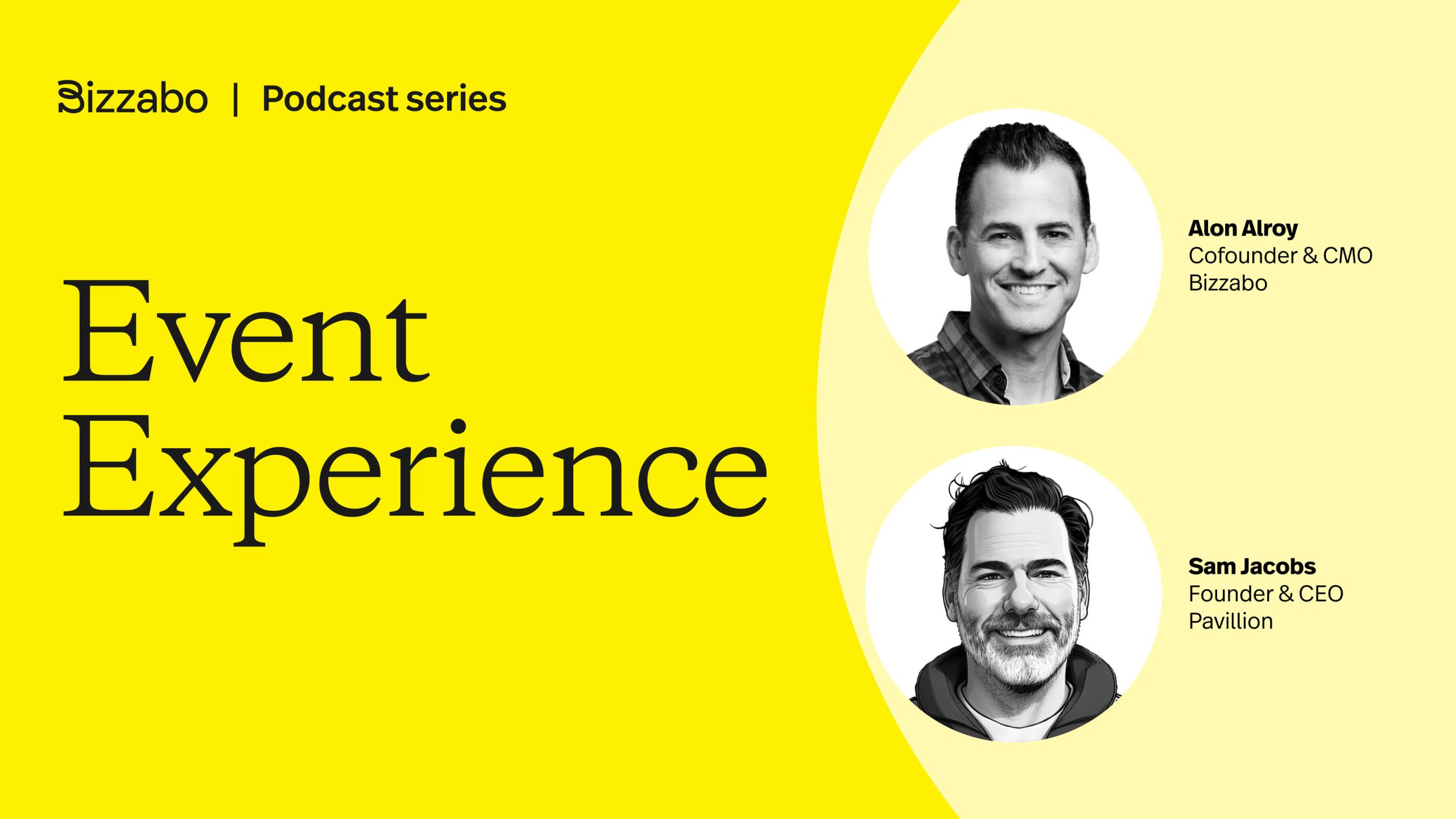
In this episode of Event Experience by Bizzabo, Rachel Moore moderates a discussion between Alon Alroy, co-founder and CMO of Bizzabo, and Sam Jacobs, CEO of Pavilion, focused on the intersection of events and community building for business growth. They highlight the importance of structure in event planning, the rise of smaller regional events, and the long-term benefits of community over immediate demand generation. Key points include how networking can be enhanced through structured events, the ROI of smaller micro-events, and how to measure the success of community building efforts.
Alon Alroy is the co-founder and Chief Marketing Officer of Bizzabo. As a refresher, Bizzabo's Event Experience Operating System enables marketing and event teams to manage and scale their event programs. Alon helped build Bizzabo’s go-to-market teams since its founding in 2011.
Sam Jacobs is the founder and CEO of Pavilion, the world’s #1 private community for GTM leaders. Since 2016, Sam has bootstrapped Pavilion to be a network of over 10,000 go-to-market professionals in B2B tech.
Here’s what you’ll hear about in this conversation:
[00:00:00] Rachel Moore: Welcome to Event Experience by Bizzabo, the podcast where we bring the best and brightest event experience leaders together to share stories, tips, and lessons learned from creating some of the world's biggest events.
[00:00:21] Rachel Moore: I'm Rachel Moore, your podcast host. In this episode, you'll learn about the intersection of events and community building to drive business growth. Alon Alroy, co-founder and CMO of Bizzabo, and Sam Jacobs, CEO of Pavilion, chat openly about the importance of structure in event planning, the rise of smaller regional events, and the long term benefits of community investment over immediate demand generation.
[00:00:47] Rachel Moore: If you've been wanting to host your own successful thought leadership dinners, keep listening for the experts' Event Experience. [00:01:00]
[00:01:03] Rachel Moore: Hello, everyone. We're so glad you're here with us today. I'm Rachel Moore, and I'm the host of Bizzabo's Event Experience Podcast, and I'm thrilled to be your moderator through today's discussion. Welcome to The Key to Accelerating Growth: Building Community Through Events.
[00:01:21] Rachel Moore: In today's discussion, we're going to discover the combined potential of events and community to drive growth. Our goal is to give you a seat at a special discussion with two leaders in events and community, respectively, which will give you practical tips to understand the importance of community to both virtual and in person events, to run micro events like dinners, to influence revenue for growing your brand or business, and to coordinate events and cultivate community hand in hand for success.
[00:01:52] Rachel Moore: We're going to talk about how running 1000 dinners helped Pavilion build a 10,000 strong community-led [00:02:00] profitable business. We're also going to reveal actionable insights, real world examples, and expert advice on making events a cornerstone of your growth strategy.
[00:02:10] Rachel Moore: All right, without further ado, let's begin our journey. It's my pleasure to introduce today's speakers. First, we have Alon Alroy. Alon is the co-founder and chief marketing officer of Bizzabo. As a refresher, Bizzabo's Event Experience Operating System enables marketing and event teams to manage and scale their program.
[00:02:31] Rachel Moore: Alon helped build Bizzabo's go-to-market teams since its founding in 2011. And his go-to event day shoes are either Vans sneakers or Cole Hans. Alon, welcome to the discussion today.
[00:02:44] Alon Alroy: Thank you very much, Rachel. Super happy to be here.
[00:02:47] Rachel Moore: Awesome. Next we have Sam Jacobs. Sam is the founder and CEO of Pavilion, the world's number one private community for GTM leaders.
[00:02:57] Rachel Moore: Since 2016, Sam has [00:03:00] bootstrapped Pavilion to be a network of over 10,000 go-to-market professionals in B2B tech. Sam's favorite shoes to wear on a long day of networking and events are Nike Air Force Ones. Welcome Sam to the discussion.
[00:03:13] Sam Jacobs: Thank you, Rachel. Super excited to be here. Always like looking at my AI generated avatar. He is incredibly handsome and unlike me in real life.
[00:03:21] Rachel Moore: I gotta say, it's pretty, I like the detail too. That's probably one of the better ones I've ever seen. So.
[00:03:26] Sam Jacobs: It looks like Indiana Jones. I love it.
[00:03:29] Rachel Moore: Where's the hat? We're just missing the hat. Well, uh, let us get started, shall we? Before we dive into our key topics, I'd like to ask our speakers today, to answer the question from an organizational standpoint, what's the biggest takeaway you hope to provide from a micro event? Uh, Sam, I'll ask you first, what's your biggest takeaway you hope to provide?
[00:03:50] Sam Jacobs: I don't mean to, to be, uh, to give a fluffy answer, but I think the biggest takeaway is a deep sense of connectedness and, uh, company from the [00:04:00] participants in the event. I think from there, you know, new network connections, new business, certainly content, new insights, tactics they can apply in their daily life.
[00:04:10] Sam Jacobs: But the foundation of it is a sense. It's an inimitable, uh, sense that you get from being in person of human connection and the energy that's created from a common group, working on a common goal, hard to describe, but you know, when you feel it and that's, that's what fundamentally that's what enables everything else for me.
[00:04:27] Rachel Moore: Love it. Alon, how about you?
[00:04:29] Alon Alroy: First, I agree 100%. I'll add that, I think a memorable experience to most people, comes with creating new meaningful connections. So I think it's a level above new network connections. We sometimes just make connections, but it's all about making deep, meaningful connections.
[00:04:47] Alon Alroy: And that can be done by organizing actually creating what Sam was talking about this, uh, atmosphere of belonging and meaning.
[00:04:57] Rachel Moore: Absolutely both, and both great takeaways. I mean, I think [00:05:00] we all want to get those things out of micro events. Let's see how our audience answered. Looks like new network connections really won the day on this one.
[00:05:10] Rachel Moore: But I think that really ties into what both of you said. I mean, that's, you know, meeting people and those making those connections is a huge part of making memories and just really, um, having those takeaways afterwards. So, excellent. And of course there's other ones figured into it, but new network connections was the big one.
[00:05:25] Rachel Moore: I am interested to see how this plays out in our discussion as we go forward.
[00:05:28] Rachel Moore: First up, I'm going to do air quotes here. "Community". Okay. We've heard it. We know about it. We participate in it. I mean, right here, right now, we're forming a community as we gather together for this singular experience.
[00:05:41] Rachel Moore: And we may nebulously know that community is important to today's events, but today is about removing any ambiguity around that notion. So let's kick things off with some clarity. Sam, I'm gonna take this first question to you. Again, I'm gonna repeat the word community.
[00:05:57] Rachel Moore: In the context of community, how [00:06:00] vital are events and why?
[00:06:02] Sam Jacobs: Events are critical because events, and it sort of depends what you mean, you know, by the word of event. But let's say you mean a group of people coming together for a common purpose through a shared experience. Maybe that's one definition, and in that context, events are literally the way that you create the sense of community, the sense of belonging.
[00:06:21] Sam Jacobs: They don't all have to be in person, but I can tell you, you know, to the point of the intro, I run a global community of 10,000 people all over the world. And how did all of this start, you know, how all of this started, the way that communities have started over the last million years, which is humans breaking bread around a table.
[00:06:38] Sam Jacobs: And, uh, this all started from a quarterly dinner of people that had shared experiences that are CROs and CMOs in New York City. And, you know, we came together to talk about our lives, to talk about the challenges we faced, and to talk about the struggles that we were trying to overcome. And that, that commonality of similar people sharing an experience around a common set of values, [00:07:00] that's what enabled and activated the community, in the truest sense.
[00:07:04] Sam Jacobs: So I think events and community are intertwined in a way that I probably didn't have a full appreciation for 10 years ago, before I started working on Pavilion.
[00:07:14] Rachel Moore: Alon, and I'd love to ask you that same question. With community and events and, you know, really does make sense too, I think, you know, Sam, you talked about like back in history, that's kind of how people gathered and also the history with Pavilion. But, um, Alon, I'd love to ask you that question, like when it comes to community building, how vital or events to that effort?
[00:07:36] Alon Alroy: I think when you reflect on, um, platforms like Reddit and at the time, meetup.com, you see that there are definitely strong communities that are digital only. Having said that, the best and strongest communities out there are those that were activated or amplified through events.
[00:07:58] Alon Alroy: And I think it's not a, it's [00:08:00] not a surprise that some of the leading B2B brands out there that over the years became category leaders like HubSpot and GameSite and so on and so on, did that on the back of a very strong community that came to life through a large event.
[00:08:20] Alon Alroy: And through a very powerful event program that gave that community a chance to meet in person, and then it's like 10xing the power of community. And as someone who's been following Sam and Pavilion for a while, that is also in my mind, kind of like the magic sauce of Pavilion becoming such a strong community, because of all of these in person moments.
[00:08:44] Alon Alroy: So people tend to think that having a slack or a digital forum is a community. We have a community. I'm part of a community because I'm part of a slack group. And yes, community is a broad term, but a true community, or at [00:09:00] least I've never met, I've never experienced a strong community that did not have strong in person elements as part of it.
[00:09:08] Sam Jacobs: Yeah. And I would also just to add to what Alon was just saying, you know, I think there's a difference between an audience and a community. And an audience is, we can say what's happening right now as a community and, you know, if we want to, we can. But really it's me, Alon, and Rachel talking to a lot of people.
[00:09:24] Sam Jacobs: Yes, there's a little bit of interaction, but community is what happens when the participants talk to each other. And when we don't need to be present in order to have that serendipity and the activation and that virality of people learning what the core values are, and what the core ideas are and then connecting and communicating with each other.
[00:09:42] Sam Jacobs: And so, you know, because I've seen many conference organizers say that they run communities when really, it's just a bunch of people coming to a conference and then dispersing without any shared sense of vision or values. So there's a lot of elements to it, but you know, I think that that's important.
[00:09:56] Sam Jacobs: What's the difference between if we all listen to the same podcast that doesn't [00:10:00] make us a community, unless we all get together and start connecting with each other, as a mechanism that was the inspiration from that podcast.
[00:10:06] Rachel Moore: That's a really, I appreciate making that point too, because yeah, I admittedly like right at the front, I'm like, Hey, yeah, we're kind of a community right now but you really did define that to say, well, wait a second, you know, how can that be different if it's an audience?
[00:10:20] Rachel Moore: And like you said, it's more of a spectator sport where, we're just in our own little silos experiencing this separately, but it's when you get people to be able to interact with each other around, you know, whatever's happening on this stage or if it is a podcast or, or at a conference, that's when the actual community happens, right?
[00:10:39] Rachel Moore: Is, it's about the audience saying, let me, let me speak to the person next to me versus just experiencing it, not, not sharing that experience with someone else.
[00:10:49] Sam Jacobs: Yeah.
[00:10:50] Rachel Moore: Yeah. I wanted to ask you to, and Alon, you actually made, you listed out some really great examples of communities that have been strengthened with, uh, events [00:11:00] coming into play.
[00:11:01] Rachel Moore: I mean, this is kind of a, not a rhetorical question, but based on what your answer was, can either of you think of any really successful business communities that weren't built or grown through events? I mean, are there any out there that have successfully done that when they haven't provided those events?
[00:11:18] Sam Jacobs: I think for B2B, I have, I struggle. By the way, you know, if you've read Behind The Cloud, Mark Benioff's, I don't know if it's his biography or autobiography, it must, one of the two, but Dreamforce is a critical part of the Salesforce story. And from the beginning, Benioff was thinking about how do I create a set of values?
[00:11:37] Sam Jacobs: It was no software, meaning no on prem installation. And then how do I create a movement around that and then catalyze everybody through, through this big event? I can think of some, you know, the one that comes to mind is Strava, actually, uh, which is, you know, I don't go on that many runs with other people that I follow on Strava, but I do feel a sense of connectedness when we're all [00:12:00] exercising together.
[00:12:00] Sam Jacobs: And I can see, and Pavilion actually has a Strava group, so that I can go through and give kudos to everybody that's exercising. So I think that's probably one. I think that there's probably, uh, to the point of what we were talking about, there's probably a lot of online gaming communities, maybe Twitch, where, or even YouTube, where people are following specific gamers and then they end up connecting with each other.
[00:12:22] Sam Jacobs: Fortnite, I don't know if Fortnite's had an in person big conference. Um, so I can think of them very easily on the B2C side. It's hard for me to think of them on the B2B side. I don't know about you, Alon.
[00:12:33] Alon Alroy: I was actually about to talk about gaming, et cetera, as an example of a community that, uh, is not activated through events.
[00:12:41] Alon Alroy: But then I thought about TwitchCon and some of these actually crazy gaming conferences. And I was like, that was not a good example. Actually, even that community is brought to life, through events.
[00:12:50] Rachel Moore: Yeah. And I appreciate you bringing, I mean, I've been to, and someone mentioned Comic Con, in the chat as well.
[00:12:56] Rachel Moore: Like I go to our local Denver Comic Con, it's not the one in San Diego, [00:13:00] but, it still is about bringing those people together. And usually even within those of those major events are smaller, we're going to get into these micro events where there's like a little panel room. So even if you get something very broad, like, let's say you do go to a really gaming conference, but even at that gaming conference, there's going to be like here's a fortnight panel over here, a room.
[00:13:21] Rachel Moore: And here's a, you know, here's a Minecraft one and things like that, or, or different, you know, even smaller ways you can kind of segment off that audience. But all of that to say, and I appreciate you bringing up Strava too. Cause I hadn't thought about that for a while as well, where it's like, and that even brings up Peloton where you are all exercising or doing something separately.
[00:13:42] Rachel Moore: There is that kind of joint place where you all know you're engaging the same thing at the same time, but it feels like that still, if you're not really connecting with the people, other people in the room, aside from the focal point of interest, maybe it's not as developed as it would be if there was a [00:14:00] gathering intended to make those people connect with each other.
[00:14:03] Sam Jacobs: A hundred percent. I mean, you could imagine Strava doing some huge annual physical conference with coaches and route, you know, and we could all go to the mountains in Colorado. I don't know. They could do something really cool.
[00:14:16] Alon Alroy: I wonder if they do. Maybe someone can Google it while we're speaking. That will be interesting.
[00:14:21] Rachel Moore: Maybe they're attending right now and taking notes and saying, Hey, this is a great idea. We should do this. Zoe's saying, let's go.
[00:14:27] Rachel Moore: Well, let's, you know, we alluded to this a little bit earlier. Let's move into this next segment. And, uh, Sam, you, you queued this up really nicely earlier because you talked about kind of breaking bread together.
[00:14:37] Rachel Moore: And wherever you're watching this right now, this next segment should make you think of your very next meal. And where I'm, I'm from, uh, where I'm joining from right now, uh, lunch is just ahead of me, but food is the great unifier for so many reasons and event types, and today's attendees have the appetite, figurative and literal for gathering together to break bread.[00:15:00]
[00:15:01] Rachel Moore: So Sam, I, I want to ask you about a LinkedIn post you put up about a year ago. And two things about that. One is that you declared that you had just posted your 214th community dinner as the CEO of Pavilion. And also in that post, you provided 14 tips to run a successful thought leadership dinner.
[00:15:23] Rachel Moore: What would you say are the top tips? I mean, you know, we might not have time to go over all 14, but top tips out of that list are applicable today for hosting a great thought leadership dinner.
[00:15:33] Sam Jacobs: I would say the very top tip I have for, I'll give one strategic one and one more tactical. The strategic one is that structure is necessary in all events. You know, we've all been, and so what do I mean by that? We've all been to a dinner where there's no seating assignment, everybody sits down wherever, everybody just starts talking.
[00:15:52] Sam Jacobs: You actually, and these are like B2B events, right? But the host is too sheepish to say anything. You're not even sure if the event has formally started. [00:16:00] At some point, everybody walks out. A bunch of people say that was great but was it really great? The conversation was completely determined by whoever you happen to sit next to.
[00:16:09] Sam Jacobs: And so, what I would encourage everybody to understand is if you're going to run an event, people want structure, they want to know what are they supposed to do, what choices are they supposed to make, what are the rules of the road?
[00:16:19] Sam Jacobs: So structure is critical. And then specifically and tactically, here's what I would say. The biggest differentiator, there are a few differentiators for pavilion dinners. Our salon dinners are basically our flagship product, so to speak, that we started with.
[00:16:32] Sam Jacobs: And to the point of structure, first of all, uh, there's a moderator, there's a host. So of course, I hosted all of the first dinners. And I set the rules of the road and those rules of the road were first of all, no crosstalk. This is the single biggest thing that you can do to make an event actually fun.
[00:16:48] Sam Jacobs: Turn down the music in the room, right? Because most of the time these restaurants think that they have to create like all of the sound and noise and what it really makes is the conversation very hard to have. So you turn down the music, you tell the [00:17:00] person to turn on the music and then you say, we're not going to have any crosstalk through appetizers and entrees.
[00:17:04] Sam Jacobs: What I mean by that is there's one conversation at the table, so that the entire table can have a group conversation and it's not 15 different people whispering to themselves. I don't know about you, but so many times I've been at a dinner table where I've heard something interesting down at the other end of the table, but I can't shift my attention.
[00:17:23] Sam Jacobs: One conversation at the table makes it feel like one event, and it feels like somebody's providing structure. And then the other thing we would say is give, uh, you know, space for all voices. So the other thing you have to remember is that , I love the gender that I identify with, but it does tend to be men, uh, that are sort of loud and they talk a lot.
[00:17:41] Sam Jacobs: They want to hear themselves talk. And so you drown out other voices. And sometimes as the host, you assume that that means that the quiet person doesn't want to speak. That's actually not true. Almost, and a hundred percent of the experiences I've had, if you just give that person an open introduction and an invitation to speak, they come [00:18:00] alive.
[00:18:00] Sam Jacobs: And so you can orient the discussion around business challenges and you can say, Joe or Sally or Lisa, Hey, you haven't, you know, what's your challenge? What are you working on? And then all of a sudden they come to life and the group can workshop and answer. So I would say it's really important just to feel inclusive.
[00:18:15] Sam Jacobs: Everybody is there. And, and frankly, a lot of introverts attend these events and they're, they're, they have their guard up and they're waiting to be dismissed. They're waiting to feel like they haven't been included. And you want to make an extra effort to make sure that everybody feels very, very included.
[00:18:31] Sam Jacobs: And then the last thing you do is you say, listen, it's chatham house rules within these four walls of this dinner, which means, everything we say is confidential off the record. Everything that happens here stays here. And that hopefully creates an opportunity for people to feel more open and sharing.
[00:18:47] Sam Jacobs: And if you do those things, but also you, you'd need that moderator. You need the person to say, Joe, thank you so much, but Joe, you've, you've spoken enough now it's time for us to hear from somebody else. If you can do that in a diplomatic way, [00:19:00] then you can really have an exceptional event. So TLDR structure is critical.
[00:19:04] Sam Jacobs: And the second thing is no crosstalk. One conversation at the table. That's what creates a really outstanding conversation.
[00:19:10] Rachel Moore: Alon, I'm going to take this to you in a second, but one thing I wanted to point out too, really crucial. And, and consider this, I have my origin story and social media where it's like, oh my gosh, share everything.
[00:19:20] Rachel Moore: But what you're highlighting there is say, no, no, no, be in the moment right now, be in the moment at the table with that discussion. Don't, it's not, the priority is not to be on your phone and be like, oh, let me take a selfie of the table and let me just lie almost live tweet what we're talking about here.
[00:19:37] Rachel Moore: You really are trying to make sure everybody is breaking bread together, and in that moment together, and not trying to diversify their attention at that moment.
[00:19:46] Sam Jacobs: Yeah. I, and I would say, you know, Alon and I were on a podcast, my podcast Top Line yesterday comes out this Sunday, give it a listen, but, um, wherever your podcast can be found, but I will say this, we, we share a [00:20:00] common passion and, and perspective that presence is at a premium right now.
[00:20:06] Sam Jacobs: Presence is at a premium. Presence is expensive. Attention is expensive. And one of the things that we have to be thinking about as we create events is that we want to create presence because our phones are killing us. You know, they're killing our brains. They are making us ADHD. They're blurring us out.
[00:20:23] Sam Jacobs: You know, we all are having trouble focusing on any one thing. I think in a given zoom, they say that people are only paying attention like 23 percent of the time, which is totally insane. So my point is, like, create these rules, create these structures, because anything that we can all do to create authentic human experience and authentic human presence, will set us apart in a world dominated by AI, dominated by digital avatars, dominated by AI that's written the entire marketing company that nobody's customized.
[00:20:52] Sam Jacobs: Like that's all just going to become noise. I was saying in the podcast yesterday, it's starting for me to be possible. And I'm sure many people [00:21:00] on the call would agree, uh, when, when the email response to somebody that your colleague, when it was written by AI, and you can sort of see because it's like each sentence references one of the sentences in your email. And then it writes it a certain way.
[00:21:12] Sam Jacobs: And my point is that we're all going to be craving presence and human connection as a premium experience. As a premium experience. And so then it's just up to us to create memorable experiences, which is Alon's passion as well. It can't just be, it has to have structure. It has to have interest. It has to have creativity, taste, and perspective. If you do those things, you can position your brand in a really, really interesting way.
[00:21:35] Rachel Moore: Alon over to you then I want to get your insights and also be able to react to what Sam just mentioned, but also what are your insights as far as the top tips from Sam's LinkedIn post about how to make a successful thought leadership dinner experience.
[00:21:50] Alon Alroy: First, I think the best reaction would be to use the digital claps that you all have because I'm sure that knowing our audience, I'm sure they all really resonated with [00:22:00] Sam talking about kind of like presence, being in the moment, and structure and making sure that, um, the event is not just kind of like a random gathering of people.
[00:22:10] Alon Alroy: So yes, for free. We want to, I want to make sure that Sam hears the claps. In addition, I'll say that, I believe, and we talked about that on the podcast as well, like dinners and large events, this is an area that we, of course, deal with a lot. Are on one hand very different because they may have different objectives.
[00:22:30] Alon Alroy: But having said that, the principles are actually very, very similar. Our best customers are very intentional about the experience they want to create at their events. And they do that with, of course, a lot of structure. We talked about memorable moments and facilitating deep connections. And I think specifically now we talked about AI and AI avatars.
[00:22:50] Alon Alroy: The good thing about, uh, there are many good things about AI, but one good thing for event professionals is that, the importance of events is only on the rise because of it.
[00:22:58] Alon Alroy: The importance of actually [00:23:00] meeting each other in person, creating those deep connections cannot be replicated with AI. I think that is one of the reasons that we see the number of events on Bizzabo's platform actually growing 40 percent compared to 2023. And specifically, the number of, uh, smaller events kind of like field dinner, some of these events that we're talking about right now are actually growing 60%.
[00:23:23] Alon Alroy: So we're only going to see that growing more and more because it provides access to authority and access to decision makers, and so on. I also believe that one of the reasons is that the new attendee pyramid of needs. It used to be that people came to hear the content to learn about new things. Then to meet people, and then to have a great experience.
[00:23:47] Alon Alroy: And now it is truly about having a great experience, meeting the right people, and then customary content. And these principles are true, whether it is a dinner, because I've seen dinners in which you bring [00:24:00] in some sort of a speaker to that dinner, and people think that if you're going to hear someone speak for 30 minutes and then just have a dinner, it will be enough, but the other way is actually the right one.
[00:24:11] Alon Alroy: You don't need, you don't need people to open up, following Sam's principles, and that is actually what creates that experience that we want people to leave the room with, in which they feel like they got many tangible takeaways, they became vulnerable. And, uh, this is the dinner that they're gonna come back to.
[00:24:29] Rachel Moore: Let me ask you both this too, do you feel like it's an adjustment. Is there a learning curve that event professionals are having today where maybe they're very used to creating almost like a stage presence that and yes, a bunch of roundtables people listen and they're not so much interacting with each other.
[00:24:46] Rachel Moore: Are they having to make that transition to say, okay, no, I'm not going to have a speaker. I'm going to instead have guided discussions at these multiple tables, is that, how's the learning curve going on there with events with event professionals?
[00:24:58] Sam Jacobs: My experience so [00:25:00] far, because we run so many events is that there is a learning curve and the learning curve is about the process of there's just a little bit, even though running a big conference has its own set of, you know, myriad objectives, obstacles, challenges, you know, a million to do things on the to do list.
[00:25:17] Sam Jacobs: The act of getting people to come is still a matter of you put out the link and you ask them to buy the ticket. And that kind of first come, first served approach doesn't work for smaller, more intimate events because the attendee list is so critical.
[00:25:30] Sam Jacobs: It's critical everywhere, but it's especially critical when there's only going to be 12 people around a table. And if there's only going to be 12 people, and so, for example, you know, Pavilion itself, we run hundreds of dinners every single year. And so we're trying to think about how to build for scale, but we also, and so for a time right now, most of our events are still first come first serve on a registration basis, but we're moving all of them, all of our dinners to apply to attend, uh, in next year in 2025.
[00:25:58] Sam Jacobs: And that's because, well, [00:26:00] there's a certain number of people that have learned how to game the system. And so you start seeing the same faces at every single dinner. And it's that operational inclination of saying, yeah, we're going to have to create more steps in our process because we have to work backwards from an amazing experience for the people attending.
[00:26:15] Sam Jacobs: We can't just work backwards from what is scalable for us and easy to do. So I do think it's a new set of muscles that are being built by event managers. But Alon, what do you think?
[00:26:24] Alon Alroy: It does require adjustment. And when you need to convince your boss to attend an event, some still lean on a fancy speaker to justify their attendance.
[00:26:35] Alon Alroy: So content, I assure you that content is kind of like the third priority in the pyramid of needs, but it is a needed one. It's not something that you can pass on. Like it is actually the hook to get people into the door. And not only that, not everyone went through that phase of experience first and actually the business impact of experience, like people tend to think, okay, experience.
[00:26:54] Alon Alroy: So we're going to all go and drink together. And that's not actually what we mean. It means we're going to [00:27:00] form the connections and we're going to build community, and that will actually drive the business objectives. More than me attending a content session that I can then watch on YouTube.
[00:27:10] Rachel Moore: That makes it really interesting too, then and I'm going to get to the next question in this segment in a moment.
[00:27:15] Rachel Moore: But, um, I think that does put also a bit of an onus upon the event professional to say, you know, so many times we see that, Hey, show this to your decision makers to convince them to invest in you going to this event. Alon, to your point, maybe it's not saying, Oh, because they're going to hear from this A list celebrity, but instead it's like, here's how they're going to benefit from having discussions with their peers at a round table about topics that are going to make your business better.
[00:27:40] Rachel Moore: So it is adjusting that, um, that hook, like you said.
[00:28:28] Rachel Moore: Sam, I'm gonna take this next question to you. And I have another number for you. 1000. I guess that's how many dinners you have helped host through Pavilion. My goodness. What did it take to achieve this milestone of 1000 dinners? And then how did that achievement have an impact on the pavilion GTM community?
[00:28:49] Rachel Moore: This is, it's an amazing number.
[00:28:51] Sam Jacobs: Well, uh, and to your point, Rachel, I haven't personally hosted a thousand, but we've enabled a thousand to be hosted. And so, um, and I think that's, that speaks to the power of [00:29:00] community, which is, you know, a pay it forward, train the trainer mentality, right? So I hosted all of the first ones.
[00:29:05] Sam Jacobs: And then when we were opening up chapters for the first time in 2018, I went to all of those cities and I, I hosted the first dinner and I showed the chapter heads, which is sort of our, our regional leadership teams, which are all, they're all members of Pavilion. They're all ambassadors. Again, a true community. Because it's not just me doing all of this, even though obviously I am a public spokesperson for Pavilion.
[00:29:28] Sam Jacobs: There are thousands of people out there. Uh, we've got 50 different chapters. Most of them have two chapter heads. So I think there's a total of like 175, including leadership teams that are community leaders around the world, that are doing these events every single day and week. And so what you do is you, you teach them the format. You know, and you make them such memorable experiences that people tell their friends and people want to come.
[00:29:50] Sam Jacobs: And I've seen even, and it's not necessarily that all of the format is ours. You know, there's another, we call them salon dinners, but they're also called Jeffersonian dinners because [00:30:00] ostensibly Thomas Jefferson hosted dinners similar to the ones that we host. So there's other formats.
[00:30:04] Sam Jacobs: I've been to events where people are in the main, the main theme, again, as I mentioned before, it's like no crosstalk is one conversation of, you know, and a shared experience. But I guess the point is what we really try to do is indoctrinate our values throughout the community so that everybody could potentially host a Pavilion dinner and have it feel like a pavilion dinner, which maybe makes me think that we should build a course around it.
[00:30:24] Sam Jacobs: We haven't done that yet, but we do spend a lot of time training our leaders and our ambassadors and our emissaries, hey, this is how you run the right event. And again, the theme of it. I think some people have an instinct not to provide the right level of structure and then they're a little cautious about moderating the conversation.
[00:30:41] Sam Jacobs: And what the consequence of that is, a few people dominating the microphone. And again, if you're out there and you want to emulate this, feel free to steal all of these ideas. But the most important thing is that everybody at the table feels included and that there's one conversation. And it does require a little bit of humorous shaming sometimes of saying, Hey, Rachel, shh.
[00:30:59] Sam Jacobs: [00:31:00] Stop. We're not, we're not, we're having no crosstalk and having the courage to say that in a way that isn't antagonistic, but is still open and inclusive, but saying, come on back into the fold.
[00:31:10] Rachel Moore: Yeah. Um, Alon, have you been to any of these dinners too? Because I have a feeling you probably have, but, um, I would imagine, I mean, not all 1000, obviously, but, uh.
[00:31:20] Alon Alroy: 900 of them. Oh, actually I've, uh, I've attended a few and I've partnered on the few as well. So to be a Pavilion partner to these dinners as well, and they do follow the structure. I can tell you that.
[00:31:33] Rachel Moore: That's amazing. And you made me think of Sam like, what's that thing where usually it's putting your hand on the shoulder of the person you're like, okay, you're the one that I need you to be quiet.
[00:31:42] Rachel Moore: I need you to stop talking so much, but it's all about learning those moderator cues, um, and Zoe in the chat. So she went to one of those in Austin. So obviously, uh, they're moving, they're moving through the community itself and around the globe. Um, well, Alone. I just asked you if you went to dinner.
[00:31:58] Rachel Moore: This actually segues nicely into [00:32:00] our next segment. As we are examining the relationship of community with events, this same conversation and this topic is happening around the globe. Everybody's talking about it.
[00:32:09] Rachel Moore: What's your point of view in regards to the rise of small regional or micro events over the past two years?
[00:32:15] Alon Alroy: You know, I thought about that a lot, kind of like what is actually driving that growth.
[00:32:20] Alon Alroy: And I think there are several reasons for it. During the pandemic, people really shifted their budgets from attending third party events to hosting their own virtual events. Because suddenly it was accessible, like anyone could now run their own virtual event. And running an in person event was very expensive.
[00:32:40] Alon Alroy: So many smaller organizations did not do that. And after you got used to the benefits of it, of owning the audience, owning the data, owning the experience, owning the follow up, they become addicted to it a little bit. They cannot do that at the same scale, meaning we see that, um, [00:33:00] you know, some, some even small brands on a very limited budget were able to, and create events to attract a virtual audience of 5, 000 people.
[00:33:08] Alon Alroy: So they're not able to do that in real life. That requires millions of dollars in budget, but they did see the benefits of hosted versus third party. Even on a smaller scale. And so that's kind of a cruising number one and two, I think they just see the ROI. Smaller events definitely drive ROI.
[00:33:29] Alon Alroy: Usually specifically, if you do these on the back of an industry conference, when you do those with partners, the investment of bringing, you know, 10 to 20 people into a room is not that high, specifically if you show the car, specifically if you have a captive audience that is there for a shared experience and people have the mindset of, you know, meeting people because again, it's on the back of an industry conference. So the ROI is definitely there.
[00:33:55] Alon Alroy: And usually when you're bringing people from your own team, you suddenly give them an [00:34:00] opportunity. And I'm talking about now kind of like not the community led event, but kind of like a vendor, uh, driven event. Suddenly you give an opportunity to your exec, so to your salespeople or CSMs to actually sit shoulder to shoulder with their customers and prospects.
[00:34:14] Alon Alroy: You really do not need, by the way, I will add that to one of Sam's rules. If it's a vendor driven dinner, do not talk about your product. And then the best thing that could happen is your customers are speaking about your product on your behalf, without you saying anything about it. And the ROI is simply just there.
[00:34:32] Alon Alroy: And the third reason is that business travel costs are still really, really high. And that is just, again, going back related to the ROI point, but it's just a very efficient way to meet your customers where they are and without waiting for a big travel or a big conference and things of that nature. Specifically at a time in which, and the economy is still not what it used to be, what it used to be CFO's and budgets are still kind of like very [00:35:00] tight, etc.
[00:35:00] Rachel Moore: Yeah.
[00:35:01] Sam Jacobs: To add on to what Alon just said I think he made a couple great points and one of them is, the interplay of the moderator and the vendor, uh, can be very effective. And it doesn't require a sales pitch from the vendor or the person that's sponsoring the activity.
[00:35:16] Sam Jacobs: I think what you do is, as a moderator, you can introduce the vendor and say, you know, we're all here, Bizzabo so generously sponsored this dinner. Hope everybody enjoys. Everybody plants the seed. If you have the right mix of prospects and, you know, customers from the vendor, or at least a few people, then inevitably what happens exactly to lawn's point is they feel a sense of obligation.
[00:35:38] Sam Jacobs: And then they say, you know, I'm a happy Bizzabo customer over here. I'm happy visit. Well, I'm talking to them right now. I guess it's better to sign up. And it becomes a point of positivity. As opposed to again, treating it transactionally. Which, you know, transactionalism, we can talk about this, uh, in the next section, but, you know, I think the key point for events and community and brand, I think all of those things are deeply [00:36:00] interconnected and what they require is a long term focus.
[00:36:03] Rachel Moore: Yeah, great point too. I was going to ask about that too. It's almost like that positive peer pressure of having everyone in the room and it's like, Oh, well, everybody's going to do this and I should do this too. And by the way, we just fed you for free. And you know, it's kind of nice, we made this whole thing for you.
[00:36:16] Rachel Moore: So it definitely lends to that environment, which takes me, Sam, to this next question for you. I mean, that's one good outcome you can have and a good result you can have from this. But, I mean, you hear from GTM leaders across the globe, through your community, you craft experiences for them, to cultivate community.
[00:36:33] Rachel Moore: Knowing how events are people centric, what are you hearing from those leaders about how community delivers better results and outcomes for them as opposed to if they didn't have community?
[00:36:46] Sam Jacobs: Well, I think, it's sort of the point that I, that I really just made. I think the conversation that I'm having over and over these days is the difference between demand generation and brand from a marketing perspective. And I think in a world where [00:37:00] demand writ large, meaning global demand in a macro sense, uh, is expanding, uh, meaning your funnel is, is full without you having to do a lot, then you can focus on demand generation, which is really moving people from the middle of the funnel to become customers.
[00:37:15] Sam Jacobs: But that is a transactional motion, you know, because what you're trying to do is take existing interest and turn it into revenue. And in that moment, there was a little bit of dismissiveness, around, uh, CMOs that were brand experts, right? I know everybody's looking for a hacker that can do demand generation.
[00:37:31] Sam Jacobs: And I think my perspective is, and any true seasoned marketer knows that brand is demand generation. It's just demand generation three years from now, four years from now, and five years from now. And you're making investments that are going to pay dividends over time. And I think it's exactly the same thing with the community. Which is why community brands and events are also closely intertwined. Because how do you do community wrong?
[00:37:55] Sam Jacobs: You do community wrong by getting everybody to sign up for free. And then everything that you [00:38:00] do is, is really, very obviously a sales pitch for whoever hosts the community, whatever software company. And that's a surefire way to lose trust, and for people to turn off. It's the same thing. You know, there's a lot happening with B2B right now.
[00:38:15] Sam Jacobs: And every brand wants to say, can you mention Bizzabo or can you mention this XYZ technology in the first sentence? And the answer is, well, not if you want people to read the post, right? So you have to play a much longer game. And the world that we're in right now, where the capital is much more constrained, requires a long term focus.
[00:38:33] Sam Jacobs: So if you have a long term focus on community as a brand investment, then you understand that it will pay dividends over two, three, four, five years. And what, what I'm saying is, it's cheaper. It's a cheaper customer acquisition cost. Brand is cheaper than no brand, is another way of saying it. As you invest in your brand, because everybody wants to, you know, my peers and my friends at winning by design.
[00:38:55] Sam Jacobs: And, um, we talk a lot about GTM efficiency. Which is a big new metric in, [00:39:00] in the ecosystem. GTM efficiency is for every dollar that you spend in sales and marketing, what is the net dollar, meaning including a churn and cancellations. What's the net dollar of ARR growth? And that number has been going in the wrong direction.
[00:39:13] Sam Jacobs: One of the reasons that it's been gone direction is, is a macro force that is constricting demand. But the point is, well, how do you counteract that? Well, you can't. Fast and cheap do not go hand in hand. At least, you know, it's fast, cheaper, good, pick two. And my perspective is, listen, if you have a long term focus, and if you think your company is going to be around for a couple of years, uh, hopefully, right? Then you can invest in the community in the same way you invest in a brand, which is understanding that over time, the top of the funnel will be replenished over the next five years.
[00:39:43] Sam Jacobs: And it will lower customer acquisition costs than if you were just focused on pure demand generation. But, if you feel like you don't have that time horizon, you're going to be under a lot of pressure and community might not be the right way to do it. Because what you'll end up doing is building a bad community.
[00:39:57] Sam Jacobs: It'll be full of transactional messages. The [00:40:00] only people that will contribute will be people looking immediately for an answer or trying to sell you something. And it really won't work. And so again, you know, this is why everybody's talking about brand right now. And brand is a moat that you can invest in that delivers cheaper, right? CAC cheaper customer acquisition costs, but it will deliver it over years, not over the next quarter.
[00:40:20] Sam Jacobs: And you have to have a longterm vision, which is hard for people in a world that's so uncertain. As uncertain as ours. So that is my, that is my soapbox.
[00:40:28] Rachel Moore: Alon, I'll let you react to that before I take my final question of the segment to you, uh, reactions to that.
[00:40:33] Alon Alroy: At first, I feel like someone was sitting in our team meeting the other day because, uh, it's, it's, it's definitely a very timely discussion, it's very challenging to do because in real life, you know, there's a lot of pressure for pipeline and kind of, but what about we're missing pipeline for next month? What can you do?
[00:40:52] Alon Alroy: And you cannot say, I will run a dinner and it requires alignment that people understand that if [00:41:00] you only focus on demand capture, it will not be enough down the line. Like you actually need the marketing team to think very, very far. And I agree a hundred percent that events and dinners are just essential pieces that over time will actually lower CAC. And will drive that efficiency.
[00:41:16] Alon Alroy: Although now they may be the more expensive line items on your budget, and you do need to have a great kind of like go to market alignment and CEO alignment that, uh, to see the value of these investments. That will not have a short term investment. Sometimes they can, by the way, help close a deal, but they will have a very meaningful impact down the line.
[00:41:37] Alon Alroy: And I think it's great that we're wrapping up the conversation with addressing kind of like a business impact because some people are finding it difficult to draw the line between community dinners and business impact. But it is very much there and in a very meaningful way.
[00:41:54] Rachel Moore: Well, I have a feeling too, everybody is going to want to take the clip from both of you talking about that [00:42:00] just now and take it to their decision makers.
[00:42:02] Rachel Moore: Do you see this is going to take time and it's worth it. You know, it's not those instant gains, but it's those longterm gains and it's very much worth it, but it's having that mindset for sure. I'm going to circle back, as to wrap up this segment, circle back to something we talked about a little bit earlier was the hook.
[00:42:16] Rachel Moore: And this leads to this question. I'm gonna ask both of you and Alon, I'll start with you. What is one thing on a dinner offering, so a thought leadership dinner, what is one thing that would make that thought leadership dinner a must attend, cancel all my plans, and climb every mountain to get to this event, what's something that would just make, I've got to be at this event. What's one thing for you that would make it a must attend?
[00:42:37] Alon Alroy: I'm a foodie and I live in New York City. So, to me personally, the name of the restaurant can really help, but in seriousness, it's actually about the people. And it's about the people, and that's honestly how I prioritize whether I go to a dinner or not. And plus points for addressing the experience in the room.
[00:42:58] Alon Alroy: If it's a [00:43:00] Pavilion like dinner that I know I'm going to have an opportunity to actually engage, versus just eat, or speak with the two people who are sitting next to me. It's one thing if I know that I'm actually going, I'm actually going to a two hour experience in which I'm actually going to meet 12 people. 12 to 15 people, that's a different story. But it's definitely about the people and about the experience with those people that will determine whether I kind of like attending or not.
[00:43:28] Rachel Moore: All right. Well, Sam, how about you?
[00:43:31] Sam Jacobs: That's the same. It's the attendee list. And it, you know, it's nice if it's, uh, and by the way, uh, I feel I have taste.
[00:43:39] Sam Jacobs: I'm probably not a foodie to the same extent Alon does, but I am also deeply impatient. So I'm real, I'm not trying to spend five hours there. We had a salon dinner in Berlin one time and they, you know, I was doing a road trip, and the chapter had said, it's going to be an eight course tasting menu.
[00:43:54] Sam Jacobs: And by, it was 8 PM and we hadn't, and then they brought something and I was like, is this the first course or [00:44:00] is this the Amuse? They're like, this is just the Amuse. I'm like, guys, no, I got to go to bed. So anyway, that's a funny little aside, but the fundamental reality is it's the people in the room. And if you can confirm that it's going to be an incredible group of people.
[00:44:13] Sam Jacobs: Everything else works. And again, if you can provide that structure, I was at a dinner that Alina hosted, uh, about a month ago, Alina Vandenberg, the CEO of Chili Piper, and she assembled the co-founder of Apollo and the co-founder of Clay and the CEO of Justworks, which is, you know, one of the big New York unicorns. And, uh, Arena, uh, the CEO of food suite.
[00:44:32] Sam Jacobs: So, uh, like to be in that room, having a really honest, authentic conversation about the challenges of being CEO, you know, it was steak, the steak was good, you know, do, does it matter? Not really. It was just, it was the conversation.
[00:44:45] Rachel Moore: Excellent. I would also volunteer too, the older I get, the earlier in the day you just mentioned like 8 PM. Y'all hadn't really started like any of the courses. I'd be like, yeah, if it's time of day, it better be a darn compelling, you know, group of people or food before I'm going to [00:45:00] stay awake for that. But that's awesome. All right. Well, I can't believe it.
[00:45:03] Rachel Moore: We're also already getting into our Q and A section, but I first like to thank our 2 experts, our two speakers for a super insightful conversation. And I'm sure you have, um, loved it too.
[00:45:14] Rachel Moore: All right, Uh, first, this is from Lacey Rose with Catalyst. How do you encourage people to network when they may be only focused on the content of the event? Very low participation in networking opportunities provided. So this, Sam, this might go back to you. Like this might go back to moderator, right? Like how, how are you making sure that they're still networking, even if they're like, I'm just here to injest.
[00:45:37] Sam Jacobs: Well, it all comes down to moderation and structure.
[00:45:41] Sam Jacobs: And so, and you know, if you're doing a summit, we have our CEO summit coming up January 22nd, 23rd in New Orleans. And if you look at the, it's a one day event and most of the days taken by networking sessions because we want to create structure. So how do we do that at a summit? One of the things, so you create space and then when you're on [00:46:00] stage as the speaker, you say, All right, we're going to go to group conversation, table conversation.
[00:46:04] Sam Jacobs: I think one of the interesting ways to think about events, instead of like B2B events, is to think about them as, um, as weddings, right? As, as receptions. So there's a sign tape, again, structures to put people together, and then clarity around the rules of the road. So you might, you know, pause and you might say, okay, everybody, there's going to be networking now.
[00:46:23] Sam Jacobs: And here's the question I want everybody to answer at the table. Here's three questions. One of the questions is how does community fit into your business? All right, everybody takes five minutes to talk about that question. And so you give them, you know, you got to think about yourself. It's not that you want to infantilize people, but you do have to, we are camp counselors.
[00:46:40] Sam Jacobs: If we're in events, we're camp counselors. And we're leading, you know, everybody sing the song now, everybody, and then we're all going to, you know, we're all going to march and hold up the flag or whatever we're going to do. You have to treat people like they are children at camp, and just provide clear structure, clear guidelines and rules and direct and firm clarity, right?
[00:46:59] Sam Jacobs: Like, [00:47:00] no, please do this. You're going to do this now. Thank you so much. So I think if you convey that sense of confidence that this is how. And I think, um, one of our board members is a community expert and she talks a lot about how it's okay to have confidence, even if they paid for the ticket, whatever, you can have confidence. This is how we behave at this event. And you can confirm, you know, the guidelines, the norms.
[00:47:23] Sam Jacobs: This is how we behave. This is what you're supposed to do. And you shouldn't feel defensive about it. Because you're, it's the same thing as training, you know, my dog's at the vet right now. So it's top of mind. It's the same thing as training your dog.
[00:47:34] Sam Jacobs: Like your dog wants rules, right? You know, we want rules. We don't want to be in violation. We don't want to act like a jerk. So just having the confidence to confirm the rules to the audience, I think is helpful.
[00:47:45] Rachel Moore: Alon, how about you with that question?
[00:47:47] Alon Alroy: One, Lacey, I think it's a great question. I hope you're still here.
[00:47:49] Alon Alroy: And I believe that some people want you to provide networking opportunities without calling them networking opportunities. They think they are there for the content, but I have not [00:48:00] met an attendee who is not excited about actually having an experience and meeting new people.
[00:48:06] Alon Alroy: When you frame it that there are 15 minutes of networking, I need to click here. I need to do that. You're gonna see some people, maybe I'm not sure if networking is actually for me. So sometimes you need to just think a little bit about what networking opportunities you provided. Can you bake those into the sessions themselves? So in the middle of the content, you're actually doing an activation that allows them to meet the people who are sitting next to you, et cetera.
[00:48:29] Alon Alroy: But show them networking without calling them networking. That's kind of like my tip.
[00:48:34] Sam Jacobs: That's a great point.
[00:48:35] Rachel Moore: Yeah, good sneak attack there, too. Be like, ha ha, just insert it right in there. Then they're part of it. Another question that came in. What advice do you have for measuring the success of community building efforts alongside event performance metrics?
[00:48:49] Sam Jacobs: I think it's not rocket science. Again, what you have to understand when you're doing community is its brand investments.
[00:48:55] Sam Jacobs: And so the first thing you're looking for is delight and then revenue will [00:49:00] follow much later. So you're looking for net promoters, you're looking for engagement, you're looking for high participation. And if you can do those things, but, and I think for me, net promoter or CSAT is like a really good way. Obviously community engagement plus enthusiasm.
[00:49:15] Sam Jacobs: The thing that's helped Pavilion grow, it sounds weird, but, uh, you know, we just did an event, by the way, powered by Bizzabo last week. It was our best event that we've ever done. And, um, what's the, what's the feeling that we created? We created joy. We create joy. Now, how do you measure that joy? You measure it. Maybe you can measure it.
[00:49:32] Sam Jacobs: Social media, you know, posts creation. You can measure it on net promoter score, customer satisfaction scores, how many people attended, drop off rate if it's a virtual event. But I think you have to work backwards from what's the experience that you want to create. And you know, it's a lesson that I've learned time and time again, if you start with the numbers with the money, you're always going to end up in the wrong place.
[00:49:53] Sam Jacobs: If you start from what is the customer experience I want to create, the money will inevitably follow.
[00:49:58] Alon Alroy: If I have to sum [00:50:00] it up to a few kind of a community focused metrics, uh, one is, uh, community growth under the assumption that if people get a lot of value, they're going to talk about it with their friends.
[00:50:08] Alon Alroy: So we're going to see the community actually growing community engagement and participation as some described. How many dinners or how active people are on the digital kind of a community. So to actually measure the number of dinners that participated and so on. And satisfaction demonstrated by NPS and then retention. Like how many people actually stayed for a year over a year and so on. I think those four, golden.
[00:50:34] Rachel Moore: So it does come down to vibes. I love this. Uh, that those actually do matter as metrics. So that's an excellent, excellent way to wrap up. And, and unfortunately, that is all the time we have. Thank you everybody for your amazing questions and insights.
[00:50:48] Rachel Moore: I want to extend again, our heartfelt thanks to our distinguished speakers, Alon Alroy, Sam Jacobs. We're grateful for your time and knowledge today.
[00:50:55] Rachel Moore: Thanks again [00:51:00] to our speakers, Alon Alroy and Sam Jacobsen, for joining us on Event Experience, and thank you for listening. If you're enjoying the show, we'd love to hear it. Connect with us on social, and subscribe, rate, and review us wherever you're listening.[00:51:13] Rachel Moore: Also, don't forget to share the show with your colleagues and friends. You can find transcripts of each episode and key takeaways on bizzabo.com/podcast. On behalf of the team, thank you. We'll gather again soon for a new episode of Event Experience.


