
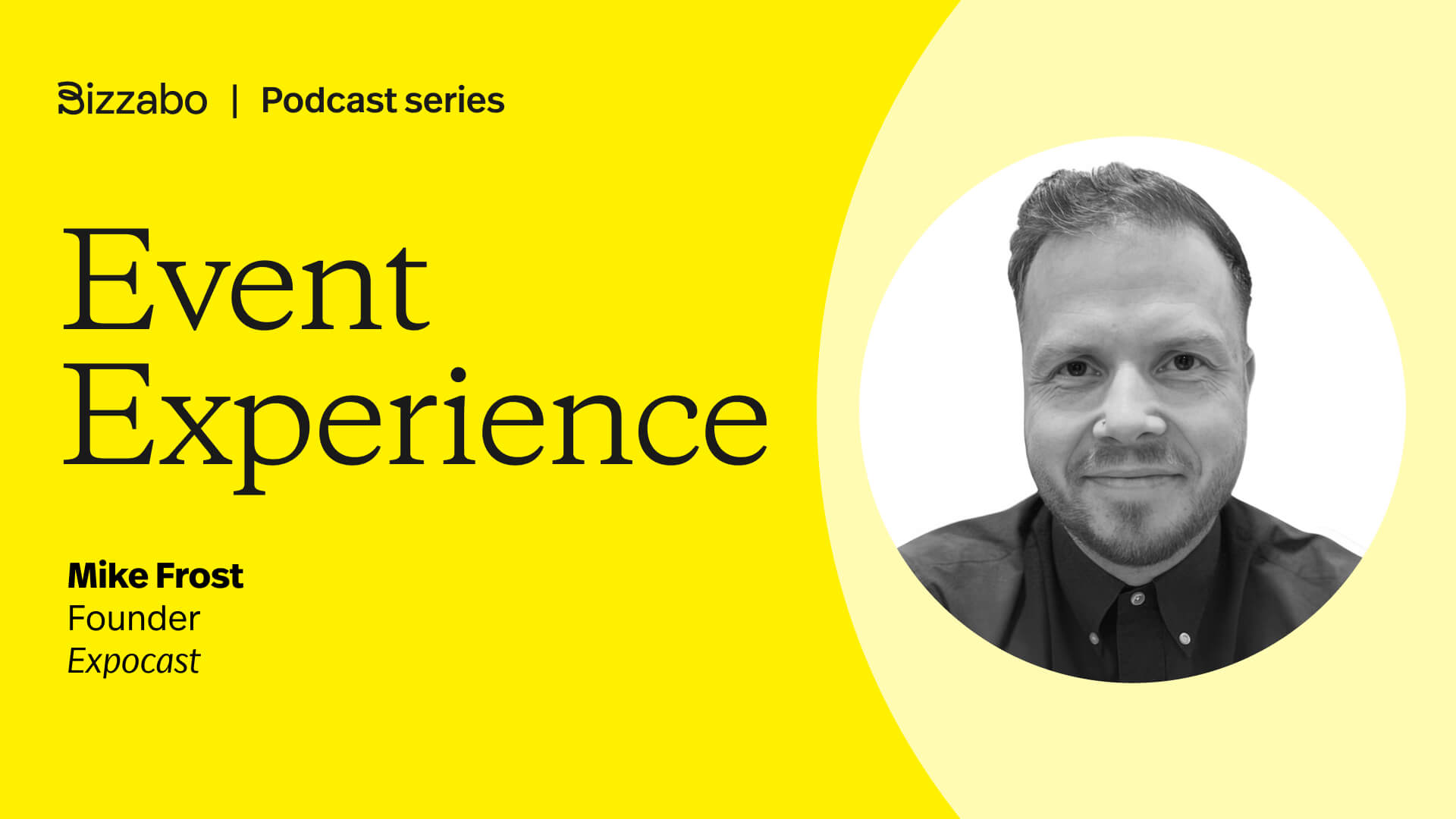
This episode of Event Experience by Bizzabo, hosted by Rachel Moore, features a conversation with Mike Frost, founder of Expocast. Together, they discuss the challenges and opportunities in the recruitment sector of the events industry, particularly post-pandemic, focus on the importance of networking and strategies for job seekers, and reveal the current state of recruitment. Mike also covers the complexity of networking as an event professional and tips for making CVs and interviews more effective.
Mike is the Founder of Expocast, a globally recognised leader in recruitment excellence for the events industry. He has orchestrated the moves of CEOs, MDs, Directors, Managers and Executives into event companies across Europe, Asia, North America, Africa and Australia.
Here’s what you’ll hear about in this conversation:
[00:00:00] Rachel Moore: Welcome to Event Experience by Bizzabo, the podcast where we bring the best and brightest event experience leaders together to share stories, tips, and lessons learned from creating some of the world's biggest events. I'm Rachel Moore, your podcast host.
[00:00:24] Every listener of this podcast can be proud of their own vast event experience. So it's often only a question of what business or brand event profs are building experiences for. In this convo with Mike Frost, founder of Expocast, we'll discuss the challenges and opportunities in the recruitment sector of the events industry, particularly in the wake of the pandemic and the "return to normal."
[00:00:48] Mike is about to share insights on the current state of recruitment, the importance of networking, even for the people who have the most face time opportunities, and strategies for job seekers. [00:01:00] We hear about Event Experience, now it's time to be able to show off our Event Experience for that next gig.
[00:01:05] Let's get started.
[00:01:12] Rachel Moore: Today's guest is no stranger to talent. Not only has he been dialed into recruitment in the events industry, but apparently he's a drummer, which is pretty cool. From founding a recruitment agency during the first days of a global pandemic, who doesn't want to do that, that effectively shuttered events worldwide, to sitting across from microphones for me today.
[00:01:33] Rachel Moore: He's a trade show tactician and the founder of Expocast. I'm pleased to welcome Mike Frost to the podcast. Mike, thanks for joining me on event experience.
[00:01:42] Mike Frost: Thank you, Rachel. Thank you so much for having me. "Trade show tactician." That's added to my profile, so that's brilliant. So yeah, look, thank you so much for having me. I am, as you say, founder of Expocast. We work with event companies around the world, finding the right people to join their teams and generally just [00:02:00] fighting the good fight for the events industry.
[00:02:02] Rachel Moore: It's been a fight.
[00:02:03] Mike Frost: Yeah, yeah.
[00:02:04] Rachel Moore: Yeah. Yeah. Yeah. Um, well, let, let me get to some, uh,we're going to segue into some get to know you questions. Let's imagine that if you have to spend a whole day on the ground at an event, what are your go-to shoes you're going to be wearing?
[00:02:18] Mike Frost: That's a great great question. So I'll be truthful. I went like overly professional to events for my first few years. I was wearing proper formal shoes and my feet would kill by the end. It's amazing the difference having your own business can have on how you feel about the way that you look.
[00:02:35] Mike Frost: So I went, I went back to just classic vans that I wore since I was in the band, right? They just, they always fit. They're comfortable. My feet are used to them after like literally 20 years of wearing them. Although the last pair that I bought just blistered me up. I was very annoyed, very, so disappointed.
[00:02:53] Mike Frost: Um, so the last couple of shows I switched to some Converse, but, but yeah, Vans or Converse. Which are probably not [00:03:00] actually the best really for a shared load of walking, but I'm comfortable with them. So that's okay. So there you go. Yeah.
[00:03:05] Rachel Moore: I'm a Converse gal myself, so. So I can definitely appreciate that. Is there a particular social post or a piece of media or a hot take about events that you found interesting lately?
[00:03:15] Mike Frost: Good question. So events are such an old format that like most sort of like hot takes, as you might put it, they don't really tend to necessarily stand the test of time. It's what I find, anyway.
[00:03:28] Mike Frost: I'm enjoying posts that challenge parts of the events experience that are just really painful for attendees in particular, making planners really think about why are we doing things the way that we are doing them?
[00:03:40] Mike Frost: Because everyone's talking about being customer centric these days, yet there are still a few certain areas that just don't work. Like overly long registration forms, which they're like, Oh, well, you know, we're gathering data to make it, you know, the best as possible. Don't do it at the reg form.
[00:03:57] Mike Frost: Or, you know, just like really long [00:04:00] queues still outside of events, you know, that. The check in tech is so advanced these days, there's no excuse. Just get more kiosks for a start, like get people in the whole point of people going to an event is that they actually get inside the event. So make that happen quicker.
[00:04:18] Mike Frost: Like take Tamar from Leaning In, her stuff's brilliant. I would highly recommend anybody who wants to, yeah, just read somebody calling out the events industry for stuff that they should be doing better by now. Tamar is the one for me. She's awesome.
[00:04:34] Rachel Moore: Well, and then what are you listening to, reading, or watching these days that you can't put down and it doesn't have to be about events.
[00:04:40] Mike Frost: Good because I don't think any of it is to be fair.
[00:04:44] Rachel Moore: Good.
[00:04:45] Mike Frost: So I'm, I've started watching through Always Sunny in Philadelphia again. It's only my second time going around it. I think it's replaced Brooklyn Nine Nine as my safety show. Like I'm one of those people where like, if I'm going to watch something, but I'm just completely [00:05:00] exhausted, I don't want to watch something where. I don't know what's going to happen.
[00:05:03] Mike Frost: I like that familiarity, right? Of just being like, "Oh, this is entertaining. I know what's going to happen. I've got two young kids. If I get distracted, that's fine. I can come back and I haven't lost my place." So yeah, Always Sunny is doing it for me at the moment.
[00:05:16] Mike Frost: Reading wise, I don't, I'm not really a fiction guy. So I tend to read business books. There's a guy called Daniel Priestly, who's got like four or five books out. They're really, really good, particularly for entrepreneurs. If there's anyone listening who runs their own business, Daniel Priestly is, he's just really succinct at how he is, you'll ask him a question.
[00:05:36] Mike Frost: I was on a Q& A with him yesterday and people just ask him questions and he just blows their mind within like three sentences just because he just thinks about things completely differently.
[00:05:45] Mike Frost: And then yeah, music wise, obviously being in a band, I would say a heavier, like, punk band that I was in. So that tends to be the genre I lean to. There's a band called Stray From The Path I've just gone into recently. I'm enjoying a lot. But yeah, it varies a lot.
[00:05:59] Rachel Moore: Nice. [00:06:00] Well, I trust your judgment on that. I am not the music person. Like seriously, I'm my, my Spotify queue is all like eighties, nineties songs and some mixed in with some.
[00:06:07] Mike Frost: I mean, you've, you've got a guitar in the background there.
[00:06:10] Rachel Moore: Yeah, I know through, and when I say I know three chords, like I use the word, no, very liberally. I used to just say that it was a cosmetic guitar. So I feel like I've moved along a little bit.
[00:06:20] Mike Frost: Hey, well, that's, yeah, that's a step. That's progress right? Take that. Take that every day of the week.
[00:06:24] Rachel Moore: Thank you. It seems, like, just reading your background too, I think you founded Expocast in March of 2020. Wow.
[00:06:33] Mike Frost: it was not quite the 18 months that we envisaged as business, business owners. I actually had a co-founder at the time who left the business back in January of this year. We're still very good friends, don't worry. And yeah, we'd worked at the same firm for about 3.5 years, and decided to set up ourselves. And March 2020 was the time.
[00:06:52] Mike Frost: I think we had roles for about three days, maybe, and then everything just, as you can imagine, disappeared, evaporated. [00:07:00] But it was weirdly good, I think, for us as a business to get the brand out there, because we just had an opportunity to take part in all of the industry conversations that were happening.
[00:07:11] Mike Frost: Nobody could run shows, we can recruit, And all of the, I guess, industry institutions were trying to do everything that they could to help the industry recover and survive as best as possible. There were loads of independent initiatives that took place. So we just tried to get involved with as many of those as possible.
[00:07:30] Mike Frost: So in a bizarre way, it helped with the awareness of this new recruitment brand that was out there, but, uh, it didn't help so much on the bank balance side of things for the first year or so. Yeah.
[00:07:40] Rachel Moore: Yeah. I, people could probably hear me laughing, but it's only in hindsight. It's like, "We can laugh now." But at the time, "Ah!"Which segues nicely into our first question. So I want to acknowledge the elephant in the room, which may not be much.
[00:07:54] Rachel Moore: Everybody's like, "Yeah, we all know it's there." That is that working in the events industry over what one could [00:08:00] generously call a very bumpy last couple of years or last handful of years. First off, uh, I'd love to get your read on, we all see the meme as, you know, how it started, how it's going, um, you know, how's it going?
[00:08:11] Mike Frost: How are things going for recruitment in the events industry right now? March 2020 very down, uh, talking to memes. I'm reminded of the cartoon dog surrounded by fire. Just saying. Everything's fine. Not so great. And then 2022 was the real recovery for recruitment within the industry. So that was, I would say what you'd call a good year.
[00:08:34] Mike Frost: 2023, it leveled off actually really, because most companies had managed to back their headcount to what they needed it to be, for the level of recovery that they were at. And this year has actually been not so great for recruitment, but not specifically for the events industry. The entire recruitment industry is kind of hurting a bit.
[00:08:55] Mike Frost: I'm in various communities and everybody's saying it's the worst that they've ever [00:09:00] seen. So it's, uh, it's some consolation. I think to know that it's not just me that hasn't had an absolute ban a year,
[00:09:07] Mike Frost: But that doesn't mean that getting a job in events or hiring people in events is tricky.
[00:09:13] Mike Frost: There tend to be trends of businesses investing in internal talent teams, which I think has happened quite a lot over the last couple of years, because recruitment consultancies like me can make quite a big dent into a budget. If you've got a lot of vacancies to fill over the course of a year. So that has had an impact, but there are obviously particularly on the tech side of things that have, we've seen several rounds of redundancies over the last couple of years as well.
[00:09:40] Mike Frost: So I think along with the tech supplies, it's been a bit of a challenging period. So how is it going? Mixed, I would say, but generally erring on the side of positivity, I'd much rather do that.
[00:09:51] Rachel Moore: Well, I, and I think that's part of your role, uh, speaking as someone who has been in that job seeking, particularly in the last few years, it's rough. [00:10:00] Uh, and it can definitely be a time when it's super easy to get, feel downtrodden, feel a little bit hopeless.
[00:10:06] Rachel Moore: So, by nature as a recruiter, I'm sure you've got to, "Hey, it's going to be fine. I mean, not the everything's fine, ignore the burning room around me, but more like, look, it's going to be okay." Encouragement, right?
[00:10:18] Mike Frost: Yeah, absolutely. I think it's just that bit of that's on fire. That's okay. It doesn't matter if that bit burns. Just put that bit of the fire out. Then everything. I think this is it. Focusing on the right thing. For those who were for a role for a very long time. One thing that we saw was that you'd have people applying for lots and lots of jobs.
[00:10:40] Mike Frost: And either getting no response whatsoever, or, getting an automated reply, which I think should be at the bare minimum, or, even getting through maybe a couple of interview stages, for example, and just not getting the job. What we saw was that if people are just kind of spamming that Apply Now button, it really takes a toll [00:11:00] on your mental health because you're just kind of piling up the amount of rejection that you've got to withstand.
[00:11:05] Mike Frost: Whereas being a bit more focused and intentional about what you apply for is a bit of self preservation, I would say really as a job seeker. I think it's really, really crucial to be aware of that aspect of it, because I don't think it gets talked about anywhere near enough.
[00:11:22] Rachel Moore: Agreed. Yeah, and I appreciate you bringing that up too. I mean, we talk a lot, I mentioned tactician earlier, I mentioned, you know, we, we do talk about tactics and strategy and all those things on here. But we always have to remember, I mean, if there's ever been an industry that is people focused or people based, it is the events industry. And,all of them really, but yeah, you're talking about people having to connect and stuff like that, and then also take care of themselves, which we'll get to here in a moment, too. I want to dive into that. I was going to, I was actually going to go to the location, but I think the discussion is taking us in this direction. I'll come back to that. So, regardless of whether an event professional is looking for a job or not, one might [00:12:00] assume that event profs, uh, have no trouble finding work. Because look, they're in everyone's face all the time. They have exposure to two people who are decision makers and could say, "Yes, you know, I want to hire you." Or "Yes, you know, reach out and we'll interview you."
[00:12:15] Rachel Moore: They're immersed in these events where they can network, surely, ad nauseum all the time. Why is that assumption flawed?
[00:12:22] Mike Frost: There's several reasons. I think the first one to acknowledge actually is that I think you and I potentially don't necessarily seem like it. But a bit of an exception in terms of how involved we are in the wider events industry. A lot of events people, they are siloed within the particular sector that they're running events for, or, the particular set of clients that they've got, or their corporate side. And therefore, all they know is the events from within that business.
[00:12:51] Mike Frost: I think actually the community of event professionals who have a network within the events industry with, probably the minority, I would say. It'd be [00:13:00] fascinating to see if there's any way of running the numbers. Because even when companies are members of associations, for example, you tend to only have a handful of points of contact within that company who are even aware of that membership.
[00:13:12] Mike Frost: Yes, okay. They might pay for a few tables and awards shows every now and then. But, other than that, the team members within the wider business, they just haven't got a clue, right? And they're not really that immersed in the industry overall. So I think that's a big one.
[00:13:25] Mike Frost: Second one is that, if you are at an industry event, your boss is probably there too.
[00:13:30] Mike Frost: So you don't, you gotta be a bit careful about how you're seen to be networking with your industry peers. Uh, just, yeah, I think it's probably not a bad idea to be aware of that. The other thing is, if you're on site at your own event, you're not focused on networking with the intention of getting a job somewhere else.
[00:13:50] Mike Frost: You're like, "Head down, this is the busiest period of the year or quarter or whatever." And you've just got to make sure that event happens. There's a million things that need to go right. [00:14:00] And you've got to make sure that is your sole focus. And then the last thing I would say is just because people work in the events industry, doesn't actually mean that they're extroverted and networking is a natural talent for them.
[00:14:14] Mike Frost: I'd actually consider myself an introvert. It took me a long time to learn how to make networking work for me.
[00:14:21] Mike Frost: How could I even start a conversation, keep a conversation going, it was quite unnatural for me.
[00:14:27] Mike Frost: And you might find that there's a lot of event professionals in teams or departments who don't necessarily see that customer-facing networking side of the industry at all.
[00:14:38] Mike Frost: So, there's lots of reasons why, yeah. It isn't the way that you may think it is in terms of ease and ability to find yourself a job, just through networking alone.
[00:14:50] Rachel Moore: Yeah. I thank you for saying that too. I have a feeling there's so many of our listeners out there are like, "Yes, we appreciate you acknowledging the fact that you do not have to be someone who's 'Oh, I'm [00:15:00] just going to jump on stage and do a song and dance. And that is my comfort zone.'"
[00:15:03] Mike Frost: Why do you think I was a drummer? I got to sit in the back.
[00:15:06] Rachel Moore: You see?
[00:15:06] Mike Frost: I got, I got to live out my pretend rockstar dreams, but sitting at the back of the stage, I just let my mate sing and do it, take all the attention. I just got to hit things with sticks. It was great fun.
[00:15:17] Rachel Moore: Right. Exactly. I think that's a great analogy too. Yeah. Cause it's so easy to fall into these stereotypes of like, well. And also, one thing, it just made me think of it too. So, even if you are at a trade show or a conference and you're working the event, you're doing your thing.
[00:15:32] Rachel Moore: It's very unlikely that someone who has, that has a potential saying, "Yes, I'm hiring for my team." Their headspace isn't there. They're thinking about their own team's presence and the ROI they need to bring back from that event. They're not going to be like, "Ooh, I see that person is doing an exceptional job. I should make sure I reach out to,"
[00:15:49] Mike Frost: Let me make a mental note of that. Yeah, no, it's not.
[00:15:52] Rachel Moore: Exactly.
[00:15:52] Mike Frost: I mean, look. It can happen, I think, in that way, but it would tend to be across multiple [00:16:00] events. And if you consistently, somebody who may be hiring in the future, if you consistently see the same person or people over and over again, being just generally impressive, that's going to sit with you over time. But, it's not going to be a case of, "Oh, I stumped bumped into so-and-so at this event, and actually they were really good. So actually next time we have a need for this type of job, they're the person I want to hire."
[00:16:24] Mike Frost: It just doesn't work that quickly. You need, it's marketing, I guess, isn't it? And sales, you need that multiple number of touch points for that sense of familiarity and likeability to get across to the extent where you'd think of someone's name next time you're hiring. It just doesn't happen on a one off occasion.
[00:16:44] Rachel Moore: That's right. Well, this segues beautifully into, I think something you can probably really help a ton of our listeners with, and that's networking. Recalling that our listeners are those same event profs that everyone assumes must be just fantastic at networking. [00:17:00] No, maybe not. It's not just this inherent, "Oh, if you're an event professional, obviously you're great at networking."
[00:17:05] Rachel Moore: Maybe not, and probably not. So, please, uh, enlighten us, uh, educate us. What is your advice on how an event professional can effectively network?
[00:17:15] Mike Frost: Yes, so as I said, I'm not a natural networker myself. So, it's A. Ease yourself in. Don't just think, right? "I don't know what I'm doing, but next time I go to an event, I'm going to be the best networker in the room." Don't rely on serendipity. It's not going to just happen. Some of the best conversations do happen completely by chance.
[00:17:35] Mike Frost: But being much more intentional, you're increasing the chances of one of those conversations you have, turning into an organic series of relationships that might then result in some kind of career advancement. Including people that you already know, with your plans to network. If there's perhaps somebody whose company you would [00:18:00] love to work for, and you have a friend in the industry who knows them already, just say, "Hey, look. If this person's at the next show that we're at, could you just introduce me? No strings attached, I just want to make my face and name known to them." and that's it. Just keep it really, zero pressure, right? On yourself, as well as the other person who you're asking to make the introduction.
[00:18:22] Mike Frost: Just don't have any expectations about what's going to happen because that, we're human beings, right? Events is a people industry. Recruitment is a people industry. It's never a straight line. So just don't, expect that any one conversation is something you can predict the outcome of. And then I would also just say, don't only talk shop. Yes, we're events people. We love the industry. We want to talk about it. But if you're going to develop that likability and that familiarity and that memorability within the other person, try and weave something a bit more personal into the conversation.
[00:18:59] Mike Frost: Like, [00:19:00] "What, you were a drummer for 10 years? Me too." That's like one of my, um,friends who I see at every single event, industry event, he's similarly got a ginger beard, much more impressive than mine. He was in a band. He was the singer. We were on the exact same scene at the exact same time. It's a miracle that we never played at the same gig.
[00:19:18] Mike Frost: Like we've both got sons called Reuben, named after a band called Reuben, who are on the same music scene as us wicked band, by the way, you should definitely check them out. So,he and I have a much, much stronger relationship because we found something in common and it doesn't have to be that crazy coincidence. But, when you're networking,especially if you've got like career in the back of your head, don't just think to yourself, "Right. I need to keep like, proving my value as an events professional to this person. I've got to make sure I come across really professional so that they think of me,” just have as organic a conversation as you have. Allow it to move into personal stuff, as long as you feel [00:20:00] comfortable doing that. Because then you'll find those things you've got in common. And again, that just makes you that much more memorable.
[00:20:06] Rachel Moore: I love that advice too, because you're right. You can come off very salesy. And all of us love when people approach us with that sales tactic kind of, "Yes, obviously. I, the radar is instantly up. What do you want from me?
[00:20:19] Rachel Moore: But instead, and I think about "I went to Event Tech Live earlier this year and just being in line for getting a snack."
[00:20:27] Rachel Moore: And, everybody can like, yeah, hungry. Right? I mean, there's those common denominators. whether food, current events. Sometimes you can kind of be careful, like which ones you bring up. But I mean, any of those things are even just, "Oh God, it's cold in here. It's hot in here." Or whatever.
[00:20:42] Rachel Moore: But it's surprising, like how easy it is sometimes just, test the waters right there and then the person either picks it up, or they're like, "Nah, I'm not going there." and then you're like, great. Move on to the next.
[00:20:52] Rachel Moore: one. And it's
[00:20:52] Mike Frost: This
[00:20:52] Rachel Moore: This
[00:20:52] Mike Frost: is it. I'm British. I think basically most conversations in Britain kick off with the weather. Uh, we're never [00:21:00] It's like it's either too cold and wet and windy or, the one day of hot weather that we've been crying out for for 12 months hits and then all of a sudden, that's too hot. a little bit cooler. We find a healthy balance, which never happens.
[00:21:12] Mike Frost: But yeah, you're absolutely right. Some sort of just, throw away icebreaker. Right? That allows them to engage if they want to, basically. And
[00:21:20] Mike Frost: yeah, don't take it to heart if that doesn't happen. You've still had that first touch point with that person and there'll be another event in the future or, you know, another line for coffee where you can bump into them again. Right?
[00:21:34] Rachel Moore: That's right. Well, that all kind of brings up like one, one great thing. Everybody always likes talking about where they're from, and like what they love about it. Oh, they're traveled to get there. Or traveled that they're facing to get home. Which, which actually brings up, I'm assuming probably figures into this.
[00:21:48] Rachel Moore: Speaking of things that have gone very topsy turvy in the space of just a few short years, you know, we've gone from in person to completely virtual by necessity, and then by choice. And, [00:22:00] then we're back to hybrid or in person and often virtual. Can you speak to how location impacts the career of an event professional today?
[00:22:09] Mike Frost: Yeah, sure. And obviously we're, we're talking about um, work environments here in terms of going completely virtual and then hybrid and back to the office. So it depends massively on the nature of the role and the company.
[00:22:24] Mike Frost: So on the tech side, I don't think fully remote was particularly uncommon before the pandemic anyway. Whereas on the organizer side, everybody was just in the office all the time. You might've had the occasional small business who were able to offer a bit more hybrid. So, yeah, the vast majority of organizers now are hybrid. There's like one or two trying to cling to the full day, yeah, full five weeks, five days a week in the office.
[00:22:52] Mike Frost: I just saw something earlier today that Amazon have gone back kicking in January 2025. So they've given people what, like three and a half [00:23:00] months to essentially make sure they are in a commutable distance within the 5 days. I think it's crazy.
[00:23:06] Mike Frost: But I think there are going to be a lot of companies who off the back of that go, well, hey, if Amazon are doing it, we'll do it too. My answer to this question may change in like two and a half, three months time, right?
[00:23:20] Rachel Moore: We’ll have you back on and talk about what's going now?
[00:23:23] Mike Frost: Yeah.
[00:23:24] Mike Frost: I'm just just lining up my next guest spot. There we go. But yeah, look, you know, doing hybrid is vastly different from doing full time in the office. You can swallow a slightly longer commute if you're only doing it two or three days a week than compared to doing a five.
[00:23:39] Mike Frost: I would say in terms of the organizer, the event planner side, it's the small businesses who are perhaps not located near those main hubs who have ventured more into remote. You know, we've got a client in Canada who have hired people remotely in the [00:24:00] UK, in the Middle East to work for them.
[00:24:01] Mike Frost: We've had an inquiry from a company based in like, I think they were Worcester here in the UK, which is not really near enough to any main cities where you might find a large enough candidate pool with events experience. So they were like, that's fine. Just need someone with the right experience. It doesn't matter where they are in the UK. We'll make it work.
[00:24:22] Mike Frost: And they were a very small business. So they, I guess you'd call it a lifestyle business as well. So they couldn't necessarily afford to completely relocate where they were, to some way that would attract more talent. They just needed to make sure that their infrastructure was set up to be able to have people work, uh, on a remote basis.
[00:24:38] Mike Frost: So, location does impact your career. I don't think we've seen the end of it fluctuating like Amazon news. Yeah, we'll see how it works. You know, there has been some reduction in terms of flexibility from some of the companies offering hybrid. You know, you did have what I would call [00:25:00] flexible working, as opposed to hybrid.
[00:25:02] Mike Frost: Hybrid is probably, to me, set days of the week that you come in, you know, set start and end times. Whereas flexible is you have to be in like a set number of days per week, but you choose what they are and you've got like, you can flex your start time and end times, which is super useful for things like childcare and appointments and all sorts of things.
[00:25:21] Mike Frost: We have seen a few companies reduce the coming down from flexible down to hybrid. Which technically is the same number of days in the office, but there's way less flexibility.
[00:26:07] Rachel Moore: You know, we're talking a lot about things that eventprofs can't control. They can't control if a company is going to be in person, hybrid, what have you.
[00:26:14] Rachel Moore: Some of the things they can control, and we're getting into CVs and interviews. Would love to kind of hear, what is your advice? What's your advice for our listeners as far as like, and again, in an environment where it is a little bit hard even just to get that first interview and stuff. What's your advice for prepping your CV and making sure this one's going to stand out regardless of how many applicants and also what ATS or applicant tracking system is, happens to be bringing in that TV. What's your advice?
[00:26:45] Mike Frost: Uh, yeah, and I try and give this advice to everybody that I speak to when I'm screening candidates and I've got either if I've got their CV already, I'm giving them feedback, or if they haven't updated it yet and they're going to send it to me. I'm kind of giving them these tips [00:27:00] before they send it to me to make sure it's kind of going to have the best shot possible.
[00:27:04] Mike Frost: And I do think, this isn't supposed to be self promotion, but I do think having a recruiter to advocate for you is a massive advantage over applying directly just through an online advert. But that's not your question.
[00:27:18] Mike Frost: So for CVs, keep it factual. It massively varies on the reader and you don't know who's going to be reading it. You haven't got a clue. So I would just make sure it is genuine to you and your experience.
[00:27:31] Mike Frost: So when I say factual, that is going to vary depending on the type of event professional you are and what department you're in. So it could just be names of the events, the sizes of the budgets. It could be if you're a salesperson, what you delivered in sales versus your target has to be contextual.
[00:27:49] Mike Frost: Number of visitors, what venues you've worked out of, which softwares and CRMs you've used. Cause like you say, their CV, it might be the 100th CV read by that [00:28:00] person that day. So another thing to do is make sure that all of that factual stuff just really jumps off the page.
[00:28:07] Mike Frost: Try not to have, I guess, any vague stuff on that first page. Cause you can't guarantee they're even going to scroll down. If you've got half a page of just personal profile and skills like in a table and bullet points, they're like they're already sighing by the time they're using their finger to scroll down. The finger that is exhausted from scrolling down 99 other CVS.
[00:28:33] Mike Frost: So get straight to the good stuff. Just highlight in bold those numbers so that they just jump off the page. It's really simple, but it works.
[00:28:42] Mike Frost: Those are my favorite CVs to come across to the ones where I'm just scrolling down the page and in bold, there's numbers and percentages and the names of shows and companies that I just recognize all of those things straight away and immediately my interest is peaked. This person is [00:29:00] highlighting all of the information that I'm looking for. I don't, I'm not having to work to try and find it. They have done that work for me by making it really, really visible.
[00:29:08] Mike Frost: So that would be the number one advice for CVS.
[00:29:11] Mike Frost: For interviews, I think for me, research, which is way more than just reading a job description. You're well within your rights to ask for the questions in advance, which is especially helpful for neurodivergent people who will benefit from just having as much context as possible going into something.
[00:29:30] Mike Frost: Because not everybody is naturally equipped, I think, to be able to answer stuff on the spot. I think not everyone necessarily is aware of that as a reasonable adjustment for interviews. So you might find that some companies may push back and say, no, we're not going to give you the questions in advance. Some companies might not have the answers. They might just be winging it.
[00:29:53] Mike Frost: Like, this is another thing with interviews. Don't it's just because somebody's interviewing you, doesn't mean they know how to interview. They might just be a [00:30:00] hiring manager who's got, okay, there's a space on my team, I'll go and interview someone and, you know, ask them questions the way I think I should. And they've never really had any training.
[00:30:09] Mike Frost: So yeah, keep bear in mind that your interviewer doesn't necessarily have any expertise coming into this conversation. But yeah, absolutely. You can ask questions in advance, try and what, and one of those questions as well to ask is who am I being interviewed by?
[00:30:28] Mike Frost: And then like, don't stalk anyone, but do look at their LinkedIn profiles. Again, like we were talking about with the networking is trying to find things you've got in common. Because it will just help you to stand out from anybody else that they're interviewing.
[00:30:42] Mike Frost: So if you've got things in common, like you can again, don't stalk anybody, but you can go on this if you can find them on like the more social, social media profiles rather than LinkedIn, you know, your Instagrams or Facebooks or whatever.
[00:30:55] Mike Frost: If they've got anything that resonates with you, bring up your [00:31:00] experience and your like of that thing in the interview and hopefully they'll chime in and say, Oh, Hey, me too. Brilliant.
[00:31:06] Mike Frost: And yeah, it's okay. It's a plan. I wouldn't say it's deceptive, but it's a plan, right? It will just paint you in that slightly brighter light throughout that interview process.
[00:31:17] Mike Frost: And I do shameful plug, but it's, it's free, right? I have a free mini course that runs through all of this stuff. So the CV stuff, the interview stuff, the networking, standing out, there's a whole chunk on LinkedIn as well. That is available on the website, but I have a feeling you might give me a chance to properly plug that at the end.
[00:31:35] Rachel Moore: I absolutely will. Well, and just like you just said, you use what you can to your advantage right? Whether it is a free course, uh, hell heck, yeah, I'm going to take a free course. Or, you know, like you said, finding whatever public information, like if you know who's interviewing you, go and just like, check them out and see if you can find them.
[00:31:54] Rachel Moore: And if you just find that commonality and like you said, it's just peppering yourself in there, which is good marketing. Like you mentioned [00:32:00] that before you're marketing yourself, even though that might not feel like it, it absolutely is. And all you're trying to do is make sure you're standing out amongst the rest of the fray.
[00:32:10] Rachel Moore: Like you said, if that is, if you're that hundredth CV that they've read that day, and you're able to then get an interview. And then again, still kind of stand out and they remember you because fill in the blank. That can make the difference.
[00:32:24] Mike Frost: Yeah, and I would say actually, in terms of looking up your interviewers, it's not just about trying to find something in common and understanding more about them. The reason you feel nervous going into an interview is because you don't really know what to expect.
[00:32:41] Mike Frost: You know, yes, you've got an investment in the outcome of this conversation. But just seeing that person's face on a profile picture on LinkedIn, that removes a certain level of, I don't know what to expect because you know what the face of the person you're walking into the room looks like.
[00:32:59] Mike Frost: The [00:33:00] more unknowns you can remove by doing your research ahead of an interview, the more your nerves will be calmed going in, and then you can just concentrate on the important stuff, essentially.
[00:33:10] Mike Frost: You know, don't just type in if it's an in person interview, don't just type in the addresses on Google maps, say, okay, it's going to take me 45 minutes to get there. I'll give myself an hour and a quarter and head off. Like, do the Google street view, know what the front of the building looks like, you know. It's simple things like that. They're just, it's familiarity, you know.
[00:33:30] Mike Frost: Cause if I didn't do that, I'd be sitting on the train. I'd just be thinking, right. Okay. Well, I know, this is the next bit of my journey, but then I'm just following the blue line on Google maps and walking to the office. I don't know what the building looks like. What if I can't recognize the building?
[00:33:43] Mike Frost: Just looking these things up helps make sure that your nerves are focused on the bit that it should be focused on, which is presenting yourself in the best possible way during the interview.
[00:33:54] Rachel Moore: As someone who once, many, many, many years ago, so maybe hopefully the Maps are better. I [00:34:00] used Google Maps and the Google Maps took me to the shipping docks of the building, and I was five minutes late for my interview.
[00:34:06] Rachel Moore: I think I still got the job amazingly. My phone even went off during the interview, which was hilarious and I was like, there's no way. And then I got, okay, you know. Hey, sometimes the stars can align.
[00:34:16] Rachel Moore: Final question. Easiest question. Where can our listeners find and follow you online?
[00:34:21] Mike Frost: I mean, LinkedIn is pretty much the only online place I hang out every now and then, like six months or so I'll try Instagram again and it just doesn't stick. You have like a week of posts from me. And then I disappear again for another six months. So yeah, LinkedIn, LinkedIn is the social place.
[00:34:38] Mike Frost: And then obviously, yeah, the website is https://Expocast.co.uk/. Email is [email protected]. And everything's on there really.
[00:34:47] Mike Frost: The free course, I mean, you talked about for, companies and hiring managers. I do have a free assessment on there of their talent attraction. It's like a mini audit. And it's just [00:35:00] answer a bunch of questions and it would give them a score and tell them how good or bad they are and what they could do to improve.
[00:35:06] Mike Frost: So yeah, that's quite, that's quite a funky thing to have on there too.
[00:35:09] Rachel Moore: Well, we love the funky. Let's do it. All right. Well, thank you so much. much.
[00:35:22] Rachel Moore: To skill up your career journey, Mike expands on the power of mentors.
[00:35:27] Mike Frost: One major piece of advice. Finding a mentor is huge and I talk about this a bit in the course. It's a huge advantage. Because, you know, ideally you would find somebody who is one or two steps ahead of you on the exact career path that you would like to take.
[00:35:45] Mike Frost: Or even if you don't know what career path you want to take, someone who was doing your job a year or two ago. Because then their experience in what you're going through now is recent enough that it's going to be accurate. Because stuff changes, right?
[00:35:58] Mike Frost: You know, if you're a marketing [00:36:00] person and you get your mentor who was doing your job 20 years ago, they looked very, very different. So, those types of relationships you can learn so much from somebody's lived experience in that job. And it might not just be what they did right. You're learning from what they got wrong as well.
[00:36:18] Mike Frost: Sometimes those are the better lessons, really the things that people got wrong. There are some formalized events mentorship programs out there. But I think most tend to just happen organically, whether it is, you know, one of these conversations that we've talked about at events. Where you just end up getting on with somebody and it's almost you, it's not like, you ever have to necessarily really have that conversation of please, would you be my mentor?
[00:36:44] Mike Frost: Um, it's just, yeah, it just happens. You just, you know, I've got, I've got a guy, I chat to every couple of weeks on zoom. He's been, you know, very senior in the events industry on the organizer side. And we just chat every two weeks. And sometimes it's me helping him on [00:37:00] the career side of things.
[00:37:00] Mike Frost: Sometimes it's him helping me with, you know, trying to be a business owner, having launched in a pandemic. It's a two way street, right? You know, even if you would consider yourself the mentee and the other person is the mentor, that doesn't mean they can't learn from you as well. You know, it's very much a two way street.
[00:37:17] Mike Frost: So if you're asking me for one major piece of advice, I would say that. Yeah, try and find someone who has been where you are and can help you make the right decisions.
[00:37:29] Rachel Moore: Thanks again to Mike Frost for joining us on Event Experience. And thank you for listening. If you're enjoying the show, we'd love to hear it. Connect with us on social, and subscribe, rate, and review us wherever you're listening. Also, don't forget to share the show with your colleagues and friends. You can find transcripts of each episode and key takeaways on bizzabo.com/podcast. On behalf of the team, thank you. We'll gather again soon for a new episode of Event Experience.


