
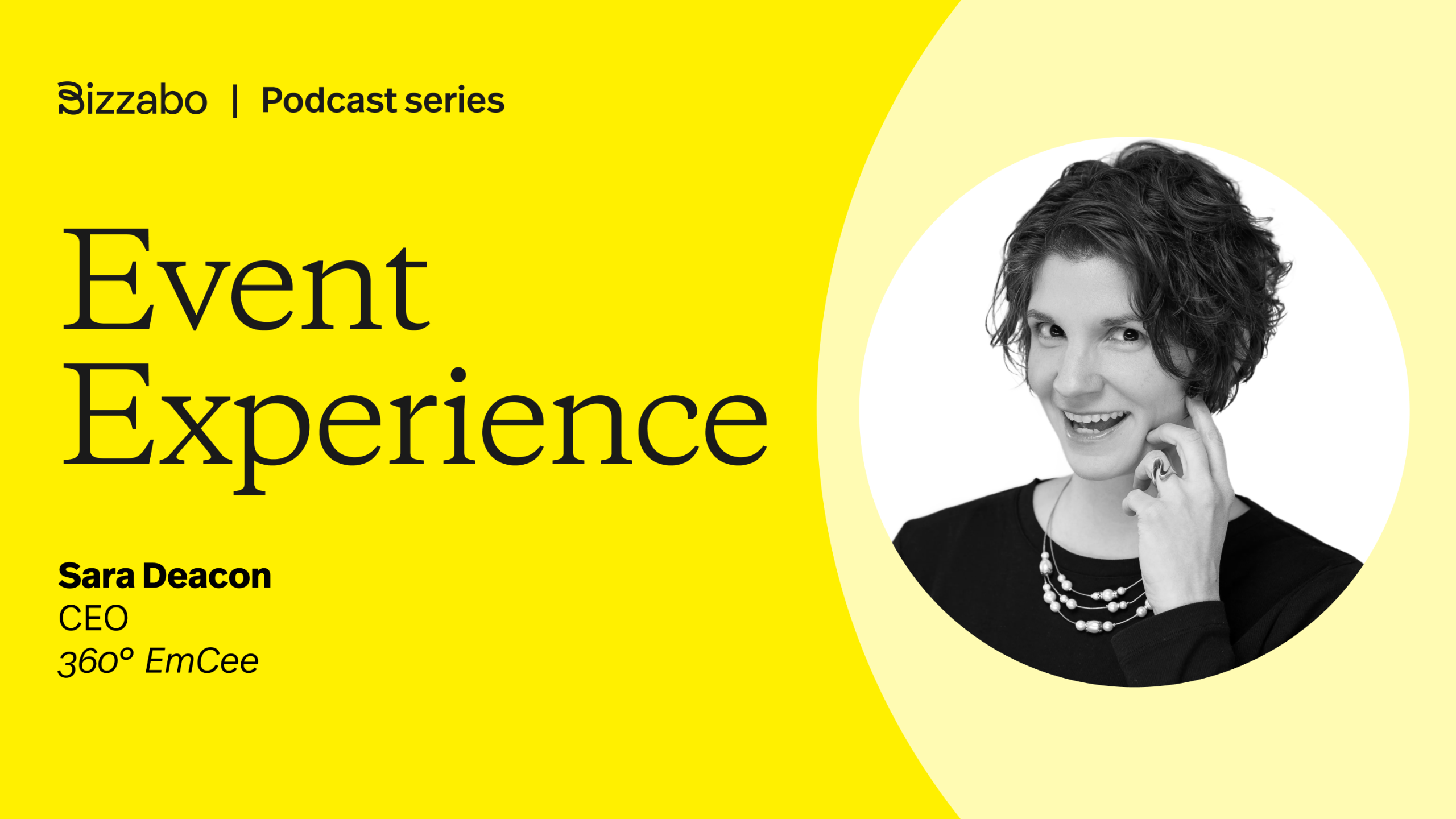
In this episode of Event Experience by Bizzabo, host Rachel Moore sits down with Sara Deacon, experienced emcee and CEO of 360 Degree Emcee, to explore the often-misunderstood role of an emcee in delivering standout event experiences.
Sara shares her unconventional journey from martial arts coaching to event facilitation, revealing how skills like presence, adaptability, and connection translate directly to the stage. She explains why emceeing is fundamentally different from keynote speaking or panel moderation, and why reading the room is one of the most critical (and undervalued) skills in live events.
The conversation goes beyond scripts and stage cues, diving into the emcee’s full-circle role: collaborating with planners, managing audience energy, supporting speakers, and adapting in real time when things don’t go as planned. Sara also offers practical guidance for event planners on how to hire and work effectively with emcees, outlining the tangible value they bring in boosting engagement, reinforcing event goals, and even increasing event ROI.
Through real-world examples, Sara illustrates how authentic connection and in-the-moment decision-making can transform an event from good to unforgettable. The episode wraps with actionable advice for planners to prioritize audience connection and invest in skilled emcees who can elevate the entire event experience.

Speaker: Welcome to Event Experience by Bizzabo, the podcast where we bring the best and brightest event experience leaders together to share stories, tips, and lessons learned from creating some of the world's biggest events. I'm Rachel Moore, your podcast host.
Speaker: Get ready to put the master into the term master of ceremonies as we're about to hear from Sara Deacon, an experienced Emcee and event facilitator of 360 degree Emcee. Sara is about to enlighten us on the vital role of an Emcee in creating successful event experiences, the importance of connection, and how to read the room effectively, know the difference between a keynote speaker and an Emcee, and how to hire the best for both for your next event experience.
Rachel Moore: [00:01:00] Welcome back everyone to Event Experience by Bizzabo. I am your host Rachel Moore of course. And I always like to tell you all who we are welcoming onto the podcast. Today's guest is no stranger to the stage.
Rachel Moore: In fact, she'll help take the strangeness out of any event stage. She has a background in event operations and publishing for When Stories Media Group as well as, and I'm super interested in this 'cause I have a little bit of this myself, not the coaching part. She has been a coach in karate as well as life, so I love who we're talking to today, and she's also today the CEO of 360 Degree Emcee.
Rachel Moore: I am thrilled to welcome Sara Deacon to the podcast. Sara, thanks for joining us today.
Sara Deacon: You're welcome Rachel. Thank you so much for having me.
Rachel Moore: It's great to have you. And I will get into like some of the personal stuff too, but yeah, I took karate back in my youth and so, to this day I can still do a high kick and so I, I, I thank it for my flexibility that I still have at the ripe age of 50, but I just love that was part of your background and I know it's just a small part.
Rachel Moore: But speaking of [00:02:00] which I barely like was able, in two sentences told people about who you are. I would love to give you the opportunity to do that today. So let me toss it back over to you. Can you tell us more about yourself, your current role, title, brand, kind of what's your world like right now?
Sara Deacon: Oh, my world is exploding all over the place. Uh, You mentioned the karate. I actually came to the martial arts when I was 39 years old, so I, I didn't do it as a kid. My kids were doing it, so I jumped on the bandwagon with them 'cause we were all there all the time. Anyway, I have three sons. So, all the four of us are black belts.
Sara Deacon: And my husband, I, yeah, my husband I think made it to green. He didn't make it quite as far. But yeah, that really informed a lot of what I was doing with the various iterations of business that I've tried. As an entrepreneur, I was working with families, postpartum, you know, working with newborns and babies.
Sara Deacon: And then, I did some coaching for some, you know, just, [00:03:00] yeah, general life. I was doing some support for teens and young adults and their parents a few years ago. And as I evolved in that business, I realized that when I would speak to promote my coaching business, that's where I felt most alive. And I know a lot of people, and you probably are familiar with this too, most people would rather die than take a microphone and talk in front of people.
Rachel Moore: Yes
Sara Deacon: Um, not me. I have always been a little bit of a performer and as I was doing more of that speaking, I started saying yes to some different opportunities, which is how I landed at When Stories with Wendy Babcock.
Sara Deacon: I did one of the events that she was doing, she does a three day conference every year and she was doing everything herself. The first one I attended and I saw it and I'm like, she needs somebody. She needs somebody to help facilitate, orchestrate. Somebody to allow her to [00:04:00] relax a little bit and actually enjoy what she was building and putting together.
Sara Deacon: And the partnership with Wendy really blossomed from there. I offered to Emcee her next event and she was all in. She said, I felt this huge weight lift off my shoulders when you asked me that. And I did the event. And again, it was one of those AHA moments where every fiber of my being stepping on that stage.
Sara Deacon: You know, interacting with the audience, connecting with the people in the room and holding that space, it just lit me up. So that is how I became a 360 Degree Emcee, because it wasn't just those moments on stage that fulfilled me. It was the collaboration before and after and throughout the process that and that's why I'd call it the 360 Degree Emcee, because it's not just showing up, grabbing a microphone. It is a full circle collaboration from start to finish.
Sara Deacon: And I see myself as a, I don't know, like [00:05:00] a cheerleader supporter. I get all in on the causes and goals and missions of the people that I work with for events, so.
Rachel Moore: I love that. I was actually too, thinking like I was thinking very literally of 360 Degrees, like theater in the round. If anyone's ever been to something like that where you're like, you know, there's a stage in the middle and there's chairs like literally all around surrounding kinda like an arena and stuff. But
Sara Deacon: Oh yeah. And your eyes have to be everywhere when you're on a stage. I mean, and as a Emcee, it's my job to make sure everything goes smoothly and that nobody ever knows if anything are a little bumpy and wiggly in the background.
Rachel Moore: I love the bumpy and the wiggly. We'll def we're definitely gonna dig into all that stuff. Let's start though with some get to know you questions just to get everybody warmed up to you here. All right, so, I would imagine you've had some days where you are gonna be on your feet all day. And every event planner listening to this is like aha.
Rachel Moore: Yeah. That's part of my world is you're just having those 12 to 14 hour days or longer where you're just on your feet all day. What are your [00:06:00] go-to on the ground, event day shoes that you like to wear?
Sara Deacon: I don't buy any shoes besides zero brand shoes now. I am a fan of the Barefoot Style Rise, so it's xeroshoes.com. So free publicity for them, but I bought a pair of sneakers from them a few years, like probably more than a few years ago. They're pretty beat up now, but I still wear them. Not on stage, but you know, out and about.
Sara Deacon: But they have boots, they have cute little Mary Jane styles. They have all sorts of different styles, and they're all that barefoot style. They're super comfortable for me. I have wide feet, I have bunions, I need comfort. And the fact that they make some really cute styles too is amazing. I have this pair of gray boots that I just love right now that I wear on, on my stages.
Sara Deacon: Yeah.
Rachel Moore: Nice. I can relate. I actually had a [00:07:00] bunion at one point too that I had removed. We named it Paul before it got evicted, but yeah absolutely.
Sara Deacon: I had surgery on one of 'em. The other one's still hanging around, but
Rachel Moore: At that point, you're like, you know, I'm just gonna wear comfortable shoes. It'll be fine but I love that recommendation. Is there anything that you're listening to, watching or reading these days that you can't put down and it does not have to be Emcee or event related?
Sara Deacon: I have been reading the Throne of Glass Series by Sara J Mass. So I'm kind of into that genre right now for fun, but I really haven't had a ton of time to read much 'cause I am in the thick of getting our next, when stories anthology to publication right now. So I've been reading a lot of other people's stories for editing purposes and publishing purposes right now, so.
Rachel Moore: Got it. Well, those, that's definitely things you can't put down, but that's a great book recommendation too, and totally can understand. Like sometimes it's like I just wanna have time to read.
Sara Deacon: Right. And most, I really love the audio versions of those [00:08:00] books, the fantasy stuff, because it helps me picture it in my mind when somebody else is reading it to me too. So.
Rachel Moore: Totally. Is there a particular social post or a piece of media or even a hot take about events that you found interesting lately?
Sara Deacon: Yeah, I actually just a couple days ago, a post came across my feed on Facebook. It's from one of the Emcee groups that I'm in, which, you know, there's not a ton of those, but I found some, and the person was talking about how they were connecting with a potential client who was hiring an Emcee for the very first time and they really didn't understand what an Emcee brought to their event.
Sara Deacon: It says on the inquiry call, I quickly realized they had no idea what an Emcee actually brings to an event in their heads. I was basically the person who grabs the mic and says names, and they go on to say like, here's what I told 'em. I don't just get on a mic. I help you protect the investment you've made in this event by keeping your donors engaged, creating momentum [00:09:00] for giving, and making sure every part of the program builds toward your goal.
Sara Deacon: And then goes on to talk about that collaboration and the sort of full circle consultation that I mentioned bringing to an event that it's we get invested with the event, even though it may be for a brief time. I mean, I still get information from various events and fundraisers that I've done in the past, and I am liking posts.
Sara Deacon: I still interact, so I become a fan. I become a collaborator. I become this connector as much as I possibly can with an event. You know, we manage the room, we keep the energy high, we get to, to do all the things. And then in that post it was really cool because that client hired that Emcee and ended up raising four times as much money for that fundraiser.
Rachel Moore: Wow.
Sara Deacon: As they had in the past. So it really does make a big impact. And I think [00:10:00] again, it's just a lot of people just have no idea. Even like my friend Wendy, who when she initially hired me, she had no idea what it would mean to have that option at an event. And now she's like, I'm never doing another event without an Emcee.
Sara Deacon: And of course she's never doing another event without me, but
Rachel Moore: Well, and I love, thank you for answering that too, because this actually segues perfectly into what we wanna talk with you about today is is all the aspects of an Emcee and, you know, we have our audience of event planners. They might be new to their profession, they might be veterans.
Rachel Moore: But when this industry is changing all the time, the way that you know, events are put on and the types of rooms and the types of setups, and it's all changing all the time and trends change. So it's a super relevant question and topic to get into.
Rachel Moore: So let's get into that topic because the the first question I kind of wanna ask you is just something super basic, like 101 here, which you just touched on a bit, but I wanna, I'd love to give you some more room to expand [00:11:00] on it. Can you describe like, how is an Emcee, you know, you just described a bit about like what an Emcee does, like what they're responsible for and what they can mean to an event.
Rachel Moore: I mean, do you feel like it feels like sometimes people might be like, oh, it's just like a keynote speaker. That's a kind of my Emcee. It's like, maybe not. Can you describe to us how is an Emcee different from say, Hey, let me hire this keynote speaker, or a panelist on this panel. What's the difference there with what an Emcee does between what an Emcee what they do?
Sara Deacon: Yeah, the main difference as I see it, and every Emcee might have a different answer for this, but the way I see it is it's when you're a keynote speaker and I've done keynotes, like I've done workshops, I've done all sorts of different speaking, and you have your notes and you have what you're there to teach them and share, and then you share it and you're done.
Sara Deacon: An Emcee is a, it's a whole different skillset. There's give and take, there's ebb and flow, there's reading the room, there's managing [00:12:00] the energy, there's making sure that the speakers aren't putting people to sleep or scaring them, or things like that where if speakers kind of go off the rails in some sort of way it's bringing the audience back.
Sara Deacon: It's really having to react and respond in a way that a keynote doesn't necessarily have to do. And obviously if you're speaking, if you're giving a keynote presentation, there is interaction, there's connection, there's communication, there's engagement, And the Emcee has to be even more on their toes for all of that thing 'cause there's so many other factors that play in an event. Because you have multiple speakers usually and multiple activities, and there's a lot that can happen and can surprise you and to have that flexibility and ability to respond.
Rachel Moore: Yeah.
Sara Deacon: Because we can all respond but it might not be the most [00:13:00] effective response in the moment, so being able to have that, both a presence and a distance to not get flustered when things kind of go off the rails to stay calm, to communicate clearly, to be concise. There's so many factors at play. And the ability to respond and stay flexible, I think is the biggest difference with Emceeing.
Rachel Moore: Yeah. Well, you touched on this a little bit you know, in, in what you were sharing with the kind of the hot take on, or, you know, a post about it where someone came in with an assumption. I still remember I, I I actually worked in radio very briefly. There's a movie I love called Radioland Murders where it's like, you know, you've got someone who's like speaking into a microphone and they're reading off a script and you know, they're putting like their energy and effort so they don't sound like a snooze fest, obviously but it seems like, you know we can tend to make assumptions and view an Emcee as the person on stage. Like, oh, you're just a warm body reading a teleprompter for me, and I know you'll, your hair and makeup and outfit will be done. Yay. You [00:14:00] know? But you've already kind of pointed out that's a wrong assumption.
Rachel Moore: Like I'd love to ask you like, so. It really is kind of a superpower facilitating you know, all the things you're talking about. This isn't just warm body showing up on stage. Okay, I did my part and I'm off, and now I'm disengaged. Can you go into us for a little bit? Like, what does it mean to you to be like that facilitator on stage and, you know, you're taking it way beyond quote, warm body with a microphone.
Sara Deacon: And I've, I've been a warm body on stage reading a script. That's fine. Like I've been paid to do that and because sometimes that's what events want. That's all they wanna do. It's buttoned up. It's, you know, A to B2C. Here's the script, read the script, say the things. And I try to bring my personality into those events too, a little, you know, I, that kind of thing.
Sara Deacon: you know, I've been a performer. I've acted, I've done things like that and reading a script even cold reading, even if I've never seen the script before and somebody's like, here, show up, do this. I can [00:15:00] read a script like I've practiced it several times, you know, it feels natural. So there's skill there too, even in reading a script.
Sara Deacon: And a lot of events, especially fundraisers and non-profits bring in like local celebrities like newscasters and things like that. And you said you were in radio where you're reading scripts and you're engaging. That is a skill and that takes talent and that takes preparation and all the training that you do for those things.
Sara Deacon: If you're reading the news, if you're a news anchor, if you're that kind of in that kind of profession, when you get a newscaster in front of a live audience, they don't necessarily have the same ability to give and take the energy. Yeah.
Rachel Moore: Mm-hmm.
Sara Deacon: They're reading their script, they're doing what they know to do.
Rachel Moore: yeah. The
Rachel Moore: Facilitation part, like, you're right. Like,
Sara Deacon: part is, it is, it's like another layer to it.[00:16:00]
Rachel Moore: Yeah. Well, and thank you for that too, because I love that analogy of a newscaster 'cause that is a completely different environment and granted it's not like, it's not a pressure environment. Right? Like if we all,
Sara Deacon: I'm not. I'm
Rachel Moore: right. Right.
Sara Deacon: and you have to, when you're planning an event, you have to consider what kind of experience you want that audience to have.
Rachel Moore: Absolutely right where it's like, 'cause. And again, those differences are like, even if I can like, think about this podcast, like right now, you and I are having a discussion and we know contextually that this is going to be listened to by people and passively, but also, you know, I definitely listened to podcast too, where I'd like talk back to it, you know?
Rachel Moore: I'm like, yeah. Now granted, Sara, you and I aren't gonna hear the people talking back to, we're imagining it, butif I were to drop you or even myself, like onto a stage now with 300 people in the room, [00:17:00] the dynamic changed just now. You know? And so you're completely right with like how that person that you're having and to become that facilitator of your event on the stage as the Emcee they have just taken on a bigger role.
Rachel Moore: You know, they've taken on or the role that you need
Sara Deacon: It's another layer, like it's a different perspective. It's a different kind of experience, different flavor, if you will.
Rachel Moore: Yeah. And really one that people can customize, like you said, like if
Sara Deacon: Yeah, absolutely.
Rachel Moore: I need you to show up and just read these names. Okay, cool. Or I need you to really, I need you to take us to the next level and just be, you know, the audience needs to have fallen in love with you by the end of the event.
Rachel Moore: And also, and be like, good, I got that too. You know, and just being able to accommodate that for whatever the need is, right?
Sara Deacon: Yeah, and I just, I have such fun doing events that I think that's something that I bring too, is just like. When you see somebody having fun, you can't help but smile a little bit, even if it's not your flavor, even if you're not really like [00:18:00] same, you know, on the same vibe, but you see somebody else, like in their element doing their thing, like passionate, happy, excited, you're gonna, you're gonna be a little bit more invested in the experience just because somebody else is going that to that level.
Speaker: We'll be right back with more event experience after the break.
From backstage to the spotlight, The Event Experience Podcast by Bizzabo gives you a front row seat to the event industry's most captivating stories. Want to get more out of each episode? Visit bizzabo.com/podcast. That's B I Z Z A B O dot com forward slash podcast for show notes, transcripts, links, and resources mentioned in each episode and more. The Event Experience Podcast by Bizzabo where events become unforgettable experiences.
Speaker: We're back with Sara Deacon to see if we can grasp the art of [00:19:00] reading the room from the stage.
Rachel Moore: I'd love to ask you about reading the room because that can be a spot where I would be willing to bet a lot of our audience has experienced it, where either they were in the room with an Emcee who didn't know how to read the room or wasn't, was choosing not to, or they've had to hire an Emcee or someone to be on stage and kind of be that persona up there.
Rachel Moore: They need them to be able to read the room again. You, You brought up already things. There are so many aspects of an event at play and anything can change. Go wrong, go really right. You know, it's just such a fluid situation to be in. Do you have any examples of how reading the room is just such a vital aspect for an event, Emcee?
Rachel Moore: 'cause I, I think we can all, I mean I've certainly seen, and maybe I've been this in the past too, the deer in the headlights person where it's like, ugh, something went wrong, what do I do? You know, and they freeze. But yeah, would love to. What's your, been, your experience with that? Any examples or anything [00:20:00] like that where that is?
Sara Deacon: Where to begin. So I have written a book and it's called Welcome to the Stage, the 360 Degree Approach to hosting events like a Pro. And there is a whole chapter called the Art and Science of Reading the Room. So, most of the time, you know, when somebody's not doing it, like as an audience member, I have sat in audiences where I'm like they haven't practiced this bit, have they? You know, and you can feel it. And it's a, it is a sensation in the body. You get a little antsy, you get a little like cringe for like what they're doing. And if it's not landing, you can kind of feel that ripple through the audience. And it's easy from the audience to say oh my God, that sucked.
Sara Deacon: It's a little harder to go from the stage and be like, what does the audience need right now? [00:21:00] You know? So it, it's so, there's art to it. There's science to it. With the science of it. When you're on stage you know, you gotta pay attention. It's, you talked about that theater in the round, right?
Sara Deacon: Paying attention to all sides. The corners of the room are people like. You know, running around, like are the event people, the staff, the caterers, are they running around? Are they whispering to each other? Are they, you know, is something, is there some energy buzz like happening in the corners on the sidelines?
Sara Deacon: Okay. What's happening? Is a speaker speaking or am I speaking?
Rachel Moore: Yeah. Yeah.
Sara Deacon: So if it's while a speaker speaking, okay. I go find my point person. What's going on? Do you need me to cover, What do you need from me? Okay. Nothing. Cool. I'll keep the show going. Oh, you need me to, to riff for 20 minutes.
Sara Deacon: Alright, cool.
Rachel Moore: And now you're a comic. Yeah.
Sara Deacon: Right Now it's okay. What story do I tell? What activity do we do? Um, and you have those, things in your back pocket, right? But as far as the audience are more people than usual [00:22:00] getting up and using the bathroom? Are people shifting in their seats? Is there more coughing?
Sara Deacon: You know, that's the science of it. Like what's the noise level? What are the bodies doing? Right? What's that body language that's the eyes and ears open all times, whether I'm talking or not, my eyes and ears still open, right? And then the art of it comes in is, okay, what do they need?
Sara Deacon: Do they need a break? Do they need to stand up and stretch? Do they need a joke, do they need a song? Do they, you know, what do they need? And now I'm not gonna sing, but maybe if there's a DJ and we can get a little dancing going.
Rachel Moore: Right?
Sara Deacon: But it, the art comes in like, how do I, like, where do they need to go and how do I bridge that gap?
Sara Deacon: Is the energy low? Is the energy too high? Have they not stopped talking from the last networking break? And then the art comes in as like, okay, what move do I make to get 'em there? [00:23:00] And that of course, is different for every room.
Rachel Moore: yeah. Well, and you brought up something super key too, which it can be really easy to think that, oh, I'm hiring an Emcee. They'll show up, they'll do what I ask them to do. What may be, and we're about to get into this question a second, but I think. You know, but you need to I like that you pointed out that you as an Emcee are like, yeah, but I'm ready for the thing that you maybe didn't think to ask me or that you didn't foresee happening, because that can totally happen.
Rachel Moore: You know, everything's running on a schedule. And if, and what if that does like something, you know, that you were basically, Hey, I'm, I was just supposed to be up here for two minutes, teeing up like another 30 minute segment. Well, that person's late now, and we had to deal with
Sara Deacon: Planes are delayed. There's traffic, there's tech issues, there's something, you know, there's always something.
Rachel Moore: Yeah. And then just a oh my God. Hey, Emcee, guess what? We have this unexpected
Sara Deacon: Guess what I'm.
Rachel Moore: Yes. And to be able to have the, oh, yep, I got that. [00:24:00] And rather than to be like, well, that's not what you hired me for figure it out yourself. But no you're actually saying, no, I know this, I'm part of this event being a success.
Rachel Moore: And that includes when the unexpected happens and therefore I'm gonna make this work for you. But that takes, like you said there's an extra level or like you said, a layer of that per
Sara Deacon: yeah. It's a different skillset.
Rachel Moore: Yeah.
Sara Deacon: to be flexible, to pivot in the moment, to respond to, to come up with something off the cuff that is related and relevant to whatever the event experience has been to that point. So, you know, there was a moment the very first event I Emcee to actually I felt this moment we were about to move into one of the last parts of the last day, there was, we were doing a panel discussion, I think it was, and it was after, you know, two days full of a lot of deep stuff, personal professional development. And it was like, I could feel that, like there was this weight in the room after the last after the [00:25:00] breakfast speaker on that third day, and I could feel that there was something like we just needed something before going right into the next thing.
Rachel Moore: Yeah.
Sara Deacon: So what I did and you know, the host trusted me. It was, Wendy and she trusted me with it and I was like I'm going off script for a minute here and just go with me 'cause I think this is gonna be awesome.
Sara Deacon: And I said just to the room, I was like I feel like we need a minute because we've been learning a lot. We've been I, I named it, I named the energy that I felt in the room and I was like, here's what we're gonna do. We're gonna just give you a little time to release and I wanna hear from you, the audience, like what has been a big takeaway for you from this experience?
Rachel Moore: Yeah.
Sara Deacon: I grabbed a handheld microphone. I went into the audience and I said, you know, nobody needs to share if they don't want to, but I feel like people need to say something like, I just felt it. And I just went with my instinct. I [00:26:00] went with my gut on it, and it was this moment at this event that it was not scripted.
Sara Deacon: It was not part of the program. Wendy talks about it to this day, and it is now part of the program
Rachel Moore: Nice. Yeah.
Sara Deacon: it was so effective and so impactful for not just for her running the event, like her experience and her success of the event, but for the people in the audience to be able to take a breath and just. You know, roll over some of their takeaways and some of those big moments that they had experienced. So yeah, it was again, and it was just this. I'm feeling a little, some sort of way in this room. Where do we need to go?
Rachel Moore: Yeah. Love it. Yeah Thank you for that example too, because yeah that's where it's like, just sensing that, yeah, I know we're on a schedule and we can still stick to that schedule, but maybe something else is called for here and that, that's such a great human thing to point [00:27:00] out about how this isn't performative.
Rachel Moore: You know, I obviously there's, you know, quote unquote performance involved, but this
Sara Deacon: yeah, a lot of it is.
Rachel Moore: right? Right. But at the beginning and the end of it, it's about humans in the same room,
Sara Deacon: I facilitated a lot of uh, very emotional events, and I don't cry until the day after. I'm
Rachel Moore: Very good. Yep.
Sara Deacon: the moment like, you know, I don't, because I, again, I'm on, I'm performing. Right. So there is performance a hundred percent
Rachel Moore: Yes, absolutely.
Sara Deacon: And it's also being real. Like, I feel like my job, especially in those more intimate events or more emotionally charged rooms, where it's my job to hold the space rather than get involved and crumble and fall apart um, and, and be like deep in the experience with everyone is I'm in the experience. I'm not all the way in because I've got a job to do. So there is that performance, so there's separation again, and that's [00:28:00] another skillset. Not everybody can do that and set aside their own emotion to meet the need of a people in a room.
Sara Deacon: So
Rachel Moore: right. That's right. Well,
Sara Deacon: Yeah.
Rachel Moore: well, and with that, with there being so much so people listening to this episode what would you like our audience of event planners? So the people who are gonna be enlisting, hiring, seeking out Emcees for their events that they're planning. what do you want them to know when it comes to doing that?
how do I get that best Emcee to make my attendee experience fantastic. What would you like them to know as they start that quest or
Sara Deacon: Oh gosh. Yeah. Well, you know, I mentioned the book, get the Book. That'll tell you a lot more than I'm gonna say right now. But well, what you need to know is whether you choose to do the Emceeing yourself or get somebody else to do it for you. Some people, you know, some teams have volunteers that, or you know, you're gonna volunteer somebody to Emcee your event Okay, cool. If you're not there to the point of hiring somebody, that's totally [00:29:00] fine. But understand that Emceeing is a whole job in itself and if you are going to choose to do it, then you need to have the bandwidth to be able to do it.
Rachel Moore: Yeah.
Sara Deacon: And again, yeah, keeping that idea in mind what experience do you want your people to have?
Sara Deacon: Because it's not about your performance as much as it is about what the people in front of you need. And yes, that is impacted by your performance, but it's not just a, okay, I'm going to get more stage time because I am gathering people into a room to sell them something or promote my business or promote my non-profit or get their money.
Sara Deacon: It's both and if the people in front of you are not having a positive, connected, you know, engaging experience, they're not going to do what you need them to do to meet your goals for your event. So keeping your event goals in mind. [00:30:00] And then what kind of experience do you want your people to have at that event?
Sara Deacon: And then again, like, are you gonna do it yourself?
Rachel Moore: Mm-hmm.
Sara Deacon: Are you gonna get somebody else volunt? Tell somebody else to do it? Are you going to hire somebody? And understanding that hiring somebody is an investment and it is going to make your event better and more successful. In ways both quantifiable and maybe not necessarily as quantifiable but you'll know the difference. You'll be able to feel it, even if you can't quantify it. I mean, it does translate into more financially successful events. I mean, that's proven.
Sara Deacon: I've done the same event with Wendy, you know, since that first one. I've done it three times, and each time she makes more money from the event.
Sara Deacon: So the first event she did by herself, she was in the hole like several thousand dollars. The second time she was in the hole a little less when I came in for the third year, and she broke even. [00:31:00] And then the fourth and fifth year she made money and more each time. So again, like bringing in that extra person, that outside person, it, it has value not only that monetary or bottom line value, but also the experience of the attendees. Like, what kind of testimonials do, are you gonna want? What do you want people seeing after that event? So thinking of all of that and again those few simple things too. To bring to your event and yeah, and just understanding that the choice you make in the facilitator that you bring in is gonna impact the event experience.
Rachel Moore: Yeah, absolutely. So thank you so much for sharing that. I love it.
Rachel Moore: So, Sara, you've shared such a tonnage of great insights today about the value of Emceeing. Is there anything else that you wanna make sure we take away with us today?
Sara Deacon: Yeah. One more thing about the value of an Emcee is an Emcee makes you look amazing if you are the only one on [00:32:00] stage. It's kind of like that you know, over exposure almost where you wanna keep a little something in the mystery. When you have an Emcee singing your praises and making you look awesome and connecting you to the audience, acting as that bridge, that is really valuable too.
Sara Deacon: So it is just something I do talk about it in the book about how having somebody else singing your praises actually makes it more impactful than you just doing it yourself for the whole time. So I
Rachel Moore: You know. I love that you brought that up because I mean, we do live in the age of reviews, you know, where people are like, Hey, it means a lot more to me. If someone who isn't you is telling me how great you are. And so that you've, that small little tweak, that small aspect can like
Sara Deacon: Yeah. It gives you credibility.
Rachel Moore: Love it. Love it.
Rachel Moore: I've got my final question for you, probably easiest question of all, where can our listeners find and follow you online?
Sara Deacon: Yeah, my website is my name saradeacon.com. [00:33:00] There's no HI think the one with the H is like a calligrapher or something, but S-A-R-A-D-E-A-C-O-N. saradeacon.com is my website. You can find links to the book there on the website. Links to all my social media at Sara. It's Sara Deacon 360 on Instagram, Facebook YouTube.
Speaker: Skill up yourself and your event, Emcee, with this piece of wisdom from Sara's experience.
it really comes down to the word that keeps coming up in my mind is connection. And if people don't feel connected to you or connected to your event, they're not going to buy into whatever it is you are trying to promote to your vision, to your mission, to your movement, whatever you're trying to build. The key is connection.
Rachel Moore: Mm-hmm.
Sara Deacon: Bringing the people together, I mean. We can do so much on Zoom. If you're having [00:34:00] in-person connection, like in-person events, there's gotta be connection. There's gotta be something that brings that spark to it. So that's really one thing I would say is my biggest piece of advice is connect, connect.
Sara Deacon: Like authentically with your people. Like share your story, share why you are so passionate about what you're building what you see, where you see your movement going. like to say that I take the mic so you can lead the movement because so many people are so passionate. You're building something, whether it's a non-profit, whether it's a cause that's due to your heart, whether it's a business that you're building, people you're trying to serve, whoever you're trying to help.
Sara Deacon: I work exclusively with people who want to bring something magical and to make the world better. Like, 'cause I wanna get, I wanna get on board. I wanna be excited and inspired by what you're doing so that the people you're bringing together are [00:35:00] excited and inspired by it. And you can't do that if you are just hanging out backstage all the time.
Sara Deacon: You're just presenting slides and not engaging with the people in front of you. People are surrounded by videos, ai. All the things. There has to be human connection. You have to understand where people are coming from and you have to share where you're coming from and find that common ground and connect.
Sara Deacon: Connect connect.
Rachel Moore: Love it. That's wonderful. And yeah, I, that's exactly what you do what every event should do, but you really have demonstrated how fundamentally necessary it is to have that person on the stage who can do that from start to finish and throughout the, all the pieces of the event.
Thanks again to Sara Deacon for joining us on Event Experience, and thank you for listening. If you're enjoying the show, we'd love to hear it. Connect with us on social and subscribe, rate and review us wherever you're listening. Also, don't forget to share the show with your colleagues and friends.
[00:36:00] You can find transcripts of each episode and key takeaways on bizzabo.com/podcast.
Speaker: On behalf of the team, thank you. We'll gather again soon for a new episode of event experience.


