
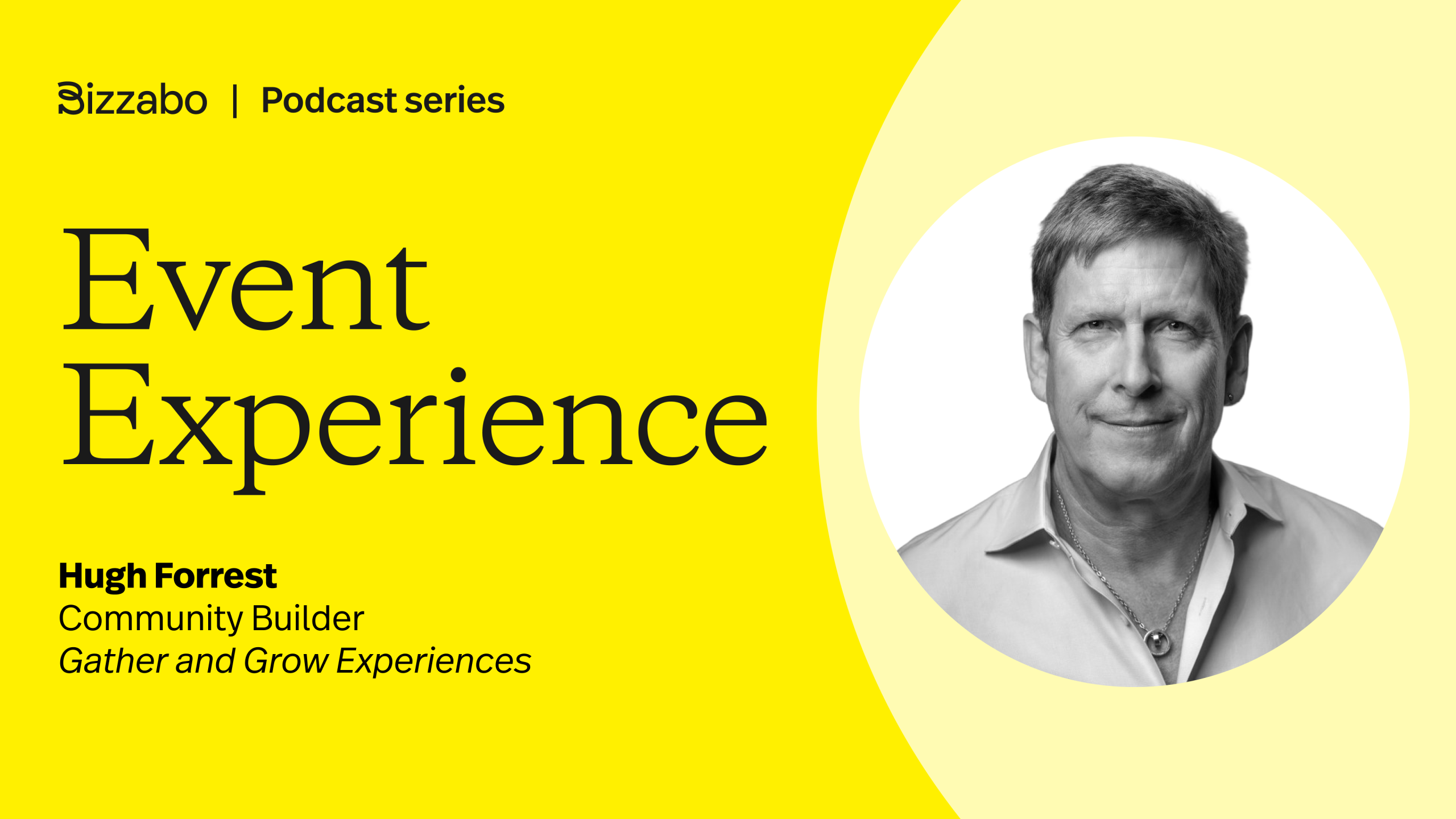
In this episode of Event Experience by Bizzabo, host Rachel Moore welcomes back Hugh Forrest, longtime leader of South by Southwest, to explore his latest venture: Gather & Grow Experiences. Drawing on over 35 years in the events industry, Hugh shares how he’s helping organizations design smaller, experience-driven gatherings that spark connection and elevate civil discourse.
They dive into the shift from massive events to more intentional, human-focused experiences, especially in Austin’s changing event landscape. Hugh also shares his work consulting for events that empower underrepresented communities and his approach to building impactful international programs. Listeners will take away valuable insights on why face-to-face interaction still matters and how thoughtful planning leads to more meaningful event outcomes.
Enjoyed this content? Subscribe to our newsletter and get insights like these delivered straight to your inbox.
[00:00:09] Rachel Moore Intro/Outro: Welcome to Event Experience by Bizzabo, the podcast where we bring the best and brightest event experience leaders together to share stories, tips, and lessons learned from creating some of the world's best events. I'm Rachel Moore, your podcast host.
[00:00:24] I'm delighted to welcome Hugh Forrest back to the podcast. You might already know Hugh from his past appearances on the show and his over 35 years driving growth of the South by Southwest conferences in Austin and beyond.
[00:00:38] Today's discussion digs into his new venture, Grow and Gather Experiences. The importance of community and events, and the evolving landscape of event planning, particularly in Austin.
[00:00:49] Hugh has, as always, a lot to teach us as we level up our own Event Experience.
[00:01:02] Rachel Moore: Coming right on back into a new episode of Event Experience where welcoming back a familiar face and voice to the podcast especially, uh, it'll be familiar for any of you if you've attended South by Southwest.
[00:01:15] After leading growth at one of the Globe's premier multi-day conferences for sharing ideas and interactivity, music, film, and TV for over 35 years. Whoa! He's onto something new these days and we can't wait to learn more about it and his takes on the events industry.
[00:01:31] Yes, indeed. I am stoked to welcome back Hugh Forrest to Event Experience.
[00:01:36] Hugh, thanks for joining me yet again here.
[00:01:38] Hugh Forrest: Rachel, it is great to be back. It's great to see you again.
[00:01:41] I have always enjoyed our times and conversations and looking forward to exploring some new ideas today.
[00:01:47] Rachel Moore: Yes, and that's the thing. Even after such a broad, a long career, a storied career, one might say, there's always something new to discover and you always bring new takes, which is really awesome. And it's one reason we just, at least one reason we love to have you back on.
[00:02:00] Rachel Moore: First one, I'm gonna give you a choice. Usually people I know which way people are gonna go, but I always like, I'm offering this choice now because of the environment we're in these days.
[00:02:07] So first of all, the, the new option you can answer, you could either answer, what is your favorite go-to AI prompt these days?
[00:02:15] If you have one, or you can do the old, the standby, which is always pertinent, especially for event planners. What are your go-to on the ground shoes for when it's a long event day.
[00:02:24] So you can choose which one you wanna answer and then you answer it.
[00:02:28] Hugh Forrest: It's an interesting juxtaposition of questions.
[00:02:31] Rachel Moore: I know. I'd like, like throw it up and just see how it does.
[00:02:34] Hugh Forrest: My favorite AI prompt is or my go-to AI prompt is, help me write this better. And I think there's probably more skillful ways of saying that. But I fancy myself as a writer. And so, for many months, years I was like, "Well, I can do this better than an AI can." And then finally became a little less of a Luddite and less stubborn on this stuff.
[00:02:58] And when I feed that prompt in, I often get stuff back to, I'm going, well, this, yeah, this is better. I, well, don't make, maybe don't like that second paragraph as much, but I definitely like , the stronger wording there. So, that is what helps me a lot.
[00:03:12] Rachel Moore: I always say to people, I'm like, if nothing else, it gets me away from a blank page. That saves a lot of time. It really does. So, I agree with you. So thank you for that. I love getting good AI prompts and goodness, we're all using it these days. So it, it's very relevant.
[00:03:26] Is there anything that you're listening to, watching or reading these days that you can't put down, and it doesn't have to be event or experience related?
[00:03:34] Hugh Forrest: I'm watching that new or relatively new. It came out a few months ago thing on Apple Tv. The Hawaii series was Jason Momoa. My family and I have been to Hawaii a lot over the years, and this is certainly a different understanding of how that, of that. And that's a lot of fun to watch.
[00:03:52] Rachel Moore: Cool. I've actually been really interested in that one too. It's, I've just started watching Scandal for the first time. I feel like I'm always on this, like, I'm watching things way after they were in the mainstream. And so, my reactions are, you know, spoilers abound. It's like, eh, I don't care. I just, you know, I just like having it on the background. But,
[00:04:08] Hugh Forrest: Well, If it's good content, it will stand the test of time.
[00:04:10] Rachel Moore: That is true. That's true. Ooh. Yeah, there are some that I, I return to faithfully. I think we, every year my family re watch Deep Space Nine. So it's one of the ones we like. Is there a particular social post or a piece of media or even a hot take about events that you found interesting lately?
[00:04:26] Hugh Forrest: I was introduced to a gentleman by one of my longtime contacts at South by Southwest, and actually had a phone call with this guy yesterday. He is based in Toronto and his name is Misha. Has a Substack and it has a really good Substack post. You can probably, your audience can probably find it if they just simply Google it, which is everything you thought you did to improve your event made it worse.
[00:04:50] Rachel Moore: See?
[00:04:53] Hugh Forrest: Has a lot of great points, a lot of which we've talked about today and back to the chair setting thing. But had a wonderful call with this guy yesterday and you know, that's kind of the magic of the internet at times, where you reach out to someone and they reply and then you end up having a conversation and again, really fascinating guy and so I love that.
[00:05:12] Rachel Moore: Awesome. No, I'm totally gonna go check that out. And again, goes right along what we're saying. It's like you did something wrong. Go learn from that and don't do it anymore. So I love
[00:05:21] Rachel Moore: that.
[00:05:21] Anybody who's familiar with events. Like, globally recognized events probably knows South by Southwest and you've had a career there, but I, I'm really curious, I wanna dig in today because you're onto something new and the what's next for your career.
[00:05:34] And I wanna give you space to talk about that. Plus our podcast fans, y'all can listen to our past interviews we've had here with Hugh on Event Experience. I want you to reveal what is going on with this next chapter, the changes that this year has brought for you and kind of the future for you and what you're hoping to bring to the future of events.
[00:05:52] So, what is new for you these days?
[00:05:54] Hugh Forrest: What is new? It's all new, Rachel. I left South by Southwest the end of April and excited for the many opportunities ahead.
[00:06:04] I have now started a new company called Gather and Grow Experiences. Essentially that is a holding company, parent company for various consulting gigs. And the goal here is to advise organizations, people, events on best practices from what I learned sometimes the hard way from 35 years plus at South by Southwest. And try to help these folks create more impactful events, experiences get togethers.
[00:06:37] As we've talked about in our previous conversations, the concept of community is extremely important to me with the context that it is a big concept. But community, bringing people together is, again, very, very important to me.
[00:06:52] And I feel like that act of bringing people together face to face has never been more important than in our world of 2025. Doubling down on the, the again, experience and expertise, "I have from South by Southwest to help other people do this in an even better way than we did."
[00:07:09] Rachel Moore: It all kind of says it in the name Grow and Gather. It's about gathering people together, like you said, bringing, fostering that community coming together. But also growing at the same time and growing in the knowledge of how to execute those gatherings. Right? And how to, like you just said, build off that experience that you've gained and learned from over South by Southwest.
[00:07:26] You talked there about community too. I feel like we hear that a lot as well here at Bizzabo. I mean, I've definitely heard it on other pod from other podcast guests. We've heard it about it on our webinars and such. Do you feel like community is gonna be like more of a fixture, more of a focus for future of events and conferences and festivals and the like, I mean, is that hopefully where people are going with that in the future?
[00:07:49] Hugh Forrest: I certainly think so. I think that while we can do a ton of wonderful things online. Witness this podcast where you're in beautiful Colorado and I'm in lovely Austin, Texas.
[00:08:01] But nothing replaces the act of, again, bringing people together face to face and reaffirming their community, creating new community, creating new connections.
[00:08:13] I think, events festivals, experiences, conferences, however you wanna phrase that in many ways, take over the community building aspect that institutions like the church did in previous decades. And I think that face-to-face interactions have always been very important to our, to our wellbeing as humans.
[00:08:33] And that will continue to grow in importance as we rely more and more on AI. You've heard this and it sounds a little bit reductive but that interacting with a human will be a premium experience as opposed to interacting with an AI.
[00:08:50] But again, I think this all adds up to well, organized events experiences are gonna become even more valuable in the years ahead.
[00:09:00] Rachel Moore: Yeah. I referred to this earlier. You've obviously been on the podcast before and you're landing on some themes you've brought up on the podcast before.
[00:09:06] Again, if anyone wants to dig more deep into that. l love that you've equated events and the need for humans to connect to historically what people have found in church and things like that.
[00:09:16] And I mean, church isn't the only thing too. We can think of all kinds of ways and organizations and ways that people gather together for a common purpose or a need to connect with fellow humans.
[00:09:28] I wanna hover on the name of Grow and Gather. First of all, I'm a huge fan of alliteration.
[00:09:34] .
[00:09:35] Rachel Moore: Once I read that, I'm like, "Oh! Way to my heart, I love it."
[00:09:38] Grow and Gather Experiences. I love the name already. Tell us more about the mission, about the mission of Grow and Gather. I can read the about section on your, on the LinkedIn company page. But, when I do that, it sounds like you're gonna go farther than just bringing people together in the same space.
[00:09:53] So, tell us more about the mission there for Grow and Gather.
[00:09:57] Hugh Forrest: I think the mission, yes, bringing people together. But I think that digging in a little deeper there, I think that people face to face are generally more civil with each other than unfortunately what we are online, where most of the algorithms elevate hate speech and disagreement over agreement.
[00:10:17] I think that face-to-face interactions remind us that maybe we don't agree a hundred percent with someone else, but we agree on a lot of things and the few things we disagree on doesn't warrant demonizing people.
[00:10:32] Again, with the context that, as I said before, technology, in all its many forms, including social media have helped us in a whole lot of ways, we've also got to acknowledge that social media has isolated us in a lot of ways. It's made it easier for us to not interact with others face-to-face. It's made it easier for us to demonize, weaponize the other. And these are all not great things.
[00:10:57] So, again, with Gather and Grow, we're very committed to this idea that a way out of the, the extreme divides that we have now is, step-by-step, smaller events, that bring people together and create meaningful connections.
[00:11:12] Maybe enough of those across the US, across the world, even more of those will again, lead to a slightly more civil and productive society.
[00:11:23] Rachel Moore: Man, that's really resonating with me. I don't know, whoever's listening or watching this is probably feeling the same way. You're so right.
[00:11:29] I wanna think like, anecdotally too. Like, I'm sure you've heard about these too. These efforts, like you've heard about where they're maybe doing a focus panel and they do it with, let's take politics.
[00:11:38] People from across the political divide, divisions that we have and polar opposite parties or what have you. But they'll have them, and it's a very small group, maybe six people, and they'll have them be in a panel in the same room and then they'll have them come back. To it over months.
[00:11:52] And I've always found those super interesting because they might have their own social media posts they're putting out about how, what they feel and believe that can sound really vitriolic. And then they get that into the same room and it changes the vibe.
[00:12:05] It changes the way they interact and also the understanding. So again, super anecdotal there as far as like me and how I felt about it. But I totally agree. It feels like you're really fostering a way back to how we can be civil with each other, have civil discourse and whether we have discourse or not, just understanding human to human right?
[00:12:27] I think it's so important too. I mean, look, we talk a lot on this podcast about business. People are in the business of putting on events. They're in the business of bringing people together because they have a bottom line. They have an end game there they need to achieve for a business, right?
[00:12:44] But, there's no reason that a business can't also accomplish what you're talking about and making "Hey, sure! I've got a business or a bottom line, but if I bring you and you together in the room and now you've got something together, great."
[00:13:00] Right?
[00:13:00] Hugh Forrest: And let me also say that certainly with Gather and Grow and with back to, to your scenarios there. I mean, trying to get people to agree on politics is really difficult.
[00:13:11] Particularly in 2025. And so maybe it starts out with agreeing on cultural things. We like the same movie.
[00:13:17] Well, how do we like the same movie if we're different? Well, 'cause we're not that different and using those kinds of touch points in a get together as a way to achieve a little more community.
[00:13:30] These are all aspirational. Let's be clear about that. It is hard to bring together different kinds of people because it's easier to bring together people that all know each other and all get along.
[00:13:41] But, I've often found that the most productive connections happen and the most, uh, productive opportunities spring forth when again, you're bringing together different people that didn't realize they had something in common, but by creating some kind of way for them to interact, to communicate, they understand that, "Wow! There's something more here. And, and we can work together. We can be friends. We can communicate and achieve something."
[00:14:06] So again, that's aspirational. That's really hard to do. But, sometimes the hard things are worth pursuing. Right?
[00:14:11] Rachel Moore: Uh, yeah, it's for real and it's not easy. I mean, we acknowledge her that's why we do this podcast. Frankly, is 'cause we know it's not easy. You really, it's humans. Humans are messy and, and business is messy. But the people who are putting on events they are superheroes. And all our heroes were capes and not all event planners wear capes, but they're heroes.
[00:14:27] But I think it is aspirational, but I think that's every event planner, right? Because you've got goals in mind. You know, you're in the business of bringing humans together and you know, accomplishing that again for whatever your goals might be.
[00:14:38] It's still quite a lofty thing to do. I'd love to learn like what, immediately, what's on the horizon for grow and gather. Like, are there some specific events or plans that you have that you wanna share about, you know, I know you mentioned about consulting and things like that, but anything in specific that you'd like to share?
[00:14:53] Hugh Forrest: Two of the things that we're definitely working with already and there are many things that are still in the idea phase that probably can't, shouldn't talk about yet. But, helping out my friend Arlan Hamilton, who has spoken at South by Southwest many, many times for those unfamiliar with her life story, origin story, she, essentially went from homeless to being a VC, and particularly the kinds of startups, entrepreneurs she works with are women, people of color, and people from the LGBTQ community.
[00:15:25] Unfortunately, those founders, those entrepreneurs get typically get like less than 1% of the total funding. So, there's a huge need to educate, inform, inspire this community.
[00:15:38] She's gone from conference speaker to conference organizer. She had, had an event that she put on in 2024 called Your First Million Live and she will do a second edition of that in April 2026.
[00:15:51] So I'm helping Arlan with the organization of that, the pulling in speakers and certainly her mission, her focus, her life story, her passion, very much resonates with what my, the things that I like about community. So, again, very excited about that. That will be in Los Angeles, April 8th, 9th, 2026.
[00:16:13] I'm also helping out with an event in Sao Paulo, Brazil that will occur in August 2026. This is called SP2B, stands for São Paulo Beyond Borders. Borders. This will be a fairly large event that, it kind of has that South by Southwest flavor of bringing together a lot of different communities, i.e. artists, filmmakers, musicians, entrepreneurs, putting in a city that is by all accounts or by some accounts, kind of the leader of the global south.
[00:16:51] Focusing a lot on tech innovation as well as a significant focus on indigenous cultures and what we can learn from these cultures.
[00:17:00] So, really excited to be involved with that. I was down, I was in Brazil about a month ago for the kickoff event for that, and a lot of momentum there.
[00:17:09] Those are two of the things so far. There are, uh, again, a number of other ideas from around the US and around the world that I'm hoping to come to fruition.
[00:17:17] But again, very exciting to be involved in this and bring some of my experience and expertise to help these events, create compelling and impactful results.
[00:17:26] Rachel Moore: It's funny because this is making me think a little bit of what we already talked about too. I mean, gosh, you, you're coming off, I mean, south by Southwest is gigantic.
[00:17:34] But you're also making this awesome event too in São Paulo, which sounds fabulous. I love too. I just wanna say, you just talked about too big efforts where I feel like, the focus is on what we just talked about, bringing humans together, even very different humans together where it can be about people who might be more marginalized or are more marginalized or aren't getting a big piece of the pie. Where, where it's like the merit is there. Let's make sure they have the same opportunity.
[00:18:02] But also, I'm a big fan too. I'm assuming you felt probably feel the same way. Not everything has to happen in the United States. I mean, we can like go to São Paulo. I mean, there's gonna be so much, so many experiences there and people of diverse backgrounds and things like that, that are just gonna add to that whole experience.
[00:18:17] So this brings me to my next question 'cause I just kind of, just, just spoiled the, the lead there, experience. We've talked about the giant experiences. You're building stuff in São Paulo, and you know, coming off South by Southwest, but we also talked about more intimate experiences. Maybe it's smaller groups and gatherings.
[00:18:34] So I, I would love to get your take on this, like when you say the word "experience," how do you, Hugh Forrest, define that word.
[00:18:43] Hugh Forrest: Well, I think that my default is unfortunately to say events. It's just kind of programmed in my brain and I need to kind of deprogram that.
[00:18:53] But I think realistically, people in 2025 or less attuned to going to an event and more attuned to being involved with an experience. And, again, that's why it's in our name. That's why it's in your name for the podcast and in my mind, that experience factor means that it's less top-down, you know, experts lecturing to non-experts and a little more bottom-up with the realization that probably everyone at the whatever it is, is some kind of expert in trying to create as many touch points where people can interact with each other.
[00:19:35] That doesn't mean you shouldn't have some panels and presentations and keynotes as a way to kind of frame what you're doing and the overall focus, but I also think that in 2025 and moving forward, the most impactful parts of bringing people together, I'm trying not to use the word events, is again, where you create something unique, one of a kind, memorable. "Wow. That experience was really fantastic. I'd never thought of interacting with other people that way."
[00:20:03] It opened up some doors in terms of new connections. And that typically happens when you empower your attendees to connect with each other as opposed to simply a more traditional approach of, " Let's file into an auditorium. Let's have a speaker. Let's file out of the auditorium. Let's have another speaker."
[00:20:23] Hugh Forrest: you know?
[00:20:23] Rachel Moore: Yeah. We'll be right back with more Event Experience after the break.
[00:20:28] Hey event professionals. Do you want to hear more from the industry's top Event Experience leaders? Don't miss out on future episodes of the Event Experience podcast by Bizzabo. Hit subscribe, drop us a review, and share this episode with your friends and colleagues. The Event Experience podcast by Bizzabo, where events come to life. We're back with Hugh Forrest to really define the term experience as it relates to events
[00:20:56] Rachel Moore: Well I think, we all can think of like a typical panel or a event room at an event, we're saying the word event, but we can think of that and all, like think it's actually physically manifested there with the chairs. The chairs are all faced forward.
[00:21:11] Everybody's focus is to the stage, not necessarily the people next to you. I was just at an event, an experience, excuse me, um, last month and instead of that, they did have that in some of the rooms, but they had a lot of round tables instead.
[00:21:25] And so, which obviously, any event planner right now is gonna be like, "Yes, but space. You know? And what about getting headcount in the," Yes, I know.
[00:21:32] But, and you do sacrifice that. But at the same time you are now, people are facing each other even if they turn their chairs and stuff. But you're still starting out with them, facing each other, they're at the same table and now you've got a commonality there.
[00:21:45] I'm, you're at my table and, but even something, a simple illustration is that can really, I think, depict what you're talking about, where it's like it's, "Yeah, you can have that focal point up front. You can have the expert or panel of experts that are, billboarding out stuff that the populace in the room needs to know or that they want them to know."
[00:22:04] But you can still design it to where, but the equal focus here is that you talk to that person next to you or that you make that connection you didn't have before with someone who's not on the stage right?
[00:22:15] Hugh Forrest: Absolutely agree with that. From my experience at South by Southwest, so many of the positive stories were people saying, the content was good, but it was the person I met in the taxi line that ended up funding my startup or just I was randomly met someone, you know, we were both lost and they ended up becoming my really good friend.
[00:22:35] And, and certainly to your, the design focus there, there is a very different dynamic when you set up a, a round table and, and as you say, you've got, "These are the people at my table. We'll take a selfie together. We're we'll tend to interact a little more and for better, for worse." I think that's a little bit different when just all the chairs are facing forward theater style. You're a little less inclined to interact with the others around you, you maybe interact with the person on the right, person on the left, but that's a little more limited than what can happen at a table.
[00:23:08] So again, I think that that the more event organizers can design for those kinds of interactions, those kinds of serendipitous interactions, the, the stronger the event may experience can become.
[00:23:23] Rachel Moore: Yeah, for real. Well, and, and sounds like they can learn all that from, uh, from you at grow and gather experiences.
[00:23:30] Hugh Forrest: They, They can learn from all the mistakes that we've made. Yes!
[00:23:33] Rachel Moore: Hey man, that is what we're here for. I mean, one of my favorite things we do is sometimes like, what, what went wrong? You know? 'cause that's how we learn. And, the events, the event profs out there are so great too.
[00:23:42] They're usually so self-deprecate and they're like, "Yeah, I'll tell you what went wrong and I wish I would've done it differently. Don't do it, I did." You know? And just helping people learn from that.
[00:23:50] Let's pivot back to, we talked about geography a little bit, 'cause you're, I'm in Denver and you're in Austin. You're still in Austin. I mean, Austin feels like it's kind of part of your DNA right now. I dunno if you feel that way, but it, you've been there for, for so long and just really let it become part of the experience that you have as a human being.
[00:24:07] But how is Austin fairing and changing as a city hosting large events and conferences and festivals?
[00:24:12] I know I can always default, "Oh, South by Southwest" is that Austin, but what else is going on with Austin? Like, what's new on the horizon? What's been changing and stuff?
[00:24:19] Hugh Forrest: Well, certainly the big change for Austin and Will creates lots of challenges for a big event like South by Southwest, is that, in April of this year, April, 2025, our convention center, which has been around for 25 years, demolition on that began. There's now a big cavity, for lack of a better term downtown.
[00:24:38] This is a completely torn down and then rebuild and it'll become much more functional. But it's down for at least three years, possibly longer. It's a big construction project and sometimes big construction projects don't, don't go on time.
[00:24:55] So, particularly for a big event like South by Southwest and Austin has been attracting a lot of other big events in the last 10, 15, 20 years.
[00:25:03] It will create a lot of challenges not insurmountable challenges. They're more down, there are more hotels downtown, and you can do a lot of the stuff in hotel ballrooms.
[00:25:13] We all, I think, as event planners have kind of a love-hate relationship with convention centers. The hate part being their, by nature kind of big, sterile, glorified barns.
[00:25:26] But the upside and the love part being you can, you can do a lot of things there. You can house a lot of people. You can put a trade show in. You can just centralize things.
[00:25:36] So again, that's gonna be a big challenge moving forward. I think that like it or not, that will that forces big events like South by Southwest to explore ways to kind of break it down to be a little bit smaller by decentralizing, paradoxically, or maybe that's the wrong word.
[00:25:54] I think that's a lot of what people want at this point is smaller, more easily digested events as opposed to just giant masses of people.
[00:26:06] Rachel Moore: I feel like you said exactly what was firing off in my brain as well. 'cause I'm like, "well, hang on a second." You know? 'cause if we're talking about experiences where it's so easy to get lost in a crowd. I mean, goodness, we've all been there where you're like going on a first day into the convention center to get your badge and there's a big long line and, and literally it's just a mass of people and they're all just floating around and it can feel, even if you're amongst in that general populace of people, you feel very alone. You feel very like, "Okay, well there's, until I get in a room or get to sit at a round table in a room, I'm not gonna feel connected really with anybody."
[00:26:41] Very different than if you're entering a smaller space where, "Okay, it's not that much real estate. It's a smaller group of people." And now there's, that just, it increases that opportunity to say, "Well, I'm gonna have to interact with somebody. 'cause maybe I am in close proximity. Now we're like both commiserated under the fact that I don't know where to go or know where to sit or whatever or where's the, what's the wifi?" You know, and stuff.
[00:27:02] It does feel like, whatever the city planning is, you know, and the need was to demolish, the existing convention center put something new up. But in the meantime, yeah, people get scrappy. I'm sure, especially an environment like Austin, and this really boils down to again, why event planners are heroes, because, you know, everybody's like, "Okay. No convention center, and it's not South by Southwest. It's some other, event that we're doing. We typically would use the convention center. What else are we gonna do?" and leaning on those local relationships and partnerships and contracts, right?
[00:27:35] And saying, yeah, how do we make this happen? And knowing that the, the resources there. And again, you know, Austin. On all those resources, so well, to know that yeah, they're gonna rise to the occasion and make it happen. And it'll be different. It'll look different. It'll feel different. Maybe a better different.
[00:27:50] Hugh Forrest: Absolutely. Absolutely.
[00:27:51] Rachel Moore: Finally, easiest question of all, where can our listeners find and follow you online these days?
[00:27:56] Hugh Forrest: I am online either at HughForrest.com. That's two Rs, or Gather and Grow Experiences, that's a little bit long. So, you can just go gg-exp.com and find us that way.
[00:28:11] Rachel Moore: Excellent.
[00:28:21] Rachel Moore Intro/Outro: Your skill up opportunity for this episode is Hugh's advice about long-term planning.
[00:28:26] Hugh Forrest: Take a long-term approach to what you're doing. Events experiences, however you wanna phrase it are challenging to put together.
[00:28:36] It's challenging to get an audience. Try to take a long-term approach. If the results weren't perfect the first year learn from your mistakes and try to do a little better the next year.
[00:28:47] That was always the ultimate secret sauce of what we did at South by Southwest is we tried to improve a little bit every year and take a long-term approach. Try to measure the success of what you're doing, in metrics that aren't strictly number-focused. Many ways a smaller, more intimate experience is much, much more valuable for your attendees.
[00:29:10] Don't use a giant event like CES or Mobile World Congress, or South by Southwest, as your barometer of success. Use the barometer of successive to the extent that you can understand what kind of connections were made, how people leverage those connections to create new opportunities. That's what we should be about as event organizers.
[00:29:30] And if scale is your goal, great. Remember that that scale is the enemy of community. But if you create a quality experience, you can achieve scale if that's what you want.
[00:29:42] Rachel Moore Intro/Outro: Thanks again to Hugh Forrest for joining us on Event Experience and thank you for listening. If you're enjoying the show, we'd love to hear it. Connect with us on social and Subscribe, Rate and Review us wherever you're listening.
[00:29:53] Also, don't forget to share the show with your colleagues and friends. You can find transcripts of each episode and key takeaways on Bizzabo.com/podcast. Plus if you found this discussion about intimate experiences interesting, you'll love Bizzabo's webinar about micro events, available on [email protected].
[00:30:13] On behalf of the team, thank you. We'll gather again soon for a new episode of Event Experience. [00:30:19]


