
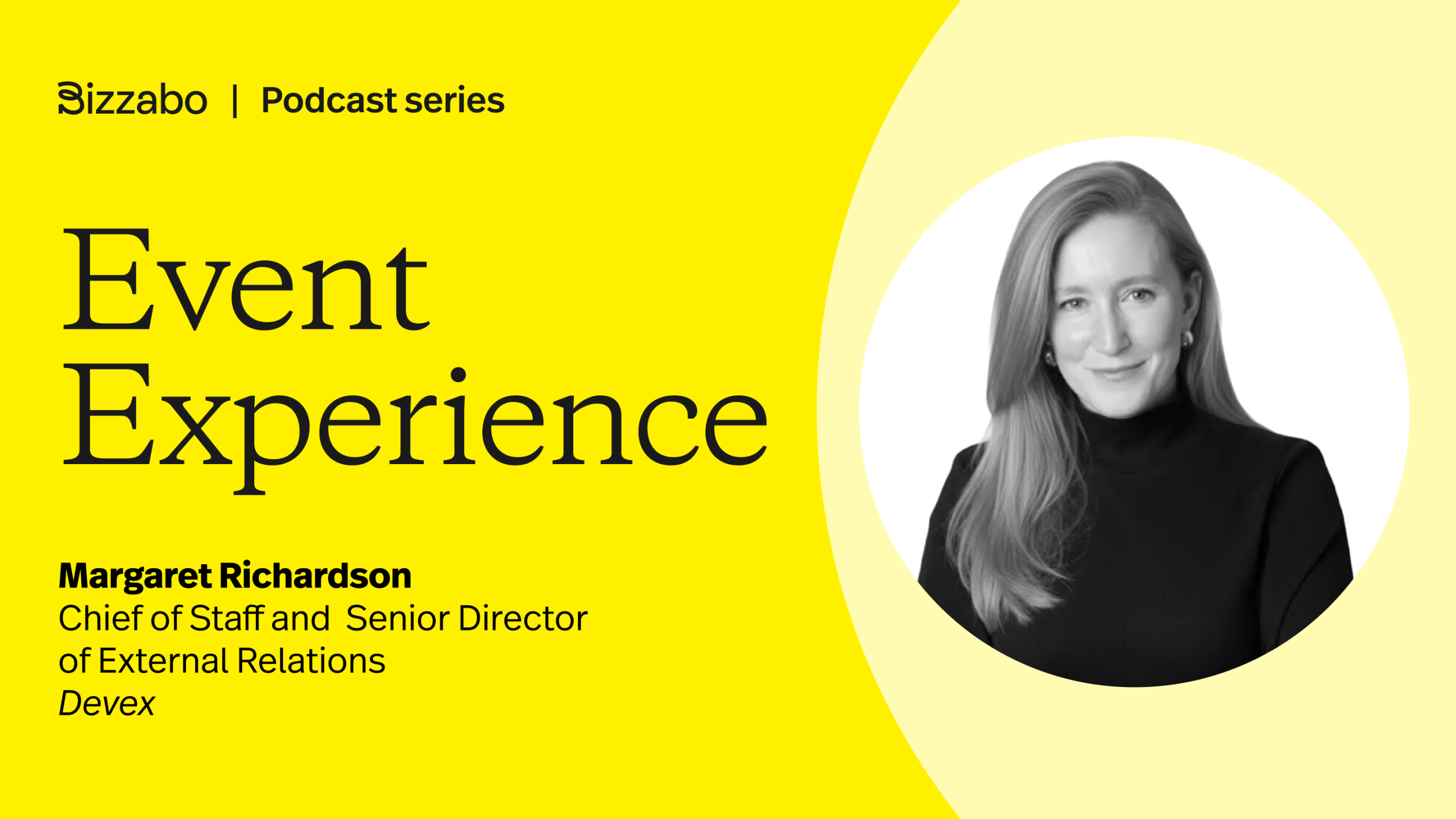
In this episode of Event Experience by Bizzabo, host Rachel Moore sits down with Margaret Richardson, Chief of Staff and Senior Director of External Relations at Devex, to explore how events can shape brand reputation and drive meaningful change.
Margaret shares how Devex bridges journalism, business, and global development through strategic partnerships and thoughtfully designed events. She explains why events should be treated as relationship infrastructure, not just marketing moments, especially during times of uncertainty and rapid change.
The conversation dives into the power of intentional storytelling, authentic audience engagement, and experience-led reputation management. Margaret also challenges event professionals to “think like editors,” designing programs with layered narratives, multiple audience perspectives, and formats built for today’s shorter attention spans.
From shortening panels to rethinking how success is measured, this episode offers a practical framework for creating events that spark real conversations (both in-person and online) and strengthen brand trust.

Speaker: Welcome to Event Experience by Bizzabo, the podcast where we bring the best and brightest event experience leaders together to share stories, tips, and lessons learned from creating some of the world's biggest events.
Speaker: I'm Rachel Moore, your podcast host.
Speaker: Events are and always have been, mostly about the who, what, when, and where. In this episode, we really get into the how and why with Margaret Richardson, Chief of Staff and Senior Director of External Relations at Devex. Together we discuss the evolving landscape of events, the importance of storytelling and global development, and how brands can effectively manage their reputations through intentional experiences.
Speaker: There might also be a not so subtle Hamilton reference in this episode of event experience.
Rachel Moore: [00:01:00] Thanks everyone again for joining us on a new episode of Event Experience.
Rachel Moore: I'm your host, Rachel Moore. And our guest today is the chief of staff and senior director of external relations at Devex, where she leads strategic initiatives and high impact partnerships that bridge business, journalism and global development. She's passionate about using storytelling. We love storytelling here and strategic partnerships to amplify stories that matter.
Rachel Moore: Having spearheaded efforts that double Devex's team size and established meaningful media partnerships with organizations like the World Bank and MasterCard Center for Inclusive Growth.
Rachel Moore: All of this and so much more that we're about to dig into is why I'm thrilled to welcome Margaret Richardson to the pod. Margaret, thanks for joining us here on Event Experience.
Margaret Richardson: Sure, I'm happy to be here. Thanks for having me.
Rachel Moore: Of course. And I always give a very brief intro of our guests. I don't do it justice and I wanna be able to hand it back [00:02:00] over to you.
Rachel Moore: Now, can you tell me and our listeners a bit more about yourself, your world at Devex, and just what kind of goes on in your, in your day to day?
Margaret Richardson: Sure. So I work at an organization called Devex with a media. We're a news organization for the international development community. And so, like any news organization, we host a lot of events. We have journalists and editors all over the world who are reporting what's happening in this space. And then we host events to kind of bring our audience into that journalism, into that storytelling and experience.
Margaret Richardson: So I sit at this really interesting place between editorial partnerships and brand strategy, helping to shape the way. We as Devex show up in the world from major global convenings like Davos at UNGA, to some of the digital storytelling we do every day to the smaller events, the ones that you'll never hear of and you might not know are happening, but are as important.
Margaret Richardson: So my real job is really to connect the dots between what's happening in global development and the audiences that need to hear it.
Rachel Moore: Excellent. Well, [00:03:00] one thing I love that you said, which we're gonna dig into, you said, use the phrase show up in the world. So we're gonna get into that. Tease the audience here a little bit. First I wanna ask you some, get to know you questions so our audience can get a little bit more sense of you.
Rachel Moore: Obviously we, we talk to a lot of event planners and event professionals here on the podcast. Something that seems to be a common theme are shoes. So I, I like to ask every guest, what are your go-to on the ground? Event day shoes, particularly for those really long days on the ground.
Margaret Richardson: Definitely depends on the event. We do global events all over the world, so from like the mountains and the Alps, I have my boots all the way to you know, the hottest climates. But I think. Most events, I'm wearing my Vivaia shoes. I'm realizing I haven't said that out loud, but their brand name out loud, Vivaia Shoes, they are a company I believe started by women who just wanted cute shoes that.
Margaret Richardson: Like, felt like sneakers. So they are this most comfortable shoes I can ever wear. They have boots, they have flats, they have actual [00:04:00] sneakers. they have eco-friendly principles throughout their supply chain. So I feel good wearing them. I really believe that like, when you feel good about the story you're telling with your clothes, you're, you're gonna be a good storyteller yourself.
Margaret Richardson: So you can always find me in that, in those,
Rachel Moore: Oh those are great wrecks
Margaret Richardson: I'll send you a link.
Rachel Moore: You had, yeah, we'll sit, we'll share it in the show notes 'cause you had me at like, oh they do boot, like all the kinds of shoes and they're comfortable and also cute. So, um, definitely a keeper there. Thanks for that. Is there anything that you're watching, listening or reading these days that you can't put down and it doesn't have to be events related?
Rachel Moore: Ooh.
Margaret Richardson: Yeah, I, well, I, you know, I work for a news organization, so I read Devex every single morning. It's what I start my day with. We have our daily Newswire, and then I'm always listening to our podcast this week in global development. It's a way for me to hear directly from our journalists about what they think has been important.
Margaret Richardson: Like obviously I try to read as much as I can, but I always listen to this week in global development, and then I have a couple of other podcasts. I like the Ezra Klein show. I like, you know, I like how I built this [00:05:00] really important podcasts. Those are interesting because they give me infrastructure ways to think.
Margaret Richardson: They help me sort of place what's happening in the world in my brain. And then, I'm a big reader. I'm, right now I'm reading The Wager which is an incredible story. It's about a shipwreck. It's by David Gan I think. And it's a story about a shipwreck and a mutiny and two sides of a story.
Margaret Richardson: Basically, the story comes to a crux when the two groups of people show up and say like, this is what happened, and then this is another side of what happened. And I think listening to fiction or reading fiction, listening to storytelling with infection is a really important way to think through how to tell.
Margaret Richardson: Your tail and how to, you know, it gives me inspiration for when I think about all of the other sort of real life stories we're trying to tell.
Rachel Moore: I love that. That's, and you're so right. I, I'm a huge fan of fiction and I love that too. But yeah, that sounds like a good one to pick up Again, we'll put that in the show notes. So that's really great recommendation. Is there a particular social post or a piece of media or even a hot [00:06:00] take about events that you found interesting lately?
Margaret Richardson: Hmm. I think there's been a lot of conversation about the return to IRL, like the return to in in real life events. But what I found particularly interesting recently is like just thinking about. And people who have been talking about the future's, not like hybrid or virtual or in person.
Margaret Richardson: It's really intention driven. When I think about events, I don't really think about them as an event planner. In fact, I would say like that's secondary for better or for worse. But I think about what do I want the audience to come away feeling? What do I want them? To know what do I want them to go back and tell their families when their families are like, Hey, like, you were gone for a week.
Margaret Richardson: how was it, you know, what is that like one piece of data that they're walking away from? I think like format's not really the point, the purpose is, yeah, and that's pretty aligned with how my thinking around events have evolved generally.
Rachel Moore: That's super fascinating. This actually is a great springboard into kind of what we're gonna cover with you today. You know, and I, I already teased a little bit, you talk about how Devex and, and your team show up in the world. That's [00:07:00] kinda what we're gonna dig into right now. You know, on this podcast we talk a lot at length about how brands and teams can and should put on events.
Rachel Moore: So, you know, they're, they're the great and powerful s behind the curtain, right? They're putting on the show, they're putting on events, executing activations, making the entire experience happen. But you know, you just, again, teased that up there. I'd love to talk about your ideas on other factors at play with how.
Rachel Moore: Individuals and companies use events across the spectrum. So first things first. I know that you have some thoughts about reputation and how that feeds, you know, how brands use events for that. What are your thoughts on how and why people and companies are intentionally using experiences to shift their own reputations?
Margaret Richardson: Yeah, I think we're in a moment where reputation is shaped not by what you say about yourself, but what people experience of you. Like. People are really smart, and we've become really attuned to trying to parse out, is this real, is this marketing? Like we're all online. Everybody's you know, scrolling on TikTok.
Margaret Richardson: They know if their [00:08:00] influencer is really, Is really excited about a brand versus doing a brand deal. Like people are really smart about that. So I think events have become a, a form of strategic storytelling. They always should be, in my opinion. But I think increasingly when you're trying to get attention spans and you're trying to convince people to put their really valuable time, like on the line in your seats, it's become much more about how people are experiencing that storytelling.
Margaret Richardson: And when done well, an event can allow a brand or a leader to really inhabit a narrative, not just announce it. And I think, you know, whether you're trying to signal a reform or you're trying to showcase priorities or demonstrating social impact, convenings lets you create living proof of your point.
Margaret Richardson: And they can be a reputational accelerator or they can act in the opposite way where people walk away feeling like, you know, this may not be something I wanna invest in again. So I think it, it's really important to think about how people are experiencing your brand, not just what they're [00:09:00] hearing.
Rachel Moore: I really like that too. You're so right too about the feed. We all have whatever feed we're going to in the day. We're experiencing that and gosh, we're, we're all battling that whole, like, is it real? Is it not? You know, is it authentic, is it not?
Margaret Richardson: Totally, especially with ai, I think it's, you know, even more people are building this muscle whether they know it or not, and so brands need to think about that when they're talking to their audiences and not to underestimate their intelligence on this point.
Rachel Moore: That's such a great point too. I love that too. And you really are giving people the opportunity, and it's just like. It's like putting out a press release. You can say, okay, well here, here's the talk about us thing. But then, you get to the show part like, well, yes, but it's way different if you're seeing us in person or seeing our team in person and experiencing that in real time.
Rachel Moore: Um, Very, very different experience. You know, we talked kind of about the state of the globe and, and, you know, all of us experiencing different things, where we're coming from and what device we're picking up and what our experience is. It's safe to say that the globe is a bit tumultuous right now in many respects which might lead one to [00:10:00] think that people and brands are tending to avoid convening and be participating in experiences. So I, I lodge that to you, but what are you seeing from your perspective? Is that the case? Are people avoiding it or are they flocking to it, do you think?
Margaret Richardson: It's both and.
Rachel Moore: Hmm.
Margaret Richardson: When the world feels fragmented, convenings become essential. When people feel tumultuous, when people are anxious, they crave community. That's why during the pandemic, a lot of people went craved time online. You know, people were connecting in some ways more than ever with their family members, online families that never FaceTimed.
Margaret Richardson: All of a sudden now, you know, were FaceTiming and spending time on Zoom when people feel when the world is fragmented, people crave convenings. Now, whether or not those are public or private convenings, I think are the question, right? Yes, I've experienced some events where there are corporations or, or sort of big brand names that are showing up differently, but that doesn't mean they're not showing up, and that doesn't mean they're not showing up privately.
Margaret Richardson: There are [00:11:00] increasingly many more private events that are happening, smaller dinners, and again, I think this speaks to the moment. Leaders are craving clarity and connection and you only get that in person. Sure, you can call up a friend, you can do a lot of things online, like you can do that when in journalism, you call your sources when you need clarity.
Margaret Richardson: Right? But you create those sources by meeting them in person. So often it's not impossible to do it, you know, digitally, but I think people are really trying to be in person and they're showing up 'cause they need to understand what's real, where things are going, and who they can rely on. and I just don't think you can replace in person events like that.
Rachel Moore: Yeah.
Margaret Richardson: Events aren't escapism, right? They're infrastructure for relationships. They're infrastructure for how you show up in the world. And there're a way for people and organizations to navigate volatility by grounding in community and intelligence and ultimately creating momentum towards what's next.
Rachel Moore: , First of all, you took me back there a little bit because I do remember I had Zoom and when COVID happened [00:12:00] we had family members in different states and had, might see each other at a random Thanksgiving, not even every Thanksgiving or something like that, but man, we just zoomed right over to Zoom and we're like, oh my God, let's get on and talk to each other.
Rachel Moore: I just wanna see
Margaret Richardson: You saw people tuning into I, I have. I have friends who never had gone to synagogue before, but they were tuning into their synagogue services because they just were craving that connection in that community. I think it's no accident that during a time of extreme isolation, we found ways to be together.
Rachel Moore: Yeah. Or, or even like taking walks and neighbors, I normally would just kinda be like, oh, I don't need Tono. Just, I was almost like, intentionally like, please acknowledge, nod. Okay, good. You're good. You're good. Great. And yeah, you're so, and, and, and that it, that was a ti I mean, gosh, we're all gonna remember that as a huge time of tumult.
Rachel Moore: But. It's not the only one out there, obviously. And I love that you bring that up too, that it's an opportunity for not just individuals but brands to seek and, you know, seek out that in-person touchpoint that really can't be replaced by anything [00:13:00] else. Yes, you and I are meeting digitally right now, you know, as we're recording this podcast, but it's far different.
Rachel Moore: Again, I'll go back and if anyone can relate to this I remember the first few times I was starting to like go out and be in, in person again with people after COVID and I was like, I am, I need to learn how to read people again ' cause Right, because it's just like
Margaret Richardson: And it was exhausting. People were really tired. I've, you know, a lot of folks were, but everybody was there. I mean, I remember talking about like, is the UN general assembly still gonna happen? Is the World Economic Forum annual meeting still gonna happen? Not only are they happening, they're bigger than ever.
Margaret Richardson: And that, you know, my time doing this, and there are definitely people who have been doing it longer than I have, but in my over a decade of experience doing this, when things are anxiety producing and tumultuous people show up. They just do. It looks different. It might feel different, but they do show up.
Speaker: we'll be right back with more event experience after the break
Behind every great event organizer is software that makes managing the [00:14:00] small stuff easy, so you can focus on crafting events that matter. From seamless registration and onsite solutions like the BizzaBox, to powerful dashboards and the Klik smart badge, Bizzabo's Event Experience Operating System is your all-in-one solution to planning conferences that captivate and experiences that elevate. Visit bizzabo.com. That's B I Z Z A B O dot com to learn more.
Speaker: we're back with Margaret Richardson for real talk about today's room where it happens.
Rachel Moore: Well, and that takes us to my next question because not only do people show up, but then there's someplace where outcomes might be determined because they did show up. And I'm gonna bring in a Hamilton reference Um, You don't have, yep, you don't have to be a Hamilton fan, but you to know the phrase, the room where it happens.
Rachel Moore: And if you are a Hamilton fan now, you're gonna probably go listen to the whole soundtrack after this episode. But in the business world, we can often think that. A room is an [00:15:00] actual conference room, or even a, you just talked about zoom rooms or a video call or a podcast recording or something like that.
Rachel Moore: But what's your take on how people are using actual convenings, events, activations, experiences in, in real life to be their proverbial room where it happens? Like how are they using that to catapult changes and outcomes and things like that?
Margaret Richardson: Yeah, I think, When the world feels fractured, when the industry feels unstable, when people aren't sure they flock to convenings because of that, right? They want to be there. They wanna hear what people are saying. They want to understand what, brands and companies are saying about the moment, what they can take back, how that fits into their worldview.
Margaret Richardson: I think people increasingly understand that the room where it happens is really actually the official agenda. It's the edges, right? It's the curated dinners, it's the hallway conversations, it's the side meetings. It's the moment where the right mix of people come together. And so when I think about [00:16:00] being in the room where it happens, my editorial brain thinks about convenings is layered storytelling. So what is the story you're telling on the main stage? What's the narrative of the event? What's the backstage narrative? And then what is the sort of network narrative that you're telling? And I think that people who do great convenings think about all three. They think about the, as I said earlier, the entire experience.
Margaret Richardson: They're intentional about who they're sitting next to, who at which dinner, who they're elevating stories that they're Reinforcing through presence and different details, I think rooms and events that create real momentum and alignment and opportunity crystallize when you are really thoughtful about all of the, the details, and that includes like who you're inviting, who are you targeting, what people, what voices are you trying to make sure are really represented.
Margaret Richardson: And it's that kind of perfect chemistry that makes people feel like, oh yeah, I've gotta be there because that's where the agenda is [00:17:00] set for the year ahead. That's where we're gonna hear about the future of this specific global health initiative, that's where we're gonna find out about what are the different factions of, of climate, resilience and I think a thoughtful event thinks about that in that chemistry.
Rachel Moore: You said something there too. This, this kind of brought me back to, I love that book recommendation you shared earlier as well, but the different storylines cause I think it can be super easy for an event planner and maybe, not even just thinking of small events. It can happen at large events as well, where you're like, well there is only one storyline.
Rachel Moore: There's just one, you know, there's one, one pathway that all attendees are gonna take, and they're all gonna be part of that one same storyline. That's not the case though. I, I like that you brought that up because it's like, yeah, there might be Okay. The keynote stage. Sure. And you know, there's people that they, they're following storyline there, but then you know, like you just said, well maybe it's like, what about lunchtime? You know, and people, maybe they leave or they go and then they're sitting at tables together. That can be a different storyline within the same arc of the narrative of that the [00:18:00] whole event. And that really, man, I love that analogy or that, how you painted that picture because it's, gives you so much space as an event planner to say there are different paths and different aspects to this event that are all still very real, but they're gonna be a different experience, but they're all part of the whole, right?
Margaret Richardson: No, that's. You've gotta think like an editor, even if you're not part of a news organization. like, look, I get it when brands show up, they have to be very careful about what is said. They have to think through like, how are we marketing ourselves? There's a lot of things to consider, especially if you're a major corporation, you've got legal to work with.
Margaret Richardson: I really understand that, but people want to hear both sides of the story, they wanna come away buzzing with perspective. And that's gonna take maybe somebody disagreeing with you or, or elevating a voice that's different for you and your brand, just like an editor would.
Margaret Richardson: You never write a story without going through due process of making sure that you know, if you're doing an investigation, everybody gets a say, everybody [00:19:00] gets to sort of the right of return, the right of the ability to tell you what their side of the story is, and I think brands should think about stories holistically, not just as telling their own story, but but where does their story sit within the entire landscape?
Rachel Moore: Such a great point and, and that also takes me to this, so I mean, I really just love too the thinking like an editor which again, event planners, you're listening to this and watching this. I mean, you know, we know you're accomplishing the Herculean you know, feats and tasks and trying to make these events happen.
Rachel Moore: But really kind of framing that again, how you're approaching this with how you're thinking about the event in a, as a whole and how the attendee will experience it, and then how you craft it then for those outcomes. But to think like an editor, like you said, and let, let each of those narratives and each of those storylines have their moment.
Rachel Moore: And like you said, not be scared of it, which, so this, this tees up this next question. You just mentioned like all the things that an organization or business are thinking about, you know, they're, they're naturally thinking and [00:20:00] considering and weighing risks and things like that. When they are showing up in the world at events what is something particular that you think they should be thinking about and mindful of as they choose as organizations and businesses choose how and where they are showing up to convenings?
Margaret Richardson: I think you need to think about where your audience is showing up. Often wear brands want to show up. They're reaching a very particular set of audience members. Maybe it's where they're most comfortable. Maybe it's where they think they should be. There are so many convenings happening, and there our audiences are growing, you know, where is Gen Z showing up?
Margaret Richardson: Where are they listening? Like, are they going to the same events that you've been going to for 20 years? If so, great. If not, maybe it's time to explore another event and you don't have to gangbusters the first event, but you should really be thinking about like, how is your audience changing?
Margaret Richardson: What are they paying attention to? What are they nervous about? Where are they showing up? And then I think you have to think about the story you're trying to [00:21:00] tell. Is this a year that you are trying to project real leadership in a space? And if so, how are you doing that across every single event that you're doing.
Margaret Richardson: And, I think don't forget the online components of events, right? Like how are you showing, you know, discipline in that storytelling across all the platforms? Because a lot of your audience isn't gonna be able to necessarily show up in person, and you wanna make sure that event is reaching those people who, you know, can't afford to fly to New York, or you know, who are not gonna be able to be there.
Margaret Richardson: How are they experiencing your event?
Rachel Moore: Yeah, really. Those are some great considerations too. And yeah, audience being the whole thing too, but I like that you're giving us so many different ways that an event planner can just like. It can be very easy to be myopic, you know, especially get in a set it, forget it kind of frame of mind where it's like, well, we just do this all the time, or this is the way we do it all the time.
Rachel Moore: And not that that's a bad thing. You, you might have a great process for like looking at data, determining what your next move's gonna be, crafting the event, you know, or the experience as, as you take all [00:22:00] that in. There's nothing wrong in everything. Right with just looking at that in it from a different lens.
Rachel Moore: And again, love the editorial perspective of it where you are looking at it from just kind of freeing up those different storylines and the experiences and letting that audience experience all of that and all of that. Driving back to what you said already about, okay, now they've got a real sense of who we are as a brand, that we can let them be who they are.
Margaret Richardson: Look, event planners are like the most amazing people on the planet. They work so hard, they balance everything. They're keeping everybody's different perspectives and opinions and needs in mind. Like I admire the hell out of event planners. And they're also the people with the most access to the information, right?
Margaret Richardson: Like there's nobody like an event planner when it comes to understanding the brand, the marketing, the stories they wanna tell the speakers, like you have access to everything. And so I think, I work with some incredible event planners and they have all taught me to take that step back and look [00:23:00] at what is the big picture and like to constantly do that. Like we're constantly in the details and keeping the big picture in mind. And I think my journalists also do that, right? When you're writing a story, it's so easy to get into the weeds, especially on a topic like international development.
Margaret Richardson: It's so easy to get super in the weeds on a very specific, you know, detail, but you always have to come back out and tell the actual story and, and the big picture of what you're trying to do and where, where does the story fall and everything else that's happening. I just think event planners have the best access to this information and they should be trusted by the other folks around them to be advising on, look like you're trying to tell this story.
Margaret Richardson: Here's how we do it. Based on, you know, your years of experience doing this and what you know to be true about the rest of the program.
Rachel Moore: I'm sure they're all, all the event planners listening are like, yes, sister. Amen. You know, and they're like, you're just, just really applauding that sentiment and possibly forwarding this episode onto their managers and be like, see, see. This such great insight and advice and, and I do wanna [00:24:00] pivot to something I always ask every guest on the show.
Rachel Moore: And this, this can be a little bit of a, a tricky or a little bit of, of a, large ask because I obviously you've got a lot. I think you, you've been with Devex, is it over 11 years? I wanted to say. I saw, yeah. So which time flies when you're doing a great work and having
Margaret Richardson: I know I'm at that point where I tell people how long I've been at Devex and they're like, wow, you know, there's like a big reaction. I'm like, yeah, you know, it doesn't feel like it, it just doesn't. But I think it speaks to how interesting the industry is and how interesting it is to work for an organization that does think in this way and does prioritize the storytelling and, and the different events.
Margaret Richardson: So, um, but yeah, I get a big reaction
Margaret Richardson: these days.
Rachel Moore: Excellent. Well, I only have one last question for you. It's probably the easiest question of all. Where can our listeners find and follow you online?
Margaret Richardson: Oh fun. I'm probably the most active on LinkedIn and even then it's, you know, it should be a new Year's resolution to get better at that. But yeah, LinkedIn is probably the best way to find me.
Rachel Moore: Excellent. Well, we'll look for you there and we'll have that link in the show notes.
Speaker: [00:25:00] You don't have to be a journalist to tap into Margaret's skill up advice for event planners.
Margaret Richardson: I think it's think like an editor. Think like an editor and shorten your panels. Shorten your panel, shorten everything. Everything that you have, cut it in half. Like we do seven minute segments, we do 15 minute panels, and have the confidence to tell your speakers that like, no, in fact, you can do this.
Margaret Richardson: Like this is actually right. We get more compliments on the length of our 15 minute panels like ever. That's the biggest compliment we get is that it's short snap. People are watching tv, right? People are used to five minute reels and quick hits on tv. Gone are the days of 30 minute panels. And, frankly, like the panel format in general, I would say like, shake it up.
Margaret Richardson: I did a great event with a [00:26:00] fantastic partner of mine where we did Hot Takes instead of a panel. We just pulled people up and they, we did really quick hot takes and then we had hot or not at the end, where people said like, I just said a word and they said, hot or not. And it was great and it was super engaging, but I think.
Margaret Richardson: It goes back to thinking like an editor where you're actually thinking about the audience experience. You're thinking about where's the tension, where's the resolution? Who's the protagonist of this story? Like what are you actually trying to get across? And when you think about it from the audience's perspective, like nobody, gonna advise sitting through.
Rachel Moore: Nope.
Margaret Richardson: You know, four hours of just back to back panels. If you're thinking about the audience, you're thinking, okay, what, like, what is that? What's interesting to them? So I think thinking like an editor and shortening everything.
Rachel Moore: Well I that man, that makes so much sense. 'Cause you're right, we, I mean, we just talked about feeds and what people are seeing and it's like there, it's brevity is the soul of wit and literally everything people are seeing and ingesting these days. But what great advice and then yeah, again, thinking like an editor that all drives [00:27:00] back to that word.
Rachel Moore: Like, think like that, think of what the audience is, is responding to and what they're used to engaging with and deliver that. And love all that. Is there any question you feel like you would like me to ask that I didn't ask or get to that you wanted? You're like, oh my gosh, it's burning in my brain.
Rachel Moore: I just wanna make sure I put this out there.
Margaret Richardson: No, I just think, just in the topic of questions, I think asking yourself a question when you're planning an event about like what does success look like at the end of the day? And thinking about it, not as like how many people are in the room, but thinking about the quality of people in the room.
Margaret Richardson: Not how many panels we did, but like what conversations we actually sparked. Not how many impressions we got on social media, but like what is that data point that now everybody is saying for the rest of the year, and how do you get to that point? I think like you just made me think about, you know, questions to be asking ourselves as people who think about events, and that's one of them that I really, I really like to think about is like, what does the actual success look like?
Rachel Moore: It's a great point. 'cause the vanity metrics are great, but at the end of the day, like what's gonna move the needle for [00:28:00] you? Right. And that that's super important to think about.
Speaker: Thanks again to Margaret Richardson for joining us on Event Experience and thank you for listening. If you are enjoying the show, we'd love to hear it. Connect with us on social and subscribe, rate and review us wherever you're listening. Also, don't forget to share the show with your colleagues and friends.
Speaker: You can find transcripts of each episode and key takeaways on bizzabo.com/podcast. On behalf of the team, thank you. We'll gather again soon for a new episode of Event Experience.


