
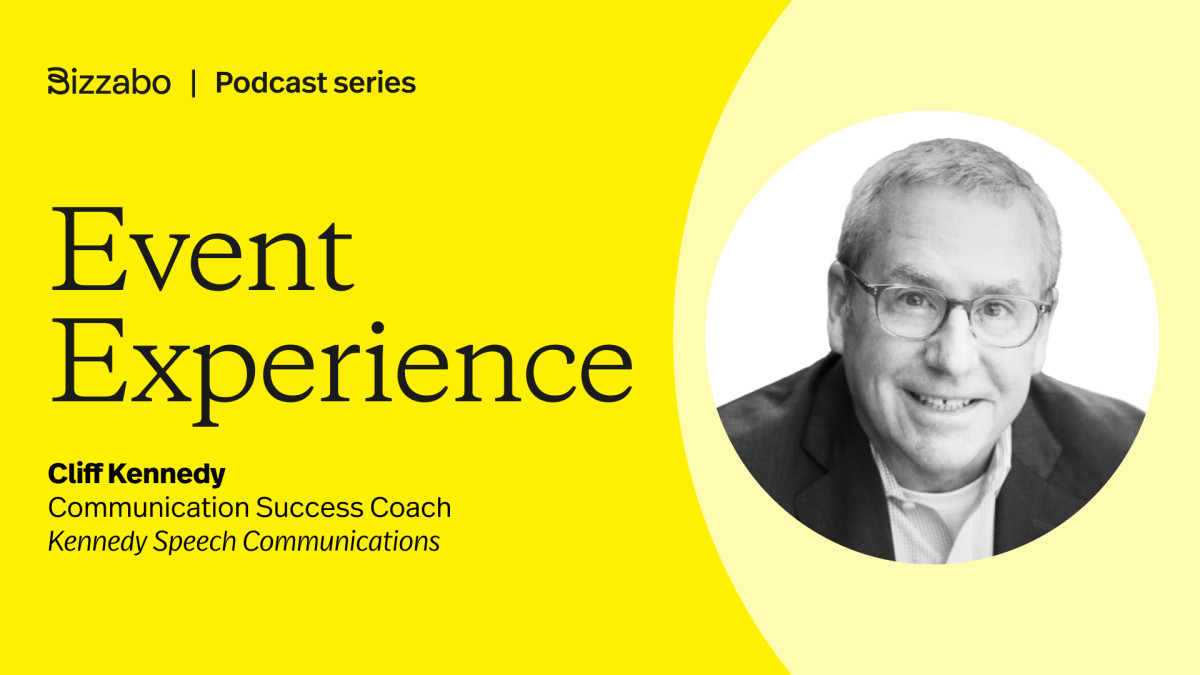
In this episode, we’ll examine the speaker lineup for today’s events and how adequate preparation can lead to astronomical payoffs.
Cliff Kennedy is the Communication Success Coach at Kennedy Speech Communications.
Cliff shares his expertise about how speakers should inspire audiences, the priority we should place on speaker preparation and rehearsal, and how non-native English speakers and technical experts can be more included and successful in event content.
Here’s what you’ll hear about in this conversation:
[00:00:12] Rachel Moore: Welcome to Event Experience by Bizzabo, the podcast where we bring the best and brightest event experience leaders together to share stories, tips, and lessons learned from creating some of the world's biggest events.
[00:00:31] I'm Rachel Moore, your podcast host.
[00:00:33] In this episode, we tap into the power of the spoken word with Cliff Kennedy, a communication success coach and public speaking consultant with Kennedy Speech Communications. In an industry so influenced by who is handed a microphone, the importance of effective public speaking is paramount to success. Cliff shares insights about how speakers should inspire audiences, the priority we should place on speaker preparation and rehearsal, and how non-native English speakers and technical experts can be more included and successful in event content.
[00:01:08] So let's get super meta and speak some words about how the spoken word impacts your event experience.
[00:01:25] We are back with another episode of the Event Experience podcast and I love talking about how much experience we bring to you listeners to really help you level up your game and on every aspect of events.
[00:01:37] For the past 31 years, our guest today has been helping in an aspect of events and experiences that impacts every audience member very directly. And that is the spoken word. His mission as a communication success coach and public speaking consultant is to develop today's speakers so they can use ideas to inspire and words to clarify and motivate who doesn't want that.
[00:02:01] Right. I'm very pleased to introduce Cliff Kennedy to the podcast. Cliff, thank you for joining us across microphones today.
[00:02:07] Cliff Kennedy: Thank you. Rachel. It's a pleasure to be here to have an opportunity to talk with you and more importantly, all your Event Experience listeners.
[00:02:15] Rachel Moore: Oh, thank you so much too. And I teased it up. Speakers are part of our everyday life in this industry, right? They're just, they're all over the place and can be all over the place, which I think is why we're talking to you a bit today.
[00:02:27] Cliff Kennedy: Exactly. So that's because my background, I provide public speaking and communication success, coaching for individuals, teams and organizations, primarily for events and other high stakes speaking opportunities. I always like to say, I help everyone with every speech presentation and conversation at an event that happens.
[00:02:45] I've been in the event industry for over 30 years. And I started as a creative director, writer, producer of these high end events, multi days, big sales meetings, customer conferences. , And then, had my own business and made it through dot-com bust, made it through 9/11, but 2008 started me on a new journey, which was really focusing on helping people develop and deliver their speeches, presentations, conversations.
[00:03:10] So I've been really fortunate to work in many different industries with the top organizations at that point. And, in a variety of different, scenarios and different locations. And I've also been a, TEDx Palo Alto coach for over since 2017. I've coached over 30 TEDx talks.
[00:03:28] Which is great.
[00:03:29] Rachel Moore: Wow. It's funny because every time I think of great speakers, I do think of TEDx or TED talks because, I know there's a lot of pressure right there. I think I even worked for a CEO one time who got to do a TEDx talk and it was like, you have to have it memorized and it's like, There's just such a lot of weight there.
[00:03:45] Maybe more so than the keynote to a big audience. You just share about that you have experience with producing events. So, you knew from the start, you're like, maybe there's a better way to do this, which is really pertinent.
[00:03:57] Cliff Kennedy: I find I end up being conduit between the production team and the speaker himself herself. So, if they have a need from production, I can put it into kind of production talk and they understand that better and vice versa. It's like, don't stand there.
[00:04:11] You'll get hit by a car, kind of instructions from them.
[00:04:14] Rachel Moore: Yeah. Find your mark on the stage. And we're going to segue into some get to know you questions. So, first of all, Cliff, what are your go to on the ground event day shoes?
[00:04:24] And I'm assuming from event, this is like you having to, walk many miles in your own shoes, but what are your go to shoes?
[00:04:31] Cliff Kennedy: It's kind of sad. They died there after the 3rd reheeling. Things started falling off. I mean, they're like the best shoes. I probably walked a few 10, 000 miles in those things. So now it's in the new ones that, I need that kind of structure and support, but then, You want something soft, but the ones that are a little too bouncy these days, I'm having some trouble.
[00:04:48] So basically, I'm open to suggestions if anyone wants to suggest certain shoes,
[00:04:53] Rachel Moore: We just did a teaser for this new season of the podcast season five that we're in. I might have to put a little montage together. So people would be like, great.
[00:05:00] Just listen to that and I can get some recommendations because we do have some guests who have made some really solid recommendations. So I'm going to do that I think for you. All right. Next question. Is there anything that you're listening to watching or reading these days that you cannot put down?
[00:05:13] Cliff Kennedy: Not really, unfortunately. I mean, I'm kind of, for some reason a little scattered and, I need to get my streaming game is off. Started a lot of things and not living up to expectations, but probably the one thing, I love music. I'm a, a very amateur musician, a drummer.
[00:05:25] And so I listen to all types of music throughout the day. So it's always my constant companion. And yeah, I picked an over ambitious novel as well, which I'm trying to get through, which,
[00:05:35] Rachel Moore: Yeah I've been there too.
[00:05:37] Cliff Kennedy: Your podcast will be the next thing.
[00:05:39] Rachel Moore: I think that's great. And like I said, I mean, you don't have to skip to the end on all of them, but at the very end, we do ask people about their shoe at least for the shoe recommendations, but excellent. Yeah, obviously there's a ton of awesome experts like yourself that have been on our podcast.
[00:05:51] So I, I highly encourage it. Is there a particular social post or a piece of media or even a hot take about events that you found interesting lately?
[00:06:00] Cliff Kennedy: There's this farm in the street Sunday brain food newsletter that comes out. And I've seen that, there seems to be a lot that typically.
[00:06:06] If not, every week, every other week, I take something from that and put that into my message hopper. And so that seems helpful. And then, I try to get as diverse of sources of news. I try to avoid getting news from social media, like, Abraham Lincoln once said, don't believe everything you read on the Internet.
[00:06:22] I'm a message collector. That's what I try to get people to do as well. Yeah. I'll sign up for a newsletter and, do a few of those and then cancel and try some different things.
[00:06:30] Rachel Moore: Nice.
[00:06:31] I want to ask you maybe let's get a status quo for the events industry, from your perspective and expertise, what do you, what would you say the state of today's speakers are at events?
[00:06:40] Like how are we doing?
[00:06:42] Cliff Kennedy: I'd say it's mixed. On one hand, there's more and more opportunities, more and more people looking for authenticity. They want it, they want to hear from the people who are actually doing it. So there's more opportunity to get people in.
[00:06:53] But, like I said, the audiences are, it's not okay anymore. It has to be, if not better than good, as great as possible. And just, the whole idea of what the virtual meetings and hybrid meetings that are going on now, it's just, that raises the degree of difficulty as well.
[00:07:07] And then, this age of AI and everything's going on, I mean, this idea of authenticity, and then this proof of humanity is really important, and that, the events are getting more technical, the LED screens, all the lighting, all these kind of things. But it's, it's all about creating this one to one personal connection with an audience. And then even more so, I think it's the role that speakers play in our life. And, where does an event really deliver that return on investment? It comes from the stage, both the big stage, but the keynotes.
[00:07:39] But I think, even more importantly, digging into the breakout meetings, the follow up the trade show conversations, that's where the rubber hits the road. And I should have my clients not to use cliches like that, but this is where the real value is made and the connections and engagement and between an organization and its key audiences. So my saying is, you can't have a successful event without successful speakers.
[00:08:03] Rachel Moore: Every single event planner listening knows the speakers are a huge part of it. I just went to an event. I think it was last week already.
[00:08:10] Geez. Where the keynote was Ryan Reynolds, very lucky, was excited and stuff like that. But it's interesting because a celebrity doesn't necessarily mean that they're going to be a good public speaker. And if Ryan Reynolds is listening to this, he was great. But also he was not by himself.
[00:08:24] He kind of did a back and forth, but then I think about C levels. So I think about C suite people where, okay, probably they're getting welcomed and invited on to keynote stages to be panelists, to be on podcasts like this one. And just because you are either a celebrity, you're a C for celebrity or you're a C suite person, that does not make you automatically a good speaker.
[00:08:46] What would you say to that?
[00:08:48] Cliff Kennedy: I definitely agree with that. I mean, too many times people are just kind of, I mean, obviously, in the C suite, you're busy and, how do you take the time and find the time to prepare? And so this kind of, digs into where I come from in terms of sharing processes and things like that to really help people prepare and deliver the value that, deserves.
[00:09:07] And again, that's for me. It's all about when you learn about my approach to things, it all starts with purpose and purpose is the value you deliver to your audience.
[00:09:17] Rachel Moore: Let's speak about that too, because I have a feeling and this, it gets really, human about, we just talked about people who, are privileged or lucky enough or have a status where like they are welcomed to speak on a stage.
[00:09:30] And there may be a lot of them that kind of get that deer in the headlights feeling like, Oh, okay. I know I need to do this. This is part of what I need to do. And but like we just pointed out, doesn't mean that they've had training, that they're coached, they're just instantly a great speaker because they happen to occupy a C suite or a corner office or a celebrity.
[00:09:48] I would love to ask you, from your perspective and experience, again, over 30 years of coaching people. In the craft of spoken word what do you find to be the greatest challenges for professionals who are finding themselves tasked to speak to audiences, yet they lack the adequate skills to be mic'd up on a stage?
[00:10:07] Cliff Kennedy: It's my little saying, a good speech code, but, everyone wants to be a better, more successful speaker. Most people need help. And for me, my mantra is change your perspective, change your expectations, change your results. And this whole idea of switching your perspective from it's about me and what I'm going to say to this whole idea of how do I create that more value for my audience?
[00:10:27] So at the end of this, at the end of my talk, they go, wow, that's the best 20 minutes or 30 minutes I've had all week versus why did I just spend my time doing this? It's kind of a question. Then you shift that perspective and then you can create and go from instead of not an informational talk, but a transformational talk where people are actually changing their beliefs and feelings and all those good things.
[00:10:47] And then, by expecting more, you may not always get everything, but you are going to get more than if you didn't expect in the first place. That's that whole idea of results. And for me, it all comes down to process. And, it's actually the formula to accomplish anything is purpose, your why and what you're going to do, then it's plus skills.
[00:11:05] How do you in speaker coaching? It's like, how do you walk and talk and all these different kinds of things. But then the third, most critical thing is your process. How do you get it done? And for me, I have, I call mine good branding, my communication success framework and it all it's a 5 step process that I realized that I started using when I was a creative director and writer.
[00:11:26] I had to wake up every day and deliver quality, creative and great ideas and great strategy. And so. I realized I had this process that I've been doing and I became a coach. I kind of drew on that. And so the process is pretty simple. It's, one is purpose, the first step and that idea of creating value.
[00:11:43] And you're going to hear me say that over and over again. And then two is strategy and this whole idea of how do you engage in power and energize your audience? How do you really bring their perspective and make it about them and more successful. And then the third step is preparation.
[00:11:57] First, your content. And I have a 10 step content development process as well. And step 10 is open PowerPoint. And so you come up creating your content and then the next part of preparation is your rehearsal. And so from there, I have, like, the 7 focus areas for rehearsal and this kind of rehearsal ladder that you go through.
[00:12:17] So, I mean, it's a whole process and meaning you can kind of, through a process means consistency as well. But then it gives you that kind of freedom within the framework. So you can continually be getting better, but more, as you go on and like for the C suite people, they kind of internalize this process and they can, they don't have to go step by step, but they know what they need to adjust and go from there.
[00:12:37] And then final, the biggest part of the process is measuring your success. And so I have four measures, which is engagement. How do you can't, you're not engaging, you're not communicating. The second one is clarity. Everyone understands what you're saying. And then the third is alignment.
[00:12:52] 'Cause we wanna get things done and you need to get people going in the same direction. And then guess what? The final measure of success is purpose and value.
[00:13:00] Rachel Moore: I want to touch on a couple of things you said there, which jumped right out at me. I liked that you said informational versus transformational. Do you find that maybe people who are not adept speakers or are looking at their next speaking engagement think I just need to get the information out there. That's the biggest thing I need. I need to make sure the audience gets this information. But they could be shooting far farther more loftier goal of transforming their audience, transforming that 20, 30, 45 minutes from what it could have been into something new for them.
[00:13:32] Cliff Kennedy: There's a Maya Angelou quote to, I may not remember what you said, but I'll remember how I felt when you said it. Humans are, we're emotional creatures, primarily. Belief drives behavior and what we believe is, how we act, but the key thing to remember is that emotion drives our beliefs, we typically believe things based on how we feel about them, but being good humans we're able to post rationalize.
[00:13:51] We come up with this kind of logic or reason, to explain why we did something based on our emotions. And this holiday, so you think of your audience, that you need to connect with them. Aristotle had their three rhetorical appeals, right? It's logos, which is logic and reason, which we think is everything.
[00:14:07] But the other one is ethos, which is your credibility as a speaker. And then the big one path pathos, which is your emotion. And, you need to appeal to at least all three of you, typically, and sometimes pathos is much more, I mean, just listen to our political discourse these days, and it's all pathos.,
[00:14:25] Rachel Moore: I even think about like a speaker where they're like, okay, I'm speaking at 1 20 PM in the afternoon.
[00:14:31] Let me think about where my audience is going to be there. They just had lunch. They're tired from a long day. This is maybe the sixth thing they've come to see today. But I know I've got to get this across, but I like that instead of making it so transactional you are, you're trying to inspire like you're saying, but I want you to come away thinking that was the best session I was at.
[00:14:49] I feel different. And almost saying, I bet they're coming into that talk with expectations like, Oh my God, I hope I can stay awake and let me multitask. But instead you can change the trajectory of their afternoon based on your talk.
[00:15:01] Cliff Kennedy: Another saying, every time a speaker stands before an audience, great things are possible. And, if you get, going back to this idea, a group of people that are aligned, going in the same direction, you can accomplish amazing things.
[00:15:13] Rachel Moore: We'll be right back with more Event Experience after the break.
[00:15:19] Rachel Moore: Let's face it. Venting won't fix outdated overpriced event management software that lacks the support and features you need. But Bizzabo's Event Experience Operating System will.
[00:15:32] Say goodbye to your frustrating legacy event software and hello to building more events that matter. Visit bizzabo.com. That's B I Z Z A B O.com to learn more about the Event Experience OS, KLIK SmartBadge, and more.
[00:15:51] Rachel Moore: We're back with cliff Kennedy to dig into when PowerPoint enters the speaker prep process.
[00:15:57] One other thing you said, it was like, wait, what? You talked about a 10 step process of preparation and step 10 was opening PowerPoint. How early are people opening PowerPoint is like, Oh, I'm preparing for my
[00:16:07] Cliff Kennedy: Most people, , they start shuffling the decks and they, kind of move things around and then they end up with a bunch of visuals that they're gonna try to message. So , that's messaging your visuals. And what I, my process is you end up visualizing your messages.
[00:16:21] So it all begins with digging into your audience and the foundation of things, the value you create, what your audience wants, what they don't want, understanding them creating, you're gathering your messages together, and then organizing them and prioritizing them so that, you want to be, what people tend to do is they, you know, evidence therefore a conclusion.
[00:16:41] But what happens when you do that with your audience, you go evidence, they come to a conclusion themselves and they stop listening to you. And so what you really want to do is, deliver your conclusion and then back it up with your secondary messages. And that way your slides are working for you and you're not working for your slides and, especially with all this inflation going on, slides don't pay well at all.
[00:17:01] Rachel Moore: That's excellent. We talked a little bit, I mean, I've noticed a thread we're talking through here, which is very true is value, the value you are delivering to audiences and then the value you feel as a speaker. Let's get back to event profs who are listening to this and they, the whole thing, I mean, speakers are an aspect of the event.
[00:17:16] They are trying to deliver an event that brings value. In many aspects, the money kind and also the experience kind. And we've all heard that practice makes perfect. But when I ask you this this might be a question that event profs even are thinking all the time too, might be a pain point.
[00:17:31] Can today's event profs really afford to let speakers learn as they go? When so much is on the line for event success, like they're like I'm going to enlist the speaker. I hope they're good. Like, can they afford to be doing that?
[00:17:44] Cliff Kennedy: Part of the eventprof struggle with this is they, typically if you ask me and any other speech coach who their biggest competitor is, it's no one, and that the event, it's, we're kind of off the radar and, hopefully this is why I'm here to get this on the radar.
[00:17:59] And, it is so they, in some ways they can't afford not to, but, in a lot of ways it's not really part of their process as well. So I have clients that work in an event with just minimal stuff. Sometimes they'll just go, Hey, Cliff, can you do a webinar? Like one on content development and one on delivery and, yes. And it's all great. Or the other ones are, no, I need you to work 20 hours with the CTO so he can walk and talk and, deliver a great keynote.
[00:18:21] And, that's the super, intense and then onsite rehearsals, presite rehearsals, all this kind of thing that you can get into. So, it's always a step process. The first thing really does, it goes back to that idea of changing your perspective and that, realizing you can, you do have control over this by really helping your speakers perform at their very best.
[00:18:40] Rachel Moore: Yeah, you're talking about every speaker can do better, even just that with a little bit of minimal support. Do you have like a particular formula or approach that you take with speakers as far as like, is it cookie cutter or do you kind of customize it?
[00:18:51] Cliff Kennedy: I have, it's a customizable, but I have a process I call, Better Speakers, Better Events process and it's a 16 week process to kind of start like 4 months in advance. And this is where you start your strategy and understand your theme and everything like that. And then you typically have a kickoff with all the speakers and their communication teams and their support. And then you begin the content development process and whether it is, working virtually and group calls, one to one calls, all those kind of things.
[00:19:19] So it's all kind of based on what's needed and by whom. And then we kind of have another touch base with all the speakers for the delivery side of things, pre site. And then, they all rehearse and, I have the seven focus areas and a lot of little rehearsal tricks, like, rehearsing backwards or rehearsing out of order and, doing all different types of things and having some fun.
[00:19:41] And then then there's, if necessary, there's pre site rehearsals. You're doing a first rehearsal with anyone on the stage with, hundreds of production personnel everywhere and just kind of, and then she's presite and onsite, kind of the offline room where they can work, whether it's scripting graphics and then, the onsite rehearsal on stage, the final dress.
[00:20:01] Rachel Moore: Nice.
[00:20:02] Cliff Kennedy: And then the nice thing is you go back and you go, okay, what, what's the evaluation? How do we get better?
[00:20:06] Rachel Moore: Nice. You said 16 weeks and at first I'm like, wow. But then I'm like, that just highlights how important this is. This is not something that someone typically you're not, it's not like, Oh, I'm just going to learn to ride a bike in an afternoon, which is possible.
[00:20:18] But this is not that. This is, it carries so much weight with it, which we're going to talk about in the next question. My next question for you, but it's obviously something that takes a lot of training. It takes building that muscle to, to get good at this. And 16 weeks actually sounds really realistic when you consider what's on the line.
[00:20:35] Cliff Kennedy: It's well, to, have people thinking about it already. I mean, so, for me, again, I tell them, fill up your message hopper, this is the time now is the time to go. Okay. I want this data. I'm going to want this. Oh, I'm going to get some stories. I can tell about this, or, I'm going to read this.
[00:20:49] I just read this interesting article. I want to bring that in. And so this is kind of, the early beginnings to start thinking about things because, we can all come up with good ideas in the moment, but what really good ideas start happening after they percolate and, they sit a while in your hopper and they start to mix together and, all these ideas.
[00:21:06] And then, when the time comes, what are my primary messages? If I look at all these things, what are the kind of five Declarative statements I can make from these that become the, basically the foundation of my talk and my speech.
[00:21:18] Rachel Moore: Yeah.
[00:21:18] Cliff Kennedy: But I'm just on the other hand, though, I've done this in 16 hours as well,
[00:21:23] Rachel Moore: Wow.
[00:21:24] Cliff Kennedy: One of my claim to fames or something. I got a call on a Friday afternoon saying, what are you doing this weekend? It's like, you want to fly into Vegas tomorrow and help the CEO, he's got to give a speech to, 5, 000 people, global sales force on Monday and he's got nothing.
[00:21:40] And, so that's the other hand thing. That's the live event, my live event experience. That's where that comes into play.
[00:21:46] Rachel Moore: Wow. And I want to, coming back to the question of value and, before we get in a couple other questions too, but just, let's hover on this too. We talked about can event profs afford to let okay, speaker, you're just going to cut your teeth on my event.
[00:21:58] I hope you're good enough for my audience. Let's do talk about money. Like what kind of ROI are we talking about when it comes to having a speaker who knows their stuff and is executing well versus someone who's just getting up there and kind of winging it. And you can tell that the skill, the prep wasn't there.
[00:22:14] What does that mean? Dollars to doughnuts. What are we talking about results here?
[00:22:16] Cliff Kennedy: So, from an ROI standpoint, it's tremendous. It's hard to quantify ROI, but there are some basic things just, a speaker that's prepared is not changing the graphics at the last minute. You're not running into overtime with the graphics team, the production team, your onsite schedule doesn't get blown up because they're doing their very first rehearsal on stage.
[00:22:36] There's kind of a logistical part of it, as an old time producer, it's like, okay, how do you make this thing work more smoothly, more effectively just from a general cost standpoint. I did some numbers. It's kind of true.
[00:22:47] It's like, if you only do a 90 foot LED wall versus, 100 foot LED wall, you can afford speaker coaching. And, obviously, depending on what's going on, but, the other story, it's like, it could be like, 1 to 5 percent of your budget. I mean, when you get into multimillion dollar budgets, it's not, and you're near that, but it's definitely affordable.
[00:23:06] And it's kind of similar to a coffee service in a lot of ways, from a cost standpoint. But the results are visible to everyone that can see, and everyone knows and they go, someone gave me something of value and I cherish that and I really appreciate that.
[00:23:22] And I remember that next time I'm going to buy something, or, all those kinds of things.
[00:23:26] Rachel Moore: I'm just even thinking while you're saying that, like, I think about a platform like Bizzabo where, we do webinars and we do we power events as particularly, virtual ones too, but also in person, but you can track, especially for virtual, but also for hybrid and in person, but you can track both.
[00:23:41] The moment that someone is checking out, like if they're like, yeah, you had me for the, maybe the first two minutes. But if it's not an impactful speaker and they're not giving me any value, guess what? My eyes are going to skate to another screen. I'm going to start looking at my phone or multitask and you lost me.
[00:23:57] And that is lost ROI.
[00:23:58] Cliff Kennedy: I mean, I do the room, the air pressure test, you're standing in the room that you can actually feel, because people start they're breathing in and breathing out at the same time and the, or the, people are holding their breath while the speaker pauses, and you can kind of sense that in the room these ballrooms with, not super high ceilings and stuff, but you can feel that, there's the energy in the room is there
[00:24:19] Rachel Moore: Yeah,
[00:24:20] Cliff Kennedy: live events.
[00:24:20] I love. So
[00:24:21] Rachel Moore: I'm going to, I'm going to be listening for that next time. And I'll be like, okay, everybody good. When you know, is there pressure changing? That's how I know.
[00:24:27] Cliff Kennedy: My, my call to action for all eventprofs is SCAITE spelled S-C-A-I-T-E and pronounce skate and it stands for a Speaker Coaching Always In The Estimate.
[00:24:38] That, again, some clients may not want it, but it's like, how, how hard is it to throw it in the optional things, the pitch and, and some clients who go, they don't think about it until you mentioned that to them and then you go, wow, we can, for 10, 000, we can get a speaker coach and, make the event better, the answer is yes.
[00:24:54] And they go it's good. Let's try it. Or, our CEO needs help. Or more importantly, we have a lot of technical and, a lot of technical people that are giving talks and how can we make them more effective too.
[00:25:04] Rachel Moore: I love that. I love it. No, and it's super important to learn. Cause again, from a planning standpoint, that's important for our audience to know, be like, Hey, this, not only is this an option, maybe it's a must do, because especially if you want that to be a successful event for everyone from attendee to sponsors, to the C suite, to your board, to the sales team and everybody super important.
[00:25:26] Thank you for sharing that. And then I know that looking at what you do you also specialize in working with non native English speakers, as well as more technical experts. And that's such an important part too. Shoot. This podcast is from a SaaS product. There are developers and engineers behind the scenes who are making this happen.
[00:25:46] They're great at what they do, maybe not exceptional or skilled at speaking to a very large audience. So, and that's just the technical side. And then of course, non native English speakers, because there are speakers across the globe that offer value. They aren't in just one geo.
[00:26:02] So I'd love if you could share a bit about that experience and why it's so crucial that you also work to help these groups get better at speaking.
[00:26:09] Cliff Kennedy: Definitely. So let's begin with English as a second language. Like you said, we want to bring new voices, more voices into these events. That's everything we want to do and for me I'm married to an English as a second language person. So I'm through that.
[00:26:22] But my whole belief is that, those people have superpowers that they're able to think in different languages. And because, the language you use has some impact on, the thoughts that you have and, that they're able to see things differently and say things in a more unique manner because they have these different perspectives.
[00:26:37] So it's like, that's, anyone says, people don't want to hear me because I have an accent or something. It's like, no, this is the superpower that they have. But when it comes to accent, there's ways to work on that.
[00:26:47] I'm not a pathologist. I don't deal with those kind of things, but I say, read English newspaper articles out loud and it'll help with that. And, if there's certain sounds that you have trouble with, we just kind of focus on that and help them avoid that or overcome that.
[00:27:02] And then for the technical people, so often they're the ones who really buy into this whole perspective and changing things around. And, this understanding, it's going from evidence, conclusion to conclusion. And here's the evidence to back it up. And, this is where we get to this idea of AMD - absolute minimum detail - that you need for your audience.
[00:27:22] And, so really helping technical people shift their perspective so much more, instead of going this is not about me and all this kind of cool tech stuff I'm loving to, this is about my audience who, for this particular audience they're not super tech people.
[00:27:36] So I need to be giving them the detail that they need. But my next one is with all these other tech geek nerd, people that we can just totally get tech out on it and and go crazy with it.
[00:27:47] It's just really, again, it starts with that shift in perspective.
[00:27:49] Rachel Moore: Yeah, I love that. And really important too. And that's where I think especially our listeners, it might be easy to default to somebody like, Oh that, that might be the easy get for a speaker. But remember if we're trying to provide value to that audience, broaden the scope of where you're looking and like you said.
[00:28:04] Tap into those non native English speakers, the global speakers, tap into the technical as well, because talk about bringing some knowledge and they really can and might just need a little help. Like you said to make sure they're bringing that across.
[00:28:15] I finally have our last and easiest question of all. Where can our listeners find and follow you online, Cliff?
[00:28:21] Cliff Kennedy: I have my website, kennedyspeech.com. There's famous Kennedy speeches and then there's me that when you look that up and I'm also on LinkedIn at Cliff Kennedy. If you have any questions, anything like that, or you'd like to get, you'll learn more about my processes. Yeah, please just reach out. I'd be glad to help.
[00:28:37] Rachel Moore: How about buy one, get four free? Cliff's skill up advice has five parts that are important to today's event planners.
[00:28:54] Cliff Kennedy: I've been playing around with micro learning courses. And I just, I'm just putting the finishing touches on one for, event planners and producers. And so it's five strategies that they can do.
[00:29:06] Notice that they're not tips or tricks because I'm a consultant. I do strategies, which you check more for but so these five strategies are one, make it a priority. So this is that, this idea of thinking about, Helping your speakers succeed, make that a priority, have a process, which, whether it's my process or your process, however, it works, but, that's your how you get things done.
[00:29:26] The 3rd, I say is walk a mile, you'll try to think about your audiences or your speakers perspective. And so often, they have missing deadlines, all these kind of things. There's usually some reasons beyond. That they don't want. I mean, a lot of people have a fear of public speaking.
[00:29:40] And, how do we help them understand that and go through that? And then you measure results with engagement, clarity, alignment, value or everything. And then the fifth strategy is get help, and whether it's, obviously I'd love to help everyone or there's many, some tremendous coaches everywhere.
[00:29:55] So, don't be afraid to get help. We're here to help.[00:29:57] Thanks again to Cliff Kennedy for joining us on Event Experience. And thank you for listening. If you're enjoying the show, we'd love to hear it. Connect with us on social and subscribe rate and review us wherever you're listening. Also, don't forget to share the show with your colleagues and friends. You can find transcripts of each episode and key takeaways on bizzabo.com/podcast. On behalf of the team, thank you. We'll gather again soon for a new episode of Event Experience.


