
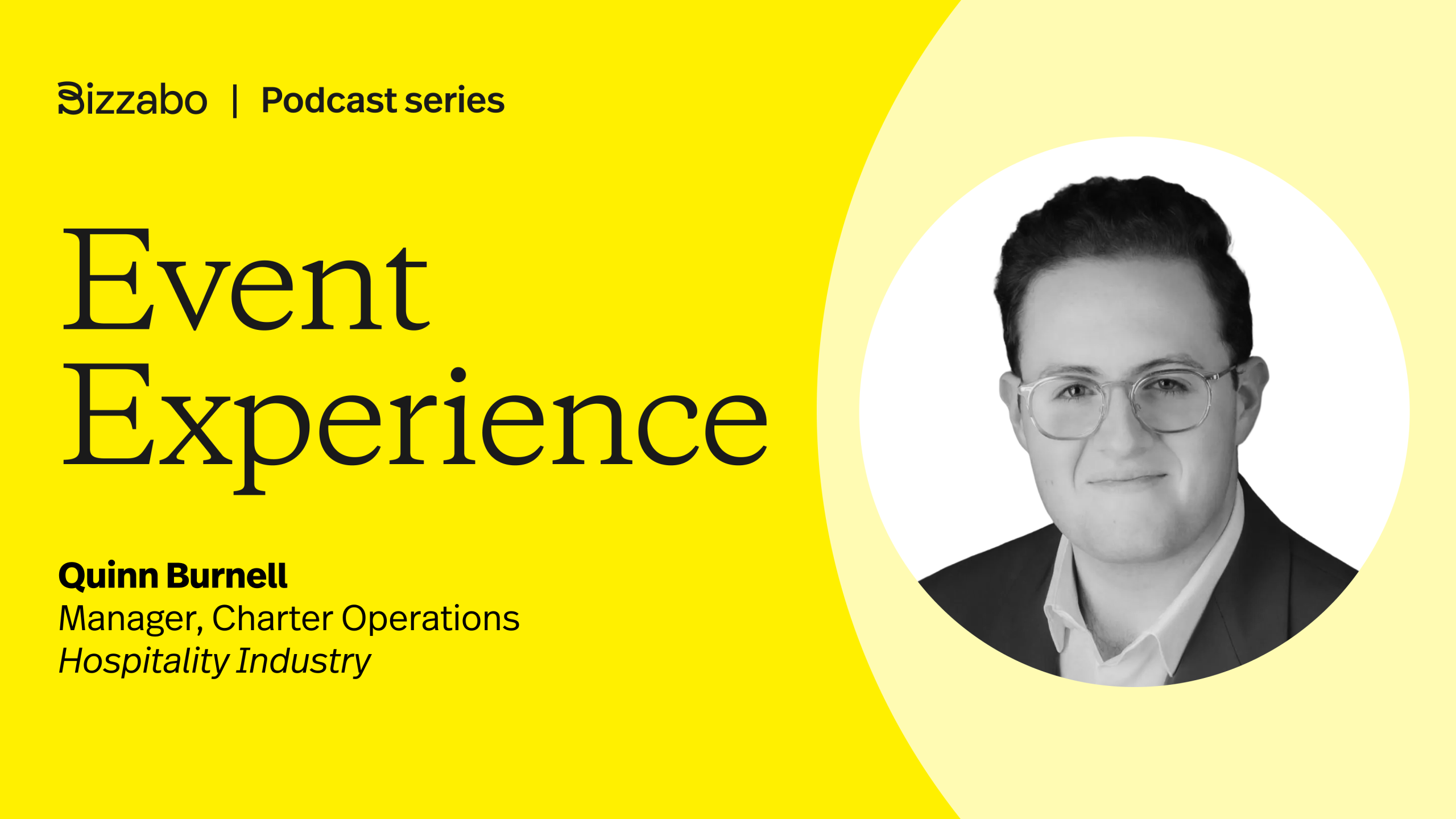
In this episode of Event Experience by Bizzabo, Quinn Burnell, a seasoned hospitality and entertainment leader with experience in cruise lines and luxury events, dives into the power of emotional intelligence and authenticity in creating memorable guest experiences. He unpacks what today’s attendees, especially Gen Z, truly value: feeling safe, seen, and emotionally connected.
Quinn shares how spontaneous moments of awe and genuine care can elevate an event beyond logistics, and why leaders must first care for their teams to deliver standout service. Drawing from global hospitality practices, he urges planners to design events that feel personal and culturally attuned, not just trendy.
What You’ll Learn:
Enjoyed this content? Subscribe to our newsletter and get insights like these delivered straight to your inbox.
Welcome to Event Experience by Bizzabo, the podcast where we bring the best and brightest event experience leaders together to share stories, tips, and lessons learned from creating some of the world's biggest events. I'm Rachel Moore, your podcast host. Today's episode takes us to the High Seas with our guest Robert Quinn Burnell, a hospitality and entertainment professional for a major cruise line.
[00:00:38] Rachel Moore: Quinn will share with us about generational differences in hospitality expectations, the significance of team care, and practical tips for event planners to enhance guest experiences. You'll also hear the word awe bandied about frequently as something we should definitely shoot for in every event experience.
[00:01:10] Rachel Moore: Everyone, great to see you again here on a new episode of Event Experience. And today's guest is a hospitality and entertainment professional whose career began in live events before he was even out of his teens.
And I'm really betting a lot of our audience, a lot of you out there can relate with this. Um, now at just 22 years old, he has built an international career managing large scale productions and creating. Unforgettable guest experiences across the cruise and luxury hospitality industries. I am thrilled to welcome Robert Quinn Burnell to Event Experience Quinn.
Thanks for so much for joining us here on the podcast.
[00:01:48] Quinn Burnell: Rachel, it's a real pleasure to be with you. Thanks so much for having me.
[00:01:50] Rachel Moore: You bet. I am super fascinated that I, I love that we get all kinds of experienced people in here. but this podcast is really for people at any age. And so, I'm super excited to have you on the pod today, but I know I just gave the briefest of brief intros, to you. So I wanna toss it back over to you.
Tell us a little bit more about yourself. Quinn, like, what's your day to day like, your roles and stuff and, and you know, feel free to get professional slash personal, but, um, tell us a bit more about you.
[00:02:17] Quinn Burnell: Yeah, absolutely. So I live a bit of a dual life, so, I work in the cruise industry, um, for, for one of the top three major cruise lines in the world. I'm the manager of charter operations, so our clients rent out the entire cruise ship and throw massive parties, corporate outings, retreats, that sort of thing. So, so that's a, a big part of my daily life.
Uh, and on the other hand, I do run my own organization and I freelance in events and parties, and then really focusing in on hospitality leadership, um, which is, is gonna be a big part of what we speak about today, as you know, we're developing hospitality, for the future, right?
So, so how are we making people feel, um, seen, heard, and, belong, uh, within our event world, our concerts and festivals.
[00:03:09] Rachel Moore: You're so right. , We are indeed gonna talk about hospitality today. By the way, I had no idea one could rent out an entire cruise ship, but of course that makes sense. I mean, I know yachts and things like that are, I mean, rented out. I worked for a company where they did indeed rent out a yacht. But cruise ship is just like, whoa. That's a whole another level. So, um, pretty wild.
[00:03:29] Quinn Burnell: Absolutely. I, I'll, I'll just tell you right off the bat, one of my favorites that we do, it's 96 hours of nonstop EDM music. We dock at a private island, uh, for about 18 of those hours and throw a massive party on the island as well. It keeps us on our toes and, and I just love that community as well.
[00:03:49] Rachel Moore: Wow. Oh my gosh. Now I just wanna go on a cruise. Okay. Um, and, and everybody listening is like, yeah, same. I am gonna segue us now into some get to know you questions. Um, I will lob a wrench into here because you can answer one this first question, it's kind of a pick the road less traveled by. We'll pick which path you want.
So you can either tell me what is your favorite AI prompt to use nowadays when you are event planning, or what are your go-to on the ground event day shoes to keep your feet alive for the 14 plus hours, you know, you're gonna be on them so you can pick AI prompt or shoes.
Which one would you like?
[00:04:23] Quinn Burnell: I'm gonna get a lot of controversy here. I am a 22-year-old event professional who doesn't use AI for my work.
[00:04:31] Rachel Moore: Okay.
No judgment. I wanna, I wanna hear more a little bit, but yeah.
[00:04:35] Quinn Burnell: I like to experience things with my heart and soul. I spend my time out in the field, uh, at restaurants, at bars, at events, at galas, at trade shows, just really feeling the soul of what is being offered today and how it can change, or how it needs to change and how it needs to level up for, for the future.
The shoes that I wear when I do that, It's funny, it's a niche question. I wear Onitsuka Tigers, which are a Japanese shoe brand, which, you actually can't buy off the shelves here in the United States. You can only buy them, you can buy them online, or you can buy them in Asia.
There's nothing crazy or special about them. I just really enjoyed them.
[00:05:17] Rachel Moore: Well, uh hey, we have a very lengthy list of shoe recommendations by our guests, so, but I also love, thank you for giving us that insight too. Um, and, and again, As I mentioned, hospitality is a major undercurrent, but yeah, AI's been a theme we
[00:05:31] Quinn Burnell: Yeah, absolutely.
[00:05:32] Rachel Moore: so it's, refreshing and neat to like be like, okay, good.
Here's someone who's, "Lemme go out and feel that stuff before I Yeah. Yeah. you know, think about, let me go run to ChatGPT now."
[00:05:41] Quinn Burnell: Because, because AI has no clue what hospitality is,
has no clue It doesn't. Sure. I know AI makes people feel certain ways, but I don't know if that's always the right way. Right. Do you feel taken care of by ChatGPT? I don't think so.
[00:05:56] Rachel Moore: Well, I'm telling you, ChatGPT wasn't gonna go run out and get that hot dog from that vendor outside and let me bring it back in. You know, it's like, not yet anyway.
[00:06:04] Quinn Burnell: Yeah, that's true.
[00:06:05] Rachel Moore: what happens. Um, next question. Are you listening to watching or reading anything these days that you can't put down and it doesn't have to be related to events?
[00:06:13] Quinn Burnell: Sure. I'm actually, I'm rereading Unreasonable Hospitality right now by Will Guidara. I think it's one of the best books for our industry. I just finished watching The Sopranos, which, uh, I hadn't seen, and I loved it. I am listening to Diary of a CEO and I'm listening to, the Caleb Hearon podcast, which is, uh, very, very funny.
It's, it's lighthearted.
[00:06:37] Rachel Moore: That's always nice. I have to laugh a little bit every day too.
[00:06:39] Quinn Burnell: Exactly,
[00:06:40] Rachel Moore: Have been a few, some humor in there. Great recommendations. Um, is there a particular social post or a piece of media or even a hot take about events that you found interesting lately?
[00:06:51] Quinn Burnell: What was it? Uh, hospitality was the original UX design.
[00:06:55] Rachel Moore: Yeah.
[00:06:56] Quinn Burnell: It's about the sincerity, it's about the, the user experience. We're seeing a new wave of embracing anti perfection. Moments that feel raw, human, that's the future of connection, by letting people be who they really are.
I think that's what it is. And I, I also think that hospitality people can read a room faster than AI will.
[00:07:14] Rachel Moore: Agreed. Yep. There's someone I work with who she's always like, "Well, these swag bags aren't gonna get filled by AI, so I think I'm good."
Sure,
[00:07:22] Quinn Burnell: exactly.
[00:07:22] Rachel Moore: It's like, not yet. Yep, that's right. So,
[00:07:25] Rachel Moore: I'm so glad to have you on. What really drew me to wanna have you on the show is because, among all the themes we've been hearing this year, particularly AI, uh, budgets, micro events, there's been a lot of those recurring themes, especially bpo we've been talking about those not just here on the podcast, but in our webinars and stuff.
But there's been this. Other kind of underlying current among it all, and I'm hearing it over and over again. And that is the concept and practice of hospitality. So to kick off today's discussion with you, I'd love to ask you, what is your personal philosophy around hospitality, especially in your role and kind of what you experienced so far?
[00:08:01] Quinn Burnell: Gosh, you know, it's nuanced, but it's also so simple at the same time. I really believe that hospitality comes down to its core of, of making people feel cared for and, and anticipating their needs before they come. And, you know, in the event world and in the festival world, we often find ourselves going to a place of, of operation, right?
What's the most efficient, what's the best way to do things. So, hospitality really turns into emotional intelligence in action. is how I see it. Because, in your day-to-day relationships, whether that be romantic, your platonic, your friendships, you have to anticipate other people's needs and really make an effort to make those people feel that they have belonging in your life and that you bring value to their life. Right?
It very simply translates across the board. And I discovered this back during, uh, the pandemic time when everyone was, you know, hurting for work and, I had become a server at a restaurant. And it was my first time ever being a server, and I just implemented a few simple pieces that are just making people feel more taken care of and that resulted in quite a big movement and what has driven me into the hospitality industry.
Hospitality can't be scripted, it's personal. And that is the piece that a lot of people struggle with.
You know, when, when we're, when we're planning and when we're working in operations, which I do, it's very easy to look beyond that. It's really about creating a place where people feel like they belong. You want to be able to surprise people with what you do.
We'll touch a little bit later on. the theory that I have around awe, AWE, as it's very important. That's my take on hospitality.
[00:09:47] Rachel Moore: You said a lot there that I think is super crucial. By the way, emotional intelligence or EQ is one of my favorite concepts out there and realities. I mean, how many of us, we know when we're working or engaging with someone who has good EQ, high EQ or, "Oh no." That's not a muscle they tend to exercise. It is night and day difference.
And so I really appreciate that you really put the emotion into it. I think all of us can relate to this, it is so easy to fall back on that checklist, get super operational, like you said, where it's like, "I'm just getting things done that need to get done."
Well, that person across from you isn't just an item on your checklist. They are a living, breathing human being with their own. They had a morning. They've got a background, or maybe they're doing great, maybe they're not, but that matters and that's gonna surpass your checklist. So I am so excited.
I wanna dig into this more with you too, because, yeah. This feels super, the intentionality that we've all been kind of striving to do, and it just really demonstrates that there's more to it. I already mentioned this, like our listeners range across generations and hospitality, uh, like, I'm Gen X, for instance. I am not 22. I am 50 right now and between you and me, hospitality can mean very different things. I can think of, for instance, in the past, whenever I've like, say applied to a job or my kids had a birthday party, I always send handwritten thank you notes went out. Whereas nowadays, people are like, "Yeah, I just, I'm gonna send an email." chat, text, whatever. It's different.
So, what do you think today's generations of planners should know and feel about hospitality and events keeping in mind, even our listeners and event planners today range across those generations. We cover all the bases there, but what should they be keeping in mind?
[00:11:33] Quinn Burnell: Absolutely. And you know, just first of all, what word comes to your mind when you think that the world is changing from sending handwritten letters to emails and texts?
[00:11:42] Rachel Moore: Digital. I mean, it, it's faster, it's digital. to me it feels like, just very online and like, that's where they're gonna see it, I guess.
[00:11:51] Quinn Burnell: That's true and, the word I describe it as efficiency.
[00:11:54] Rachel Moore: Yeah. Yep.
[00:11:55] Quinn Burnell: And as the world has changed, I find that Gen X values efficiency as one of the top pieces because you're moving very quickly. You have a very busy life. You have a lot to provide for, so you want to be efficient. You want to still let people feel taken care of, but you like efficiency.
Also, you know, oftentimes when we're out in the world, people have value efficiency within that demographic. Now, baby boomer generation values familiarity. That makes them feel welcome and taken care of, and heard and seen. It's what feels normal to them and familiar.
And Gen Z, it changes to authenticity. It's not perfection, it's authenticity and the through line there is emotional resonance, right? It's the want or the need to feel like you're a part of something. It runs through each piece of that aspect of hospitality. And I think that that's where it comes into the importance of, being able to recognize hospitality through events.
We need to focus less on micro trends, we need to focus less on this, and we need to focus more on how people feel during and after the experience. That is what we're developing. Data helps us plan, but empathy keeps people coming back to our events, to our spaces, and it keeps clients sharing your, information and recommending you to further work.
[00:13:22] Rachel Moore: I so appreciate that too, and thank you too for breaking that down, amongst generations. 'Cause I, I have a feeling, you know, again, an operationally minded event planner might be like, "Great. Yeah, I do need to have a hospitality factor in there. But my audience of, you know, whatever your target audience is, is probably spanning multiple generations."
So are they thinking, "Well, I've gotta create something different." Or they're like, "Well, what can I do that will tick all the boxes for all those different generations?" And you gave that to us, that emotional residence. Every person, whether it's me as a Gen Xer, or you as a Gen Z or a Millennial, or a Baby Boomer, they wanna feel like they're part of it.
How do you get them across that line? So I thank you for providing that, 'cause I think that can help say, "Great, okay, I can do that." What are those ways and activations and what kind of environment can I structure that makes sure that they have that right?
[00:14:13] Quinn Burnell: And I'd love to share just a funny story about that is so, I'm the type of person that I enjoy absolute topnotch, fine dining service. I come from a, uh, restaurant background growing up. My family owned and operated restaurants. My father was an executive chef. I really value that. I have a standing table at Le Bernardin in New York. Come on. You know, like we, we, we like to have a good time here.
But, speaking to the desire for authenticity, I'm also a regular and have lunch multiple times at the diner in my town. The diner is the diner that inspired the Norman Rockwell painting. You know, if the police officer looking at the at the boy. Yes, exactly. So it's that diner that that Norman Rockwell got the inspiration. And the prices are still from the nineties. uh, you know, You can get in and out of there under $10. It's great. But I'd say the service is far from perfect. Right? It is a small town, local diner with maybe 20 seats in the whole place.
The authenticity part, it feels like you are in an episode of sitcom. There's no option to not be a part of the story, right? So it's everyone's interacting with each other, everyone's speaking and, and having a good time. You know, and I think that's where that authenticity piece comes in.
Yes, do I enjoy perfect five star service? A hundred percent. But I also equally enjoy an authentic experience that feels down to earth, grounded and not like it's trying to be something else. And I think that that's where we run into a big issue with events these days is we're putting on a mask of hospitality. It's not about putting on a show. It's about really developing those skills and ideas to really get that point of across because people can see through fake hospitality, it's pretty easy. But when you're really considering how you are making other people feel, that's when you make a difference.
[00:16:14] Rachel Moore: Yeah. No, for sure. Thanks for sharing that too. That's such a great thing to highlight as well because, one person's gonna wanna go do something different. Like, you're gonna have different things you want to engage with, where it's like, yeah. I wanna go out for a fancy dinner, have the full pristine dining experience.
Um, but today, now I wanna go be cash, you know, and I just wanna like, hang out. I'm cool if, even the table might be a little wet from them, wiping it down from the last person or what, whatever. This is what I do. That is super key too, because, setting those expectations is important so the person knows what they're in for and then you can surprise and delight from there.
Right. But, I love that you gave that as an example of how you are equally delighted. Whether you're in one of those situations or the other, because your expectation of what you're gonna get, and what you're appreciating. And as you said, that also again highlights that difference of like, well, is it familiarity? Is it authenticity? Is it efficiency? Et cetera, or, you know, something super elite feeling, right?
[00:17:14] Quinn Burnell: Just one extra thing to highlight here, and I wanna focus specifically just for a moment on, the wedding industry. And that is realistically, what the client is paying per person, per head is often close to that of a Michelin starred restaurant.
Right. You know, we're, we're talking a couple hundred dollars ahead. Right? At the very least. With a lot of the, weddings that happen, that I've been involved in, I mean, these are 60, 70, $80,000 weddings, there's a level of expectation that comes with the hospitality, right? I think, too often we see that fall short because the wedding industry is seen as, side work or side hustle, um, hospitality work, especially, you know, the, the people that we're hiring for servers and restaurant side of the wedding. And I think that's where we could really see some development within the industry, is how we can train and develop our staff further into those industries when there is an expectation that comes with a price point.
[00:18:15] Rachel Moore: We'll be right back with more event experience after the break.
From backstage to the spotlight, The Event Experience Podcast by Bizzabo gives you a front row seat to the event industry's most captivating stories. Want to get more out of each episode? Visit bizzabo.com/podcast. That's B I Z Z A B O dot com forward slash podcast for show notes, transcripts, links, and resources mentioned in each episode and more. The Event Experience Podcast by Bizzabo where events become unforgettable experiences. We're back with Quinn Burnell to tackle how team leaders can be training up their event employees to truly deliver authentic hospitality.
[00:19:00] Rachel Moore: Well, you're segueing me perfectly into what I wanna go into next because a lot of our listeners might be team leaders of event planners or brand leaders where you're like, you, you've got an eye over how successful your event experiences, your activations are. But you know, you have a team of people that need to, execute those for you and get the results that you're looking for.
So, I wanna ask you this then. What do team and brand leaders today need to be mindful of around hospitality and the experiences that they and their staff are delivering?
[00:19:33] Quinn Burnell: That's a really great question, and the surface level answer is the tale as to as old as time. And, if you're listening today and, you've heard this many times, but you really haven't made a change yet, please. This is the number one piece and that is, if your team doesn't feel cared for, they are not gonna care about your guests.
Very simple. And, that piece that we were just talking about, that so many of the, staff that are hired for events are temporary workers, right? They're only being hired and paid for that one event. So why should they care? if you aren't showing them that you care? No one wants a flustered team leader running around saying, "Who tied the seat cushions on backwards?" And all this stuff, you know. That's the core piece of it.
The next piece there, once they feel cared for, it's giving them the space of structure with spontaneity. To not structure every minute and every piece of their service.
And this is where we saw this huge shakeup with Will Guidara, in Unreasonable Hospitality, because he was in a three-star Michelin restaurant. and in those settings, the service is literally written down on a checklist, and you must abide by every single piece. And that is a, uh, a formula as to how to give someone the perfect meal at this restaurant, right?
And then Will Guidara shook it up. Many people know that the famous story, um, he overheard a table they had visited New York and the one thing that they never did, that they really felt that they missed out on, was that they didn't get to have a New York hot dog.
So he literally ran out to the sidewalk and bought a hot dog, brought it back to the kitchen, had the chef cut it up into four pieces, a swish of mustard, a swish of ketchup, and he walked out and he put this down in front of them, and they were really blown away. So. It is disrupting the formula. We all have a formula.
I have a formula. I'm like, oh, you know, when, when we're talking to people, we have a formula in our heads of what works, what doesn't work, what we should say, what we shouldn't say. But it's about giving space to be more spontaneous and allow to create moments of delight.
It's also structuring consistency within your team. I always say consistency builds trust, but humanity builds loyalty. Really treating those around you like humans.
And that goes back to what we were originally saying is, that server that came in today might be breaking up with his girlfriend right then. You know, like you literally don't know where people are at. But then at the same time, that server could also be turning around and serving a guest that is also breaking up with their boyfriend.
And no one knows. No one knows that this is happening, right? These are all things that we carry internally, but it's about walking around with that on your shoulders that you understand that people are victims of the human condition all around us. And it's about being able to act with levity and positivity, and really to develop a successful connection.
[00:22:41] Rachel Moore: It's so, so true. And, a similar story. I know I've shared this on the podcast before. My, my stepfather used to be a hotel manager in Houston, and they had someone who reserved a room and they sent a note in with the reservation saying, and it was a test, But the person was like, "When I arrived to my room, I would like there to be three individual peanut butter M&Ms sitting on a napkin on my bed. And I was also like a picture of those three M&Ms framed on the table."
What, why do you want that? But they did it. They were like, yep, we did the whole thing. And they, they did it exactly according to what the person asked for and what it wound up going viral, 'cause the person went on Reddit and said, "Oh my God, I totally was joking around and they did this," and led to just them getting a whole lot of like, "Whoa, that's going above and beyond." You know, and everybody can like, kind of judge like, what kind of request is that? But still, it's like, "Well, look what they did. I mean, it's, that was pretty amazing."
But, and a lot of that, I'm a big fan also of eavesdropping. I love listening to people, and it's not like I'm being sneaky or creepy, you know, but I'm, I'm listening.
I'm like, okay, I am, I'm picking up on some cues and you know. "Okay, these people, like the guy did, he is like, they want a hot dog. Uh, I can make that happen." Step outside that script and go and make it happen and create that delight. Such a great example. I and really appreciate who you bringing up the culture needs as well, but yeah.
[00:23:59] Quinn Burnell: Yeah, but I will have to say I've never gotten that service at the Hilton Garden Inn. Uh, I don't know what, what hotels you guys are staying at,
[00:24:07] Rachel Moore: I know well, uh, note for everybody listening, I'm like, "Hey, you know, when you make that happen, I mean, it's, you can go viral, just making a someone's delight happen. That's pretty cool."
So for our audience of event planners that are listening, and they're like, "Okay, great, I'm hearing you. I need to incorporate hospitality more, I need to keep that more in my frontal lobe as I'm putting these things together." How can those event planners with some practical advice that you have, or how they can weave hospitality into their opportunities for attendees to connect, and any examples you can share of that would be great too.
[00:24:38] Quinn Burnell: Genuine connection happens when people psychologically feel safe. You need to create an environment in which people feel safe. And that can be done in a few different ways, but I think, the one that stands out the most to me is creating and designing spaces that encourage interaction. Shared experiences, lounges, micro moments between breakout sessions, this type of thing, designing these spaces.
You know, I've always said as a hospitality leader, and this is something that I thought about back when I was like 16 or 17 as, 'cause I was attending weddings. Personally, I, I cannot stand this whole white folding chair sitting in circle tables situation.
I've always said that my wedding, it'll have a seated dinner, but we'll have lounge spaces, we'll have couches, we'll have coffee tables. We'll have different environments in which people can be drawn to, to feel more comfortable.
One of the best dining experiences I've had was at the Stissng house in in upstate New York. We had a great meal all the way through, and then it came time for dessert. And mind you, when you first walk into this restaurant, you don't get seated right away. They have you, you know, sit down in the lounge, order a drink, whatever. That lounge at the beginning I was like, oh, this is very interesting. It's like old couches and chairs and, and a wood fire, and you're, you know, you're, you're kind of lounging around and then they kind of bring you to your table.
The end of the meal, I'm full, the dessert menu comes, definitely want dessert. And so I was thinking, and, and I said to the server, I said, do you think I could maybe take my dessert in the lounge? Because who doesn't like eating their dessert on the couch? It feels normal. It feels natural.
So she said, "Let me go ask." Um, she said that no one has ever requested to have their dessert in the lounge before. And I thought that was so odd. Um, and so, uh, she got the approval and, you know, we went over and they had set the coffee table for us with the tablecloth and the fork and the night, whatever it was very, very sweet.
But, you know, it's moments like that that make you feel safe and taken care of. And, by allowing people to be in their element where they feel safest and feel comfortable, I feel comfortable eating a brownie on the couch instead of sitting, you know, with my fork and knife in this fancy dining room.
That's just one of those simple examples.
[00:27:00] Rachel Moore: Everybody, we're all, you know, we're vet planners, but let's imagine, 'cause you know, we've all been to events, so let's, let's all put ourselves in our shoes of, I'm walking into a trade show. I have gotten off a plane probably in the last little bit. I'm staying at a hotel that is not like my house. Maybe I've been able to cram like my slippers or something in, into my carry-on or whatever. But I'm limited into so far as like how I can make now this environment I'm in feel more like home. And we all miss home.
Yes, it's fun to travel. But man, you come across something like that where you're like, "I have given you the opportunity to sit in a recliner or sit on something that's similar to your couch. Tuck your knees up underneath you if you want. Maybe there's a blanket and a pillow and you can actually eat your dessert there and feel like you're home."
And I also love in a couple of your answers, you've really harkened back to like Maslow's hierarchy of needs where you're like, "These are just the fundamental, the base things needs that you can meet for these attendees that might feel very instinctual and visceral." But it's like, if you meet those, then you get up to the higher processing stuff. But by meeting those simple needs, oh my, I feel like I'm back home. Instantly trust, instantly feeling safe, like you said.
Just really great examples of not big, not heavy lifts either to bring people into that safety space and the possibilities after that are endless.
[00:28:19] Quinn Burnell: Absolutely. You're so right about that. And you know, one of the other things that I love to do to keep people speaking about my events once they leave is obviously creating unforgettable moments. sounds simple. But it also sounds very hard at the same time.
In my brain, I'm like, "Okay, I think it's doable."
And I'll use, for example, one of my favorites, which is on, so we do a lot of music festivals on the cruise ships. Recently we implemented a new concept that has been working really well and people are still talking about it, which is great. One of the unique things about going on a music festival on a cruise is that the artists are on the same ship as you and you can't escape. No one's going anywhere. Um, and I'll say 99% of the artists usually just stay in their suites or to room service, whatever. It's like a normal festival.
But, we're often able to convince a few artists to, for example, come down and play in the casino. Right. They'll sit alongside the people that are there to attend their festival and attend their concert, and they'll play some blackjack and they'll just draw it out and have fun.
So it's integrating these moments that, once again, people are in an environment that they feel safe. You're not asking them to come into a meet and greet where it's awkward and stubby, uh, uh, uh, you know, and stuffy. And they're about to walk up to a celebrity and they're nervous and they have butterflies in their stomach.
No, you're bringing the celebrity into an environment that they are already in. They feel safe, they feel comfortable, and then maybe in that moment they actually can ask that celebrity a question that they wanted to because they're not in their head and all flustered, right? They're just normal and engaging.
And, about reworking the perception around it, at its very core thinking, how is this experience going to make people feel?
[00:30:04] Rachel Moore: Yeah, exactly. Going right back to that feeling. And, I love that too. Like, you're not making them do all the work. You're bringing things to them again. And of course, you know, they can ask for things too.
I, I'd love to, I'm just going back to where like, you know, you talked about going off script sometimes with, you know, like a Michelin Star, you know, restaurant's gonna have a very scripted experience, but that hot dog thing was unscripted and like even you saying, well, can I go eat my dessert on like that lounge area over there? Unscripted, right? It's, it's okay to. Ask to go rogue, and like you said, who knows what could happen then because yeah.
Uh, if that's in my power and that's not, yeah, why not go do that. And who knows if that might bring to you the next opportunity to be like, "That was a really great idea. Let's do more of that." Right?
[00:30:48] Quinn Burnell: Exactly. And I totally left out the part at that restaurant, if people are familiar with the comedian Eric Andre, he was one of the Impractical Jokers. He was also at the restaurant at the same time with his friends. He took the entire kitchen staff outside and everyone in the restaurant, and 'cause he had a trunk of his car was full of fireworks, and the guys from the kitchen lit off fireworks with a blow torch in the parking lot of this restaurant.
So that, that also made it memorable. But, you know, I was, I was more focused on getting back to my brownie on the couch.
[00:31:19] Rachel Moore: Let's be honest. I'd want the brownie as well, that'd be brownie versus fireworks.
[00:31:23] Quinn Burnell: Exactly. But that really, I think, ties back into what I wanted to talk about earlier, and that is, awe.
[00:31:29] Rachel Moore: Yes.
[00:31:30] Quinn Burnell: I read a really interesting study recently that kids in school are experiencing way less awe than generations before.
And that is from just being chronically online and having anything accessible at your fingertips. You know, if I wanna see a video of Rio de Janeiro on a perfect summer day, I can find it within 10 seconds. So then if I go there, I'm like, yep, this is what it looked like in the video.
[00:31:59] Rachel Moore: yeah.
[00:32:00] Quinn Burnell: There's no awe left. And so it's actually, it's not just a simple laughable matter which we're having. It's actually really being damaging on these future generations. This is where I'm seeing a huge uptick in success when it comes to events.
If we're able to introduce an aspect of awe into people's lives, it really, really is easily unforgettable. You know, when we laugh at it's that it's a big challenge to make an unforgettable thing. But think about how simple it is to actually make people feel this emotion of, of awe. Um, I'll use for example, one of our, um, charter cruises that we do.
The entire ship turns into a winter wonderland. There's snow, there's Christmas trees. This is the middle of the summer. People walk into this experience and they really feel transported. So it's about being able to, access this element of awe that really develops into something much, much bigger for your guests at your event.
[00:32:58] Rachel Moore: I completely agree, and I think that's so key what you said too. This goes back a bit to the generational thing too. Like maybe things have come full circle, like, you know, you might think or might assume, uh, like I've got a 17-year-old and a 19-year-old, and I'm gonna be like, they can see everything.
But no, you, you still have the capability, particularly this comes right back to this is why. Some of these things are, they're tangible, tactile things you can do in the moment. Or like you said, spontaneity where you're like, "Hey, let's just do this."
You can create, you can manufacture an awe moment out of something that seems very rudimentary just by like, okay, like you said, let's go off script. Gonna throw a wrench in the works and see what happens. And instantly you now have an experience like, I don't know that I could have found that online and it's unique to them. Really great ideas to cut it from a different cloth and not be afraid of like, and some of this involves risk, you know, and it's like, "Okay, we're gonna see what happens." But the reward is huge when you can do that. And like, I did create something that wouldn't have been there otherwise and nobody expected. And the attendee is swashbuckled.
[00:34:01] Quinn Burnell: There you go. Not not a term that I would use in my generation, but,
[00:34:06] Rachel Moore: Well, there you go. See that. This is what we're talking about y'all. So Yeah, you got, and, and I don't even wanna, I'm not, gonna say the two digits that are being said in classrooms right now. And if you don't know what I'm talking about, reach out to me on social. You'll know. I'll tell you what I'm talking about.
It's not dirt or anything, it's just like, oh God. I'm just, I'm gonna leave that to the side trends y'all. Generational trends, dunno what it means. So really great. All right. And the last easiest question of all, where can our listeners find and follow you online?
[00:34:35] Quinn Burnell: Sure. You know, honestly, I, um, I work under the radar folks. I don't, I don't have a website. I don't have any of that. I'm word of mouth only. Um, so you can, uh, you can follow me on Instagram, @r.quinnburnell, where you can keep up with all my activities and parties I'm throwing and events that we're at, and then really getting down to the root of hospitality as well.
[00:35:08] Rachel Moore: Quinn's advice to skill ourselves up is specifically directed at folks based in America. It's time to get your passport busy.
[00:35:16] Quinn Burnell: Get your mind out of America. There is so much. Better hospitality outside this country. Like we were just speaking about trends, don't chase them. I am a staunch anti-trend chaser. I think we need to be focusing more on international design that each of your touch points should have purpose and be intentional.
As an event professional, you need to be able to stand in the middle of your room before uh, the guests get there and close your eyes and think about, "What do I hear? What do I smell? What do I taste in the air? What do I feel around me?" By taking this moment to analyze every piece, you could quickly weed out the things that aren't intentional. You hear some, silverware being cleaned from the kitchen. Well, that's not intentional. Do you want your guests to experience that? Of course not. Of course not. It's by taking that moment of, of calm in the storm to be able to really analyze and, have that.
And going back our first question shouldn't be what will X look like? It should be, how will X make our guests feel? Hospitality isn't what you do, it's how you made them feel.
It's very, very simple and, and that's the route that comes down to it, is being able to take a step back, and put yourself in. Because truly, we know a lot of the professionals that are attending these major events, whether it's weddings.
People are often saying, "Oh, okay, I've gotta go to another wedding." They know the drill. Same thing with trade shows, convention shows, "Okay, I'm being sent to another trade show. Same, same. Staying in the same stuffy hotel." Think about how easy then it would be to set yourself as an outlier, by just changing a few simple things and really making people feel taken care of.
[00:37:01] Rachel Moore: Thanks again to Robert Quinn Brunell for joining us on Event Experience, and thank you for listening. If you're enjoying the show, we'd love to hear it. Connect with us on social and subscribe, rate and review us wherever you're listening. Also, don't forget to share the show with your colleagues and friends.
You can find transcripts of each episode and key takeaways on bizzabo.com/podcast. On behalf of the team, thank you. We'll gather again soon for a new episode of Event Experience.


